What Are Leading and Lagging Strands in DNA Replication?
TL;DR
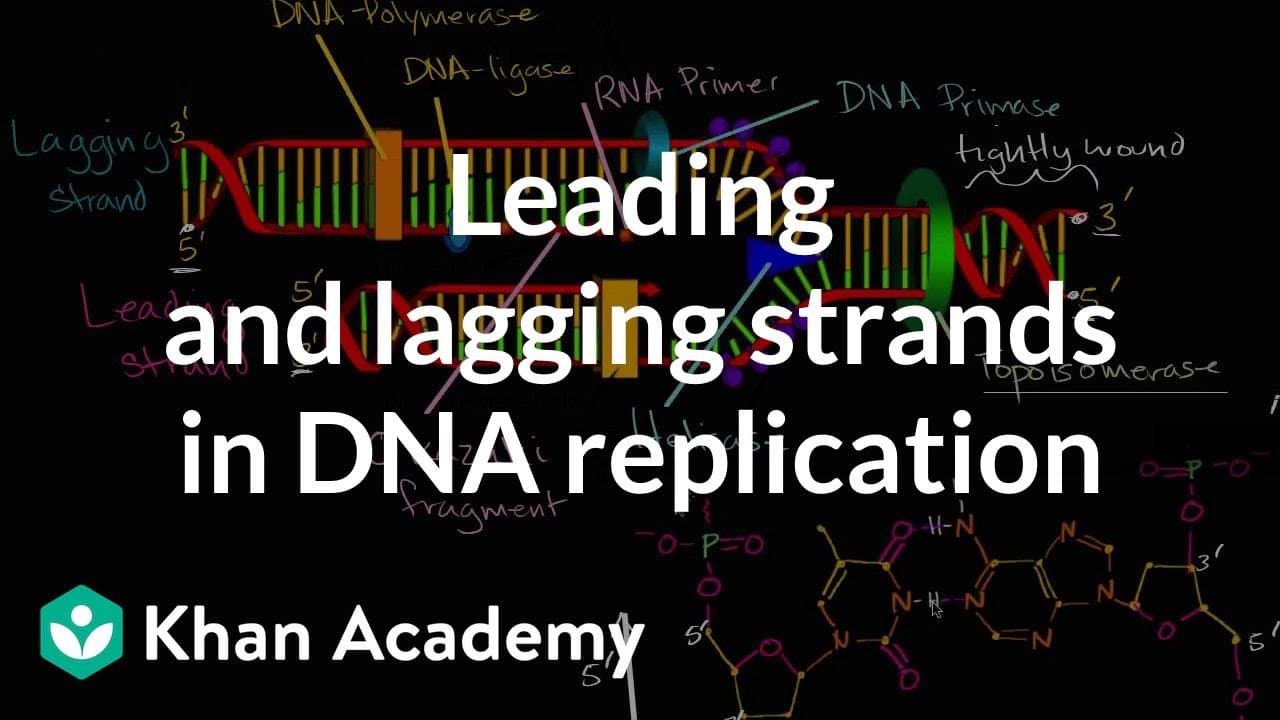
In DNA replication, leading strands are synthesized continuously in the 5' to 3' direction, while lagging strands are created in short segments called Okazaki fragments due to the antiparallel nature of DNA. Leading strands allow for straightforward nucleotide addition, whereas lagging strands require RNA primers and subsequently use DNA ligase to join the fragmented DNA.
Transcript
- [Voiceover] Let's talk a little bit in more depth about how DNA actually copies itself, how it actually replicates, and we're gonna talk about the actual actors in the process. Now, as I talk about it, I'm gonna talk a lot about the 3' and 5' ends of the DNA molecule, and if that is completely unfamiliar to you, I encourage you to watch the video... Read More
Key Insights
- ❤️🩹 The 3' and 5' ends of DNA play a crucial role in replication as nucleotide addition can only occur at the 3' end.
- 👻 Topoisomerase helps unwind the tightly coiled DNA structure, allowing for replication to take place.
- 🥺 The leading strand is replicated continuously, while the lagging strand is replicated in fragments called Okazaki fragments.
- 🧬 DNA ligase is responsible for joining the Okazaki fragments and replacing RNA primers with DNA during replication.
Install to Summarize YouTube Videos and Get Transcripts
Explore YouTube Video Summarizer or Get YouTube Transcript Extractor
Questions & Answers
Q: Why are the 3' and 5' ends of DNA important in replication?
The 3' and 5' ends determine the directionality of nucleotide addition, with new nucleotides only able to be added at the 3' end.
Q: What is the role of the topoisomerase enzyme in DNA replication?
Topoisomerase helps unwind the tightly wound DNA helix by temporarily breaking parts of the backbone, allowing for replication to occur.
Q: How does the leading strand differ from the lagging strand in DNA replication?
The leading strand is replicated continuously, while the lagging strand is replicated in fragments called Okazaki fragments due to its opposite orientation.
Q: What is the function of DNA ligase in replication?
DNA ligase joins the fragments of the lagging strand and replaces the RNA primers with DNA, resulting in a fully replicated DNA strand.
Summary & Key Takeaways
-
DNA replication involves unwinding the double helix structure of DNA and adding new nucleotides to create two identical strands.
-
The 3' and 5' ends of the DNA molecule are crucial for understanding replication, as nucleotide addition can only occur at the 3' end.
-
The leading strand is replicated continuously, while the lagging strand is replicated in fragments called Okazaki fragments.
Read in Other Languages (beta)
Share This Summary 📚
Summarize YouTube Videos and Get Video Transcripts with 1-Click
Try YouTube Summary with ChatGPT & Claude or YouTube Transcript Generator
Explore More Summaries from Khan Academy 📚



Summarize YouTube Videos and Get Video Transcripts with 1-Click
Try YouTube Summary with ChatGPT & Claude or YouTube Transcript Generator