How to Conduct Long-Term Top-Down Market Analysis
TL;DR
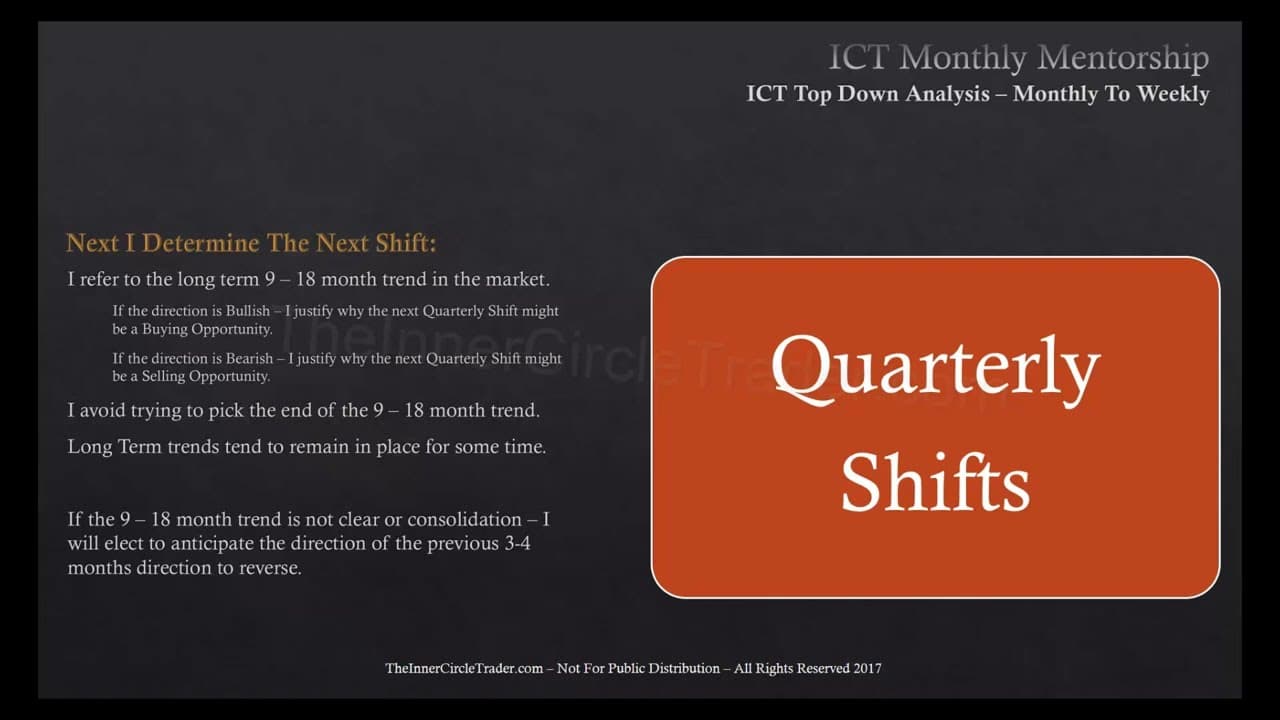
To conduct a long-term top-down market analysis, start by examining monthly charts to identify trends and key price levels. Incorporate factors such as seasonal tendencies, quarterly shifts, interest rate differentials, market structure, and intermarket correlations to develop a well-informed monthly bias that can then be applied to your weekly analysis.
Transcript
okay folks August 2017 we finally made it it's the last month of the mentorship's teaching and this is going to be teaching the ICT the long-term top-down analysis I'm going to be going over how I personally go through the monthly chart to arrive at levels that would be transposed and ideas to the weekly chart thank you all right so before we begin... Read More
Key Insights
- 🖐️ Seasonal tendencies play a role in determining the possible direction of an asset or market.
- ☠️ Interest rate differentials provide fundamental support for trade ideas.
- 🆘 Understanding market profile and structure helps in anticipating potential breakouts or reversals.
- 💡 Intermarket analysis can confirm or negate trade ideas through correlations with other markets.
- 🤩 PD array matrix helps define key price levels for trade opportunities.
- 🍉 The monthly bias can be transposed onto the weekly chart for intermediate-term analysis.
- ☠️ Traders should align multiple factors, such as seasonal tendencies, interest rates, and market structure, for higher probability trades.
Install to Summarize YouTube Videos and Get Transcripts
Explore YouTube Video Summarizer or Get YouTube Transcript Extractor
Questions & Answers
Q: How often does the speaker perform monthly analysis?
The speaker performs monthly analysis at the close of each month, ideally as soon as the market closes. The analysis takes into account seasonal tendencies, quarterly shifts, and interest rate differentials.
Q: How does the speaker determine the direction for the monthly chart?
The speaker considers multiple factors such as seasonal tendencies, interest rate differentials, market profile, market structure, and intermarket analysis to determine the direction for the monthly chart. They also look for confirmation in positively or negatively correlated markets.
Q: What role do key price levels play in the analysis?
Key price levels are derived from the PD array matrix, which helps define premium and discount areas. These levels serve as potential entry points or targets for trades. The speaker rounds the PD arrays to the nearest 10, zero, or five levels to calibrate the key price levels.
Q: How does the speaker confirm their analysis and bias?
The speaker looks for confirmation in other markets through intermarket analysis. They compare the direction of their market of interest with positively correlated markets and oppose it to negatively correlated markets to support their analysis and bias.
Key Insights:
- Seasonal tendencies play a role in determining the possible direction of an asset or market.
- Interest rate differentials provide fundamental support for trade ideas.
- Understanding market profile and structure helps in anticipating potential breakouts or reversals.
- Intermarket analysis can confirm or negate trade ideas through correlations with other markets.
- PD array matrix helps define key price levels for trade opportunities.
- The monthly bias can be transposed onto the weekly chart for intermediate-term analysis.
- Traders should align multiple factors, such as seasonal tendencies, interest rates, and market structure, for higher probability trades.
- Monthly analysis provides an outlook for the next few months' price action, allowing traders to plan their trades accordingly.
Summary & Key Takeaways
-
The speaker explains their personal approach to analyzing monthly charts to determine levels and ideas for the weekly charts.
-
The process involves considering seasonal tendencies, quarterly shifts, interest rate differentials, market profile, intermarket analysis, market structure, and key price levels.
-
By following this process, traders can develop a monthly bias and transpose it onto the weekly chart for intermediate-term analysis.
Read in Other Languages (beta)
Share This Summary 📚
Summarize YouTube Videos and Get Video Transcripts with 1-Click
Try YouTube Summary with ChatGPT & Claude or YouTube Transcript Generator
Explore More Summaries from The Inner Circle Trader 📚


Summarize YouTube Videos and Get Video Transcripts with 1-Click
Try YouTube Summary with ChatGPT & Claude or YouTube Transcript Generator