What Are Homogeneous and Heterogeneous Mixtures?
TL;DR
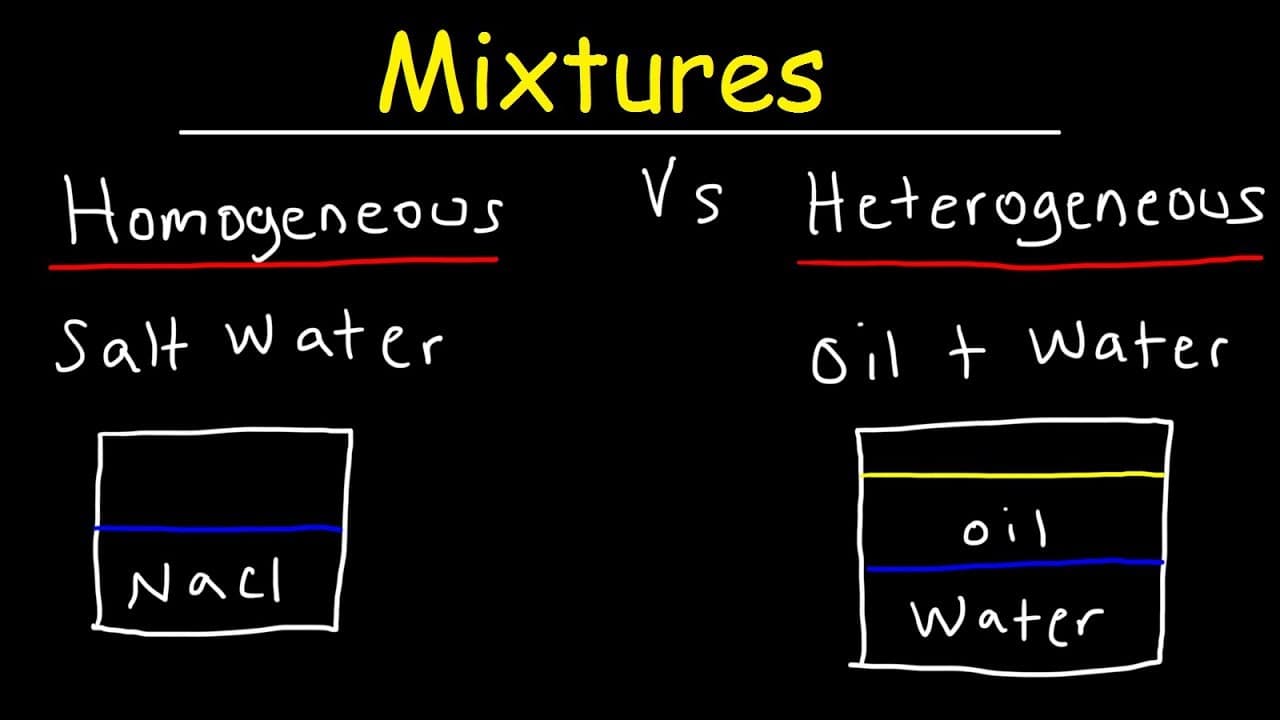
Homogeneous mixtures have a uniform composition with indistinguishable parts, like saltwater and air. In contrast, heterogeneous mixtures show visible distinguishable parts and varying composition, such as sand and water or oil and water. Understanding these differences helps classify matter effectively.
Transcript
in this video we're going to talk about the difference between a homogeneous mixture and a heterogeneous mixture but what do you think the difference is between these two types of mixtures a homogeneous mixture has visibly indistinguishable Parts all you could see is one clear solution in a heterogeneous mixture you can see multiple distinguishable... Read More
Key Insights
- 🥳 Homogeneous mixtures have uniform composition with no visibly distinguishable parts.
- 🥳 Heterogeneous mixtures have visibly distinguishable parts and can have varying composition.
- 👱 Examples of homogeneous mixtures include saltwater, brass, and air.
Install to Summarize YouTube Videos and Get Transcripts
Explore YouTube Video Summarizer or Get YouTube Transcript Extractor
Questions & Answers
Q: What is the difference between a homogeneous and heterogeneous mixture?
A homogeneous mixture appears as one clear solution with no distinguishable parts, while a heterogeneous mixture has multiple visibly distinguishable parts.
Q: How does composition differ in homogeneous and heterogeneous mixtures?
In a homogeneous mixture, the composition is uniform throughout, while in a heterogeneous mixture, the composition can vary by position.
Q: Is saltwater a homogeneous or heterogeneous mixture?
Saltwater is a homogeneous mixture because it appears as one clear solution with no distinguishable parts.
Q: Why is air considered a homogeneous mixture?
Air is a homogeneous mixture because it has a uniform composition and doesn't exhibit distinguishable parts.
Q: Is sand and water a homogeneous or heterogeneous mixture?
Sand and water is a heterogeneous mixture because the sand is visibly distinguishable from the water, forming two separate parts.
Q: How would you classify a bottle of rubbing alcohol?
Rubbing alcohol is a homogeneous mixture as it appears as one clear solution with no distinguishable parts.
Q: Why is toss salad with ranch dressing considered a heterogeneous mixture?
Tossed salad with ranch dressing is a heterogeneous mixture because the ranch dressing and green salad are visibly distinguishable, forming two distinguishable parts.
Q: What is the determining factor to classify a mixture as homogeneous or heterogeneous?
The ability to visually distinguish parts is the determining factor. If only one clear solution is visible, it's a homogeneous mixture. If multiple distinguishable parts are visible, it's a heterogeneous mixture.
Summary & Key Takeaways
-
A homogeneous mixture has indistinguishable parts, appearing as one clear solution, while a heterogeneous mixture has multiple distinguishable parts.
-
Composition is uniform throughout a homogeneous mixture and can vary in a heterogeneous mixture.
-
Examples of homogeneous mixtures include saltwater, brass, and air, while sand and water, oil and water, and tossed salad with ranch are examples of heterogeneous mixtures.
Read in Other Languages (beta)
Share This Summary 📚
Summarize YouTube Videos and Get Video Transcripts with 1-Click
Try YouTube Summary with ChatGPT & Claude or YouTube Transcript Generator
Explore More Summaries from The Organic Chemistry Tutor 📚




Summarize YouTube Videos and Get Video Transcripts with 1-Click
Try YouTube Summary with ChatGPT & Claude or YouTube Transcript Generator