File Concept & its Attributes - Storage Management - Operating System
TL;DR
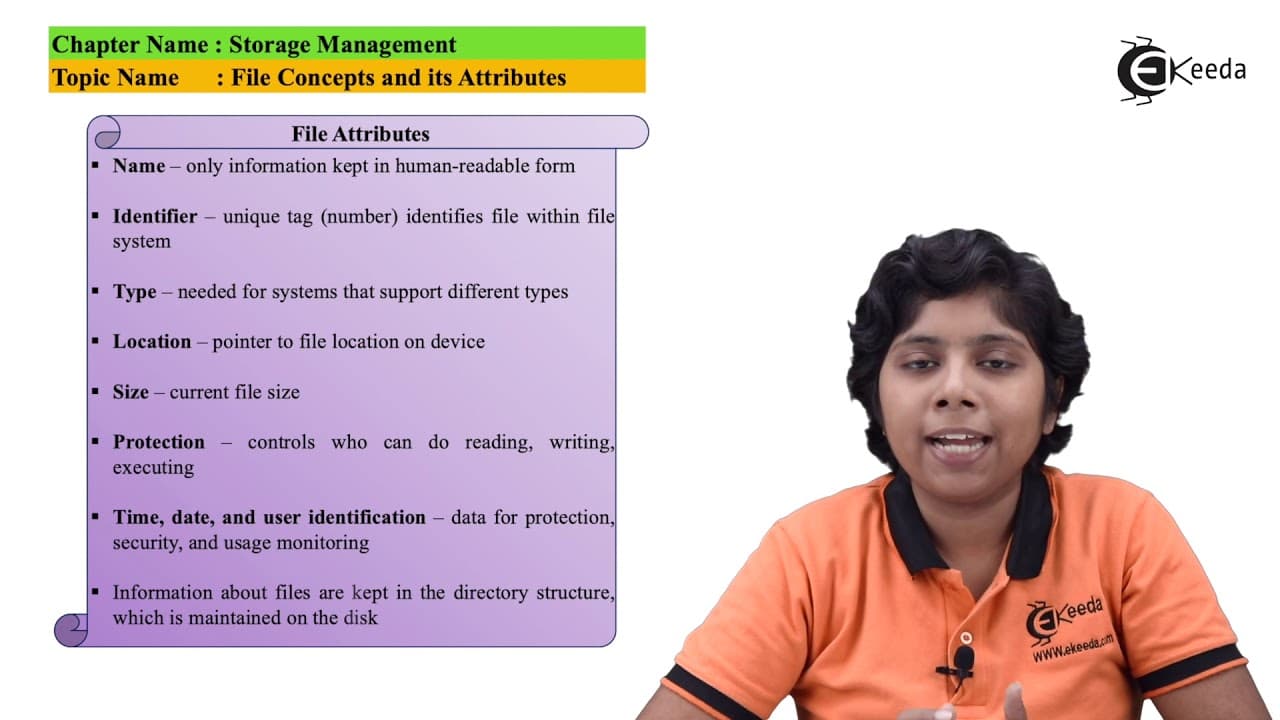
Files in operating systems are a way of organizing and accessing information. They have attributes such as name, type, location, size, protection, and time data.
Transcript
click the bell icon to get latest videos from akira hello friends today we will discuss about what is a file that it differentiate between the physical and logical information how it is conceptualized and what are the attributes of a file that is defined inside an operating system computers can store information in various types of storage devices ... Read More
Key Insights
- 👻 Files are a fundamental concept in operating systems, allowing for the organization and access of information.
- 🏪 Different types of files (text, numeric, binary) can be stored on various storage devices.
- 💁 Attributes like name, type, location, size, protection, and time data provide essential information about a file.
- 👤 Files are independent of the user and system, making them easily transferable and usable across different platforms.
- 📁 File attributes may vary across different operating systems, but they generally include the basic properties discussed.
- 📁 The directory structure stores information about files, allowing for efficient retrieval and management.
- 📁 Files and their attributes are crucial for maintenance, protection, and usage monitoring in an operating system.
Install to Summarize YouTube Videos and Get Transcripts
Explore YouTube Video Summarizer or Get YouTube Transcript Extractor
Questions & Answers
Q: What is the purpose of using files in an operating system?
Files in operating systems are used to store and organize information, making it easier to manage and access data for users and the operating system itself.
Q: What are the attributes of a file in an operating system?
The attributes of a file include its name (in a human-readable form), a unique tag (in a non-human-readable form), type (text, numeric, etc.), location (pointer to the device), size, protection (readable, writable, executable), and time/date/user identification (for maintenance and usage monitoring).
Q: How are files identified within an operating system?
Files are identified by their name and a unique tag within a file system. The file's identifier locates it on a device. The directory structure stores the file's name, tag, and attribute information.
Q: What is the relationship between logical and physical files?
Logical files represent the user's view of stored information, while physical files correspond to the actual storage on devices. The operating system maps logical information into physical files for efficient management.
Summary & Key Takeaways
-
Files are used in operating systems to store information on storage devices like magnetic tapes and disks.
-
An operating system maps logical information into physical files for convenient usage.
-
Files can be of different types (text, numeric, alphanumeric, binary), and can contain various types of data (programs, text, music, photos, videos).
Read in Other Languages (beta)
Share This Summary 📚
Summarize YouTube Videos and Get Video Transcripts with 1-Click
Try YouTube Summary with ChatGPT & Claude or YouTube Transcript Generator
Explore More Summaries from Ekeeda 📚





Summarize YouTube Videos and Get Video Transcripts with 1-Click
Try YouTube Summary with ChatGPT & Claude or YouTube Transcript Generator