Lexical analysis with FA
TL;DR
This content discusses the concept of lexical analysis and finite automata in programming, focusing on token generation and the construction of finite automata.
Transcript
it's wonderful so programs that focus on the mythical animals which are called it would be futile analyzers of play chess oh they contain the token and put on the stand that can deliver it is from the shape of the movie broken and fast this is that abideth in Iman so in this link you can analyse it will let people analysis is gone so actually need ... Read More
Key Insights
- 👨💻 Lexical analysis is an essential step in understanding and analyzing programs, as it breaks down code into meaningful tokens for further processing.
- 🛟 Finite automata serve as mathematical models used to recognize regular languages in programming, facilitating the detection of patterns.
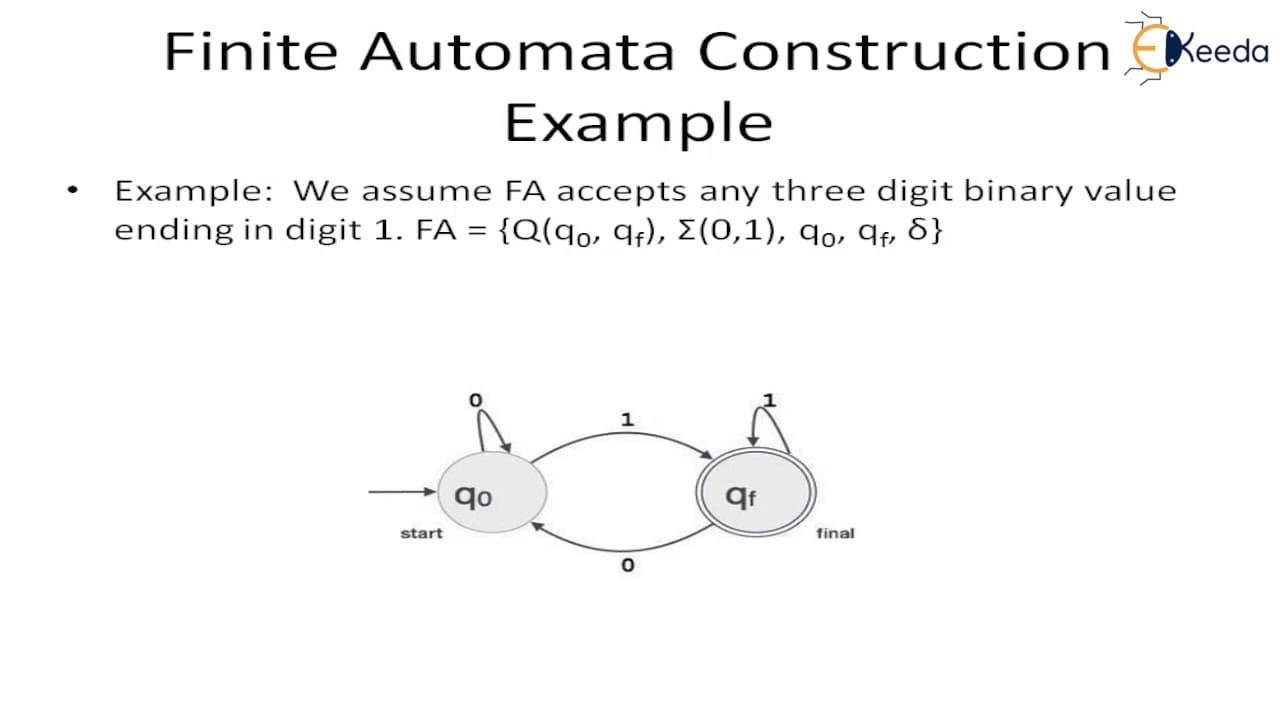
- 🔣 The construction of finite automata involves defining states, input symbols, transition functions, and the acceptance state, enabling the recognition of specific language patterns.
- 🫠 Lexical analyzers perform token generation by reading characters, applying defined rules, and classifying them into appropriate categories.
- 🫥 Errors in programs can be detected by lexical analyzers, which provide error messages along with the line and column number.
- ❓ Tokens can include keywords, operators, identifiers, and punctuation, representing the different elements of a program.
- 💘 Finite automata construction provides a visual representation of the recognition of regular languages, with states, transitions, and acceptance states depicted as circles and arrows.
Install to Summarize YouTube Videos and Get Transcripts
Explore YouTube Video Summarizer or Get YouTube Transcript Extractor
Questions & Answers
Q: What is the purpose of a lexical analyzer in programming?
A lexical analyzer is responsible for dividing programs into valid tokens, which are meaningful units of code. It helps in error detection and facilitates further analysis of the program.
Q: How does finite automata relate to lexical analysis?
Finite automata are mathematical models used to recognize regular languages in programming. Lexical analysis employs finite automata to identify patterns and tokens in the input program.
Q: What are some examples of tokens generated by a lexical analyzer?
Tokens can include keywords (e.g., if, while), operators (+, -), identifiers (variable names, function names), and punctuation symbols (comma, semicolon).
Q: What is the function of the transition function in finite automata?
The transition function maps a state and an input symbol to the next state in the finite automaton. It determines how the automaton transitions between states based on the input.
Summary & Key Takeaways
-
The content explains the process of lexical analysis and how it divides programs into valid tokens, helping with error detection.
-
It describes the construction of finite automata and its use in recognizing regular languages in programming.
-
The content provides an example of a lexical analyzer and illustrates the generation of tokens for different types of characters in a program.
Read in Other Languages (beta)
Share This Summary 📚
Summarize YouTube Videos and Get Video Transcripts with 1-Click
Try YouTube Summary with ChatGPT & Claude or YouTube Transcript Generator
Explore More Summaries from Ekeeda 📚



Summarize YouTube Videos and Get Video Transcripts with 1-Click
Try YouTube Summary with ChatGPT & Claude or YouTube Transcript Generator