What Are Parallel and Perpendicular Lines and Their Angles?
TL;DR
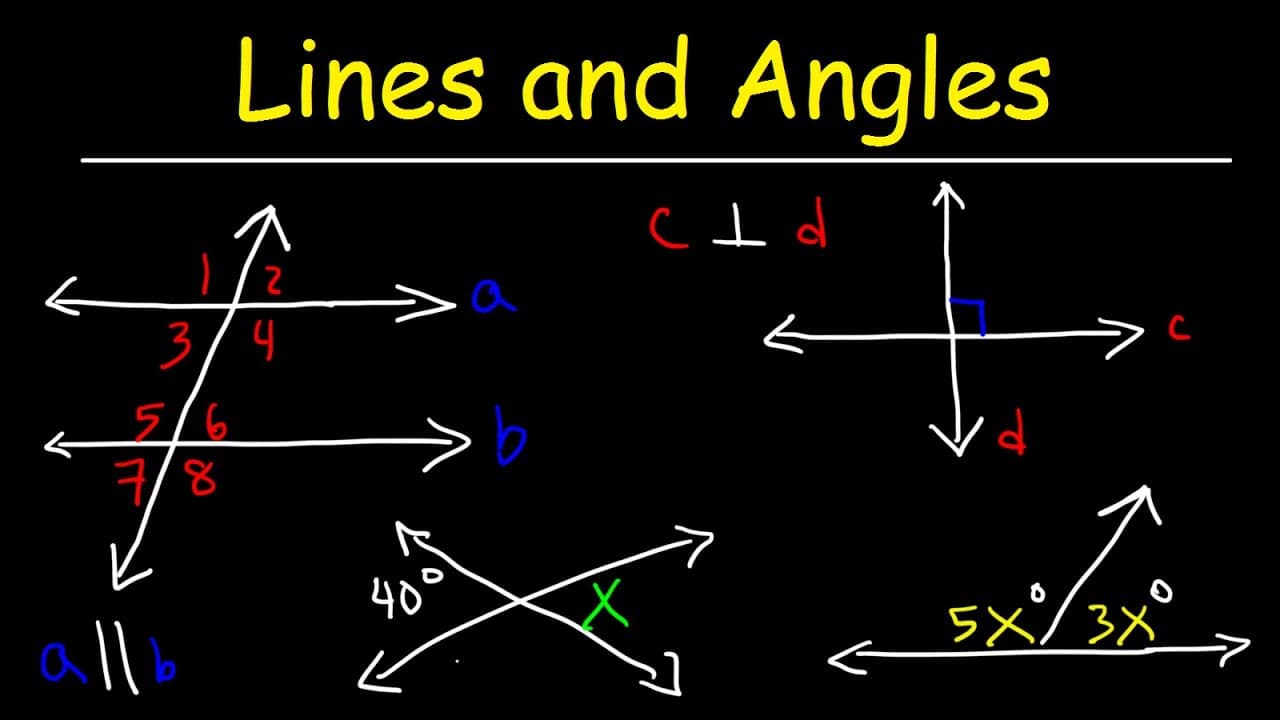
Parallel lines never intersect and share the same slope. Perpendicular lines intersect at right angles. The video explains various angle types formed by these lines, including alternate interior, alternate exterior, corresponding, consecutive interior, and vertical angles, and discusses how to calculate their relationships and sums.
Transcript
in this video we're going to talk about lines and angles the first type of line that you need to be familiar with are parallel lines parallel lines do not intersect so let's call the first line a and the second line B so we could say that a is parallel to line B so these two lines are also parallel they share the same slope so if the first line has... Read More
Key Insights
- 🫥 Parallel lines never intersect and have the same slope.
- 🫥 Perpendicular lines intersect to form right angles.
- 🫥 The slope of a perpendicular line can be found by flipping the fraction and changing the sign.
- 🔺 Interior angles are located between two parallel lines, while exterior angles are located outside them.
- 🔺 Alternate interior angles and alternate exterior angles are congruent.
- 🔺 Corresponding angles and vertical angles are also congruent.
- 💄 Consecutive interior angles add up to 180, making them supplementary.
- 🍹 The sum of the interior angles in a triangle is 180, while the sum in a quadrilateral is 360.
Install to Summarize YouTube Videos and Get Transcripts
Explore YouTube Video Summarizer or Get YouTube Transcript Extractor
Questions & Answers
Q: What are parallel lines?
Parallel lines refer to lines that never intersect and have the same slope. They can be represented as lines with the equation y = mx + b, where the "m" value is the slope.
Q: How can you find the slope of a perpendicular line?
To find the slope of a perpendicular line, you need to flip the fraction representing the slope of the given line and change the sign. For example, if the slope of line C is 3/4, the slope of its perpendicular line D would be -4/3.
Q: What are alternate interior angles?
Alternate interior angles are angles that are located on the inside of two parallel lines and on opposite sides of the transversal. They are congruent, meaning they have the same measure. For example, in the given diagram, angles 3 and 6 are alternate interior angles.
Q: What are vertical angles?
Vertical angles are angles that are formed by the intersection of two lines. They are congruent, meaning they have the same measure. For example, angles 1 and 4 in the given diagram are vertical angles.
Summary & Key Takeaways
-
The video introduces parallel lines as lines that never intersect and have the same slope, while perpendicular lines intersect to form a right angle.
-
It explains how to find the slope of a perpendicular line by flipping the fraction and changing the sign.
-
The video discusses interior angles, exterior angles, alternate interior angles, alternate exterior angles, corresponding angles, consecutive interior angles, vertical angles, and complementary and supplementary angles.
-
It also covers the formulas for finding the sum of interior angles in polygons and provides some practice problems to apply the concepts.
Read in Other Languages (beta)
Share This Summary 📚
Summarize YouTube Videos and Get Video Transcripts with 1-Click
Try YouTube Summary with ChatGPT & Claude or YouTube Transcript Generator
Explore More Summaries from The Organic Chemistry Tutor 📚



Summarize YouTube Videos and Get Video Transcripts with 1-Click
Try YouTube Summary with ChatGPT & Claude or YouTube Transcript Generator