How to Implement Object-Oriented Programming in Python
TL;DR
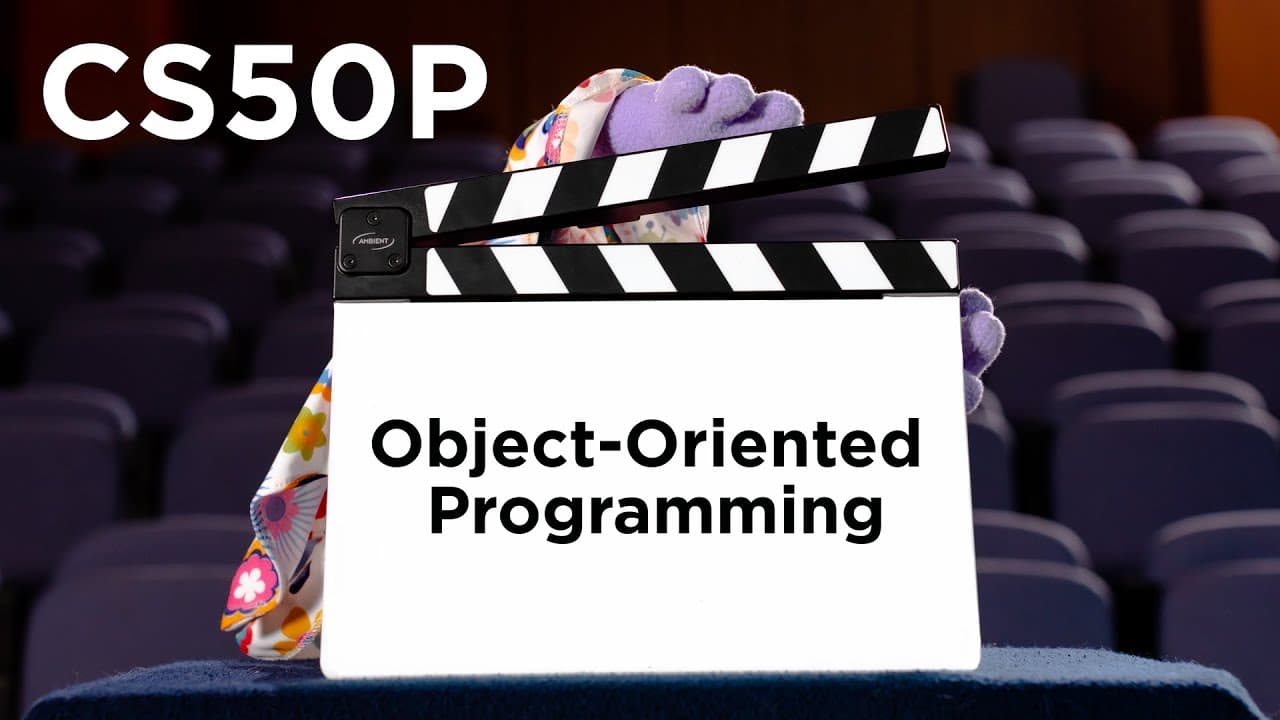
Object-oriented programming (OOP) in Python allows for the creation of custom data types using classes, which can encapsulate data and functionality. By defining classes, you can create objects with attributes and methods, providing a structured approach to programming. This enables better data management, error checking, and code organization, making complex software development more efficient.
Transcript
all right this is cs50's Introduction to programming with python my name is David men and this is our week on object oriented programming or o it turns out that in the world of programming there's different paradigms of programming languages there's different ways of solving problems with code and it's a little hard ... Read More
Key Insights
- Object-oriented programming (OOP) is a paradigm that allows for creating custom data types using classes.
- Classes in Python let you define blueprints for objects, encapsulating data and methods.
- Tuples, lists, and dictionaries are fundamental data types in Python, each with distinct characteristics.
- The init method in a class is used to initialize object attributes and can include error checking.
- Python supports properties, getters, and setters to control access and modification of object attributes.
- Special methods like str allow customization of how objects are represented as strings.
- OOP promotes better code organization and error management through encapsulation and abstraction.
- Raising exceptions within classes allows for more robust error handling and validation.
Install to Summarize YouTube Videos and Get Transcripts
Explore YouTube Video Summarizer or Get YouTube Transcript Extractor
Questions & Answers
Q: What is object-oriented programming in Python?
Object-oriented programming (OOP) in Python is a programming paradigm that uses classes and objects to model real-world entities. Classes define blueprints for objects, encapsulating data (attributes) and functionality (methods). This approach promotes code reusability, modularity, and organization, making it easier to manage complex software systems.
Q: How does the init method work in Python classes?
The init method in Python classes is a special method called automatically when a new object is created. It initializes the object's attributes with values provided as arguments. The method can also include error checking to ensure that the object's state is valid upon creation, enhancing data integrity and reliability.
Q: Why use properties, getters, and setters in Python?
Properties, getters, and setters in Python provide controlled access to an object's attributes. Properties allow for defining methods that manage attribute access, enabling encapsulation. Getters retrieve attribute values, while setters validate and set them, ensuring data integrity and preventing unauthorized modifications.
Q: What is the purpose of the str method in Python?
The str method in Python is a special method that defines how an object is represented as a string. It is called automatically when an object needs to be converted to a string, such as during printing. By customizing this method, developers can provide meaningful and human-readable representations of objects.
Q: How can exceptions be used in Python classes?
Exceptions in Python classes can be used to handle errors and exceptional conditions. By raising exceptions within methods, developers can signal that something went wrong, allowing the calling code to handle the error appropriately. This enhances robustness by preventing invalid operations and maintaining data integrity.
Q: What are the benefits of using OOP in Python?
Using OOP in Python offers several benefits, including improved code organization, reusability, and modularity. Classes encapsulate data and behavior, making it easier to model complex systems. OOP also promotes abstraction and encapsulation, allowing developers to manage complexity and build scalable, maintainable software.
Q: How do classes and objects differ in Python?
In Python, a class is a blueprint for creating objects, defining the data structure and behavior. An object is an instance of a class, representing a specific entity with attributes and methods defined by the class. While classes define the structure, objects are the actual entities created and manipulated in code.
Q: What role do decorators play in Python?
Decorators in Python are functions that modify the behavior of other functions or methods. They are often used to add functionality or perform checks before or after a function executes. In OOP, decorators like @property and @staticmethod are used to define properties and methods with specific behaviors, enhancing flexibility and control.
Summary & Key Takeaways
-
Object-oriented programming in Python allows for creating custom data types using classes, which serve as blueprints for objects. Classes encapsulate both data and methods, facilitating better code organization and error management. The init method initializes object attributes, and Python supports properties, getters, and setters for controlled access to these attributes.
-
Special methods like str customize how objects are represented as strings, enhancing readability. By using exceptions within classes, developers can implement robust error handling and validation, ensuring data integrity. OOP provides a structured approach to programming, making complex software development more efficient and organized.
-
Python's OOP features, such as encapsulation and abstraction, promote a modular coding style, allowing developers to build scalable and maintainable applications. This paradigm is particularly useful for modeling real-world entities and managing complex data interactions within software projects.
Read in Other Languages (beta)
Share This Summary 📚
Summarize YouTube Videos and Get Video Transcripts with 1-Click
Try YouTube Summary with ChatGPT & Claude or YouTube Transcript Generator
Explore More Summaries from CS50 📚

Summarize YouTube Videos and Get Video Transcripts with 1-Click
Try YouTube Summary with ChatGPT & Claude or YouTube Transcript Generator