What Are Data Structures and How Do They Work?
TL;DR
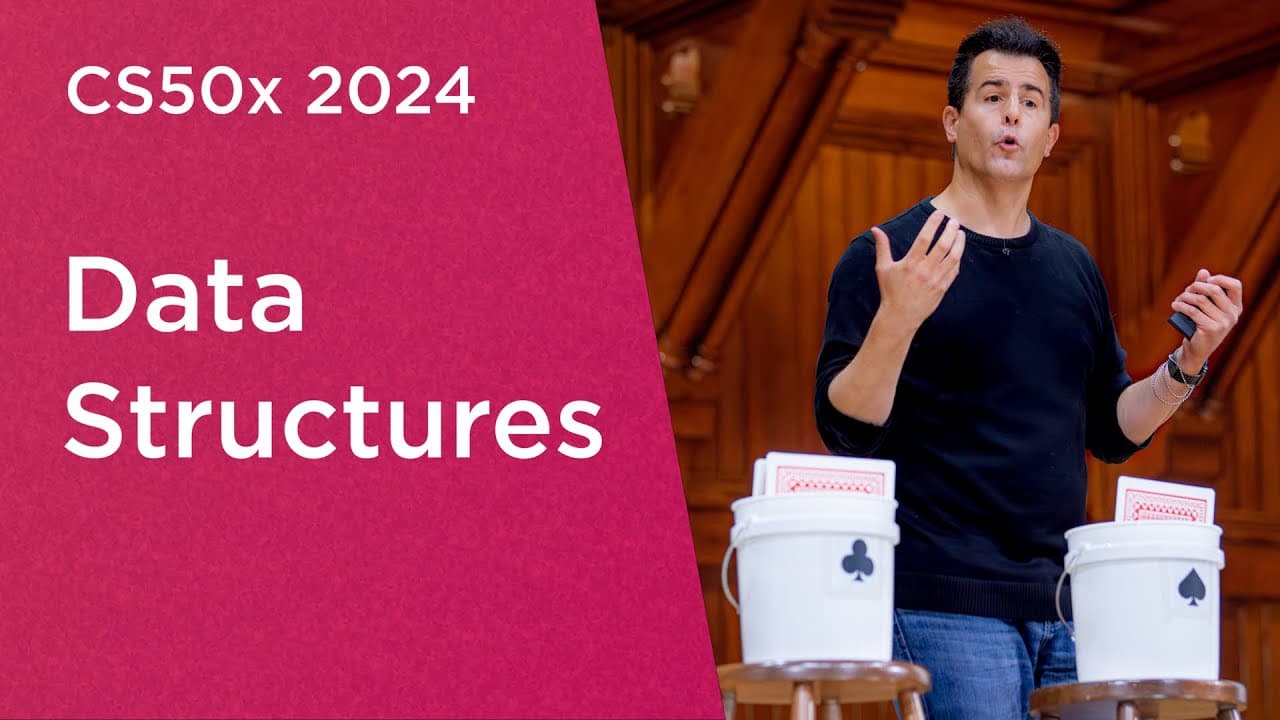
Data structures are ways to organize and store data in memory to solve problems efficiently. Key types include abstract data types like stacks and queues, which manage sequences with FIFO and LIFO operations, as well as linked lists that allow dynamic memory allocation without fixed size limitations. Other structures discussed include binary search trees for efficient searching, hash tables for quick data retrieval, and tries for associative data.
Transcript
Read and summarize the transcript of this video on Glasp Reader (beta).
Key Insights
- Data structures enable efficient problem-solving by organizing data in memory, with various types offering unique advantages.
- Abstract data types like queues and stacks provide specific operations, such as FIFO and LIFO, for managing data sequences.
- Linked lists offer dynamic memory allocation, avoiding the fixed size limitation of arrays but requiring more space for pointers.
- Binary search trees combine the benefits of arrays and linked lists, enabling efficient search and dynamic growth.
- Maintaining balanced binary search trees is crucial for optimizing search times, preventing them from degrading into linked lists.
- Dictionaries, as abstract data types, pair keys with values, and can be implemented using arrays, linked lists, or hash tables.
- Hashing functions transform data into fixed-size values, facilitating efficient data retrieval in hash tables.
- Tries are specialized tree structures used for storing associative data structures, like dictionaries, with fast retrieval times.
Install to Summarize YouTube Videos and Get Transcripts
Explore YouTube Video Summarizer or Get YouTube Transcript Extractor
Questions & Answers
Q: What are abstract data types, and how are they used?
Abstract data types (ADTs) are high-level descriptions of data structures that define their behavior and operations without specifying implementation details. They provide a way to organize data and manage operations like insertion and deletion. Examples include queues, which operate on a FIFO basis, and stacks, which use LIFO. ADTs allow programmers to focus on the design and functionality of data structures, leaving implementation specifics to be decided later.
Q: How do linked lists differ from arrays?
Linked lists differ from arrays in that they allow dynamic memory allocation, meaning they can grow or shrink as needed without a predefined size. Unlike arrays, which store data contiguously in memory, linked lists use pointers to connect non-contiguous memory chunks. This flexibility avoids the fixed size limitation of arrays but requires additional memory for pointers, making linked lists more space-consuming than arrays.
Q: What are the advantages of binary search trees?
Binary search trees (BSTs) combine the benefits of arrays and linked lists, offering efficient search operations and dynamic growth. In a BST, each node has a key, and all nodes in the left subtree have smaller keys, while those in the right subtree have larger keys. This property allows for efficient searching using a divide-and-conquer approach, reducing search times to logarithmic complexity. However, maintaining a balanced tree is crucial to prevent it from degrading into a linked list.
Q: Why is maintaining a balanced binary search tree important?
Maintaining a balanced binary search tree (BST) is important because it ensures that search operations remain efficient. A balanced BST has a height proportional to the logarithm of the number of nodes, allowing for logarithmic search times. If a BST becomes unbalanced, it can degrade into a linked list, resulting in linear search times and negating the advantages of using a BST. Balancing techniques, such as rotations, help maintain optimal tree structure.
Q: What is a dictionary in the context of data structures?
In data structures, a dictionary is an abstract data type that stores key-value pairs, allowing for efficient data retrieval. It is similar to a real-world dictionary, where words (keys) are associated with definitions (values). Dictionaries can be implemented using various data structures, such as arrays, linked lists, hash tables, or tries. They are commonly used in applications requiring fast lookups, such as spell checkers and contact lists.
Q: How does hashing improve data retrieval in hash tables?
Hashing improves data retrieval in hash tables by transforming data into fixed-size values, known as hash codes, which are used as indexes in the table. This allows for constant time complexity, O(1), in average cases, as data can be accessed directly using its hash code. Hash functions are designed to minimize collisions, where different inputs produce the same hash code, and efficient handling of collisions is crucial for maintaining performance.
Q: What are tries, and how are they used?
Tries are specialized tree structures used for storing associative data structures, such as dictionaries or sets. They are particularly effective for applications involving prefix-based searches, like autocomplete and spell checking. In a trie, each node represents a character, and paths from the root to leaves form words or keys. Tries allow for fast retrieval times by leveraging common prefixes, making them efficient for large datasets with shared prefixes.
Q: What is the significance of big O notation in evaluating data structures?
Big O notation is significant in evaluating data structures as it provides a way to describe the efficiency of algorithms in terms of time and space complexity. It helps compare the performance of different data structures and algorithms by focusing on their growth rates rather than specific execution times. Big O notation is crucial for understanding the trade-offs between time and space, enabling developers to choose the most suitable data structure for a given problem based on its efficiency characteristics.
Summary & Key Takeaways
-
The lecture revisits data structures, focusing on their design and implementation in C to solve problems effectively. It covers abstract data types like queues and stacks, demonstrating their properties and operations. The session emphasizes the distinction between high-level abstractions and low-level implementation details.
-
Linked lists are introduced as a solution to the fixed size limitation of arrays, allowing dynamic memory allocation. The lecture explains how linked lists use pointers to connect non-contiguous memory chunks, enabling efficient data storage and manipulation without the need for contiguous memory blocks.
-
Binary search trees are presented as a combination of arrays and linked lists, offering efficient search and dynamic growth. The lecture discusses the importance of maintaining balanced trees to optimize search times, preventing them from degrading into linked lists. Hash tables and tries are also introduced as advanced data structures for efficient data retrieval.
Read in Other Languages (beta)
Share This Summary 📚
Summarize YouTube Videos and Get Video Transcripts with 1-Click
Try YouTube Summary with ChatGPT & Claude or YouTube Transcript Generator
Explore More Summaries from CS50 📚



Summarize YouTube Videos and Get Video Transcripts with 1-Click
Try YouTube Summary with ChatGPT & Claude or YouTube Transcript Generator