Partial Derivative of Second Order Problem 9
TL;DR
Easily prove the given result by using second order partial differentiation.
Transcript
hello friends so after completing this question number eight now let's move to the question number nine here uh we have a function and for this function we have to prove one given result with the help of second order partial differentiation so let's see how to get the solution so here u is given as a into e to the power minus g x sine of n t minus ... Read More
Key Insights
- 👍 Second order partial differentiation can be used to prove mathematical results.
- 🫡 Constants in a function do not affect its partial derivatives with respect to variables.
- 📏 The product rule is useful for differentiating functions that are products of other functions.
- 👍 Simplification and cancellation of terms can help prove mathematical equations.
Install to Summarize YouTube Videos and Get Transcripts
Explore YouTube Video Summarizer or Get YouTube Transcript Extractor
Questions & Answers
Q: What is the given equation that the function u satisfies?
The given equation is del u / del t = mu * del^2 u / del x^2.
Q: How do you find the value of del u / del t?
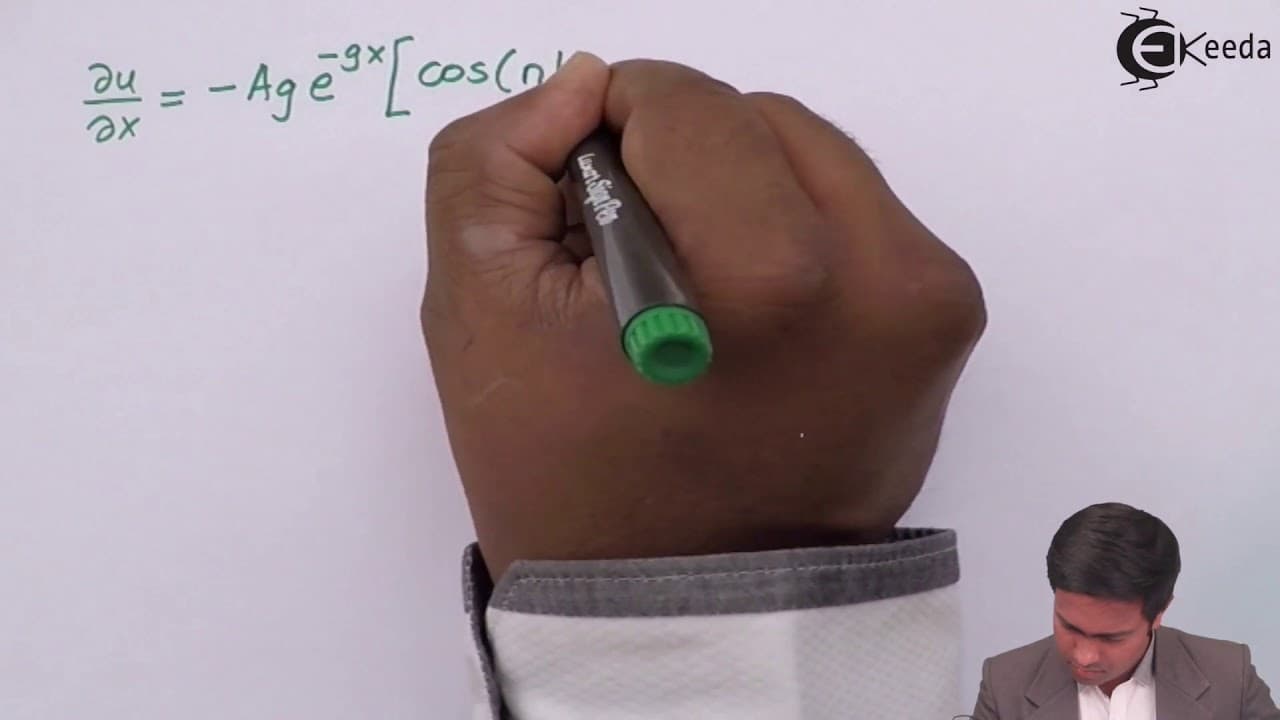
The function u has constants a and e^(-gx), so their derivatives with respect to t are zero. The derivative of sin(nt - gx) with respect to t is cos(nt - gx), and the derivative of nt - gx with respect to t is n. Therefore, del u / del t = a * e^(-gx) * n * cos(nt - gx).
Q: How do you find the value of del^2 u / del x^2?
First, find the derivative of u with respect to x using the product rule. Then, differentiate the result with respect to x again. Simplify the expression to get del^2 u / del x^2 = 2ag^2 * e^(-gx) * cos(nt - gx).
Q: How does the equation simplify to prove the given result?
By substituting the values of del u / del t and del^2 u / del x^2 into the given equation, the cos(nt - gx) terms cancel out. Cancelling a, e^(-gx), and g^2 from both sides, the result g = sqrt(n / 2mu) is obtained.
Summary & Key Takeaways
-
The video demonstrates how to prove a given result using second order partial differentiation.
-
The function u is given as a * e^(-gx) * sin(nt - gx) and satisfies the equation del u / del t = mu * del^2 u / del x^2.
-
By finding the value of del u / del t and del^2 u / del x^2, and substituting them into the equation, the result g = sqrt(n / 2mu) can be proven.
Read in Other Languages (beta)
Share This Summary 📚
Summarize YouTube Videos and Get Video Transcripts with 1-Click
Try YouTube Summary with ChatGPT & Claude or YouTube Transcript Generator
Explore More Summaries from Ekeeda 📚





Summarize YouTube Videos and Get Video Transcripts with 1-Click
Try YouTube Summary with ChatGPT & Claude or YouTube Transcript Generator