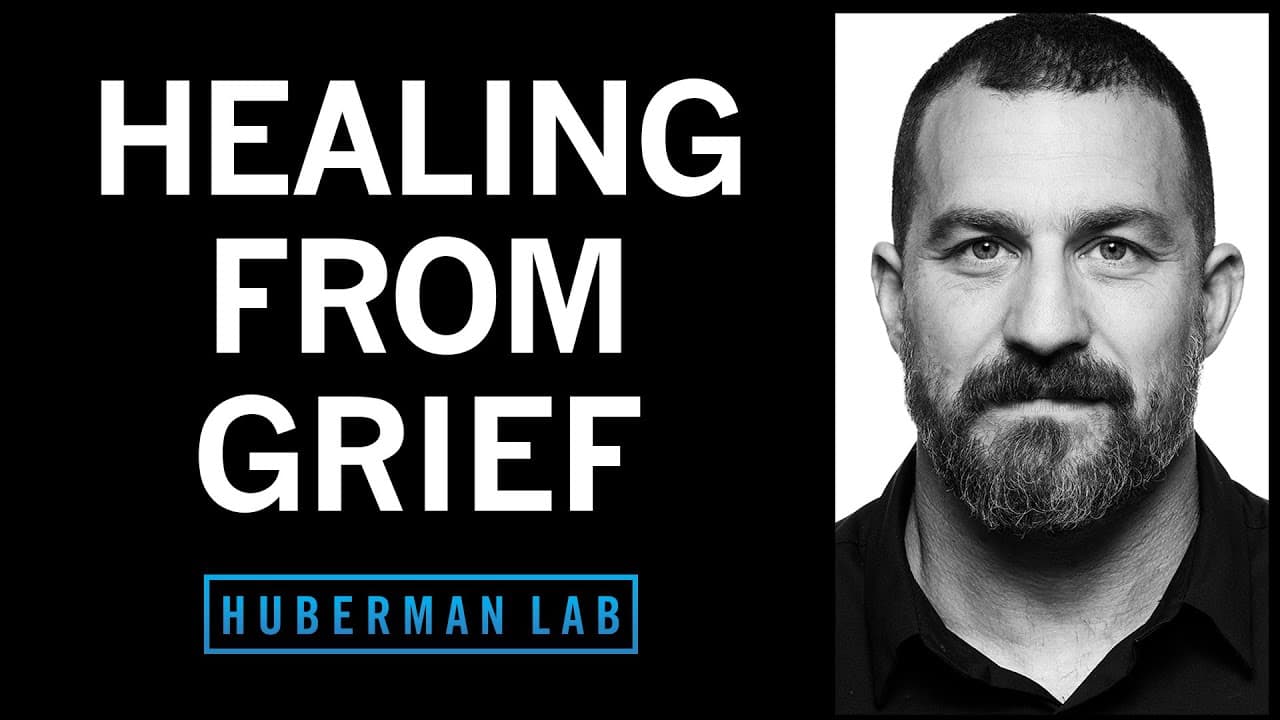
The Science & Process of Healing from Grief | Huberman Lab Podcast #74
TL;DR
Grief is a complex and natural emotion that occurs when we lose someone or something significant. It is a process that involves remapping our emotional and logical framework, as well as uncoupling the intensity of our attachment from the space, time, and memories associated with the person or thing we have lost.
Transcript
- Welcome to the Huberman Lab Podcast, where we discuss science, and science-based tools for everyday life. I'm Andrew Huberman, and I'm a professor of neurobiology and ophthalmology at Stanford School of Medicine. Today, we are discussing grief. Grief is a natural emotion that most everybody experiences at some point in their life. However, grief ... Read More
Key Insights
- 🌸 Grief is a natural response to loss, requiring remapping and reorganization of our emotional and logical framework.
- 👾 Our attachment to people and things is mapped in three dimensions: space, time, and closeness.
- 💨 Understanding the neuroscience and psychology of grief can assist in navigating the process and finding healthy ways to cope.
- ❓ Maintaining our attachment while uncoupling it from the physical and temporal dimensions is vital in moving through grief.
- 🤔 Counterfactual thinking and guilt hinder the process of healing, and setting aside dedicated time to feel the attachment while focusing on the present moment can be beneficial.
Install to Summarize YouTube Videos and Get Transcripts
Explore YouTube Video Summarizer or Get YouTube Transcript Extractor
Questions & Answers
Q: How does grief differ from depression?
Although grief and depression may share similar symptoms such as loss of appetite and challenges sleeping, they are distinct processes in the brain and body. Grief is a natural response to loss, while depression is a separate mood disorder. Antidepressants are generally not effective in treating grief, as grief responds better to addressing our emotional and logical frameworks surrounding the loss.
Q: How can we navigate the grieving process in a healthy way?
Navigating grief involves understanding and accepting the intensity of our attachment while remapping our emotional and logical framework surrounding the loss. Recognizing that memories and expectations linked to the person or thing we lost may persist, it is essential to set aside dedicated time to feel and process the attachment, focusing on the present moment and uncoupling it from past memories or counterfactual thinking.
Q: How can the understanding of the neuroscience behind grief assist in the healing process?
The neuroscience of grief helps us comprehend the brain's mechanisms and our emotional and logical responses to loss. Recognizing that grief is a motivated state involving desire and yearning for the person or thing we lost, we can better navigate the process by remapping our attachment while maintaining our emotional connection. This understanding allows us to reframe our expectations and find healthier ways to cope with grief.
Q: Is it normal to still feel attached to someone or something long after their passing?
Yes, it is entirely normal to maintain a deep emotional attachment to someone or something even after their passing. Our brain's memory system preserves and triggers memories, creating an ongoing sense of attachment. Acknowledging and accepting this attachment while reframing our expectations and engaging in healthy coping mechanisms can aid in navigating the grieving process.
Summary & Key Takeaways
-
Grief is a natural emotional response that most people experience at some point in their lives when they lose someone or something. It is often overwhelming and mystifying, as we struggle to reframe our minds and adjust to the absence of the person or thing we lost.
-
The neuroscience and psychology of grief reveal that our emotional attachment to people and things is mapped in three dimensions: space, time, and closeness. When we lose someone or something, our brain and body need to reorganize and remap our emotional framework to adapt to the absence.
-
Moving through grief requires specific neuroplasticity, as we need to rewire our brain connections and our connection between the brain and body. It involves acknowledging and maintaining our attachment while uncoupling it from the physical and temporal dimensions.
-
Contrary to common myths, grief does not follow a rigid set of stages, and not everyone experiences the same stages or in the same order. There are different types of grief, including complicated and non-complicated grief, which differ in resolution time and require different approaches.
-
How we approach grief, both in terms of our psychological and biological state during the loss and our understanding of the grief process, significantly impacts our ability to navigate it in a healthy manner.
Read in Other Languages (beta)
Share This Summary 📚
Summarize YouTube Videos and Get Video Transcripts with 1-Click
Try YouTube Summary with ChatGPT & Claude or YouTube Transcript Generator
Explore More Summaries from Andrew Huberman 📚



Summarize YouTube Videos and Get Video Transcripts with 1-Click
Try YouTube Summary with ChatGPT & Claude or YouTube Transcript Generator