Stanford CS105: Intro to Computers | 2021 | Lecture 6.2 Network Protocols: Protocols of the Internet
TL;DR
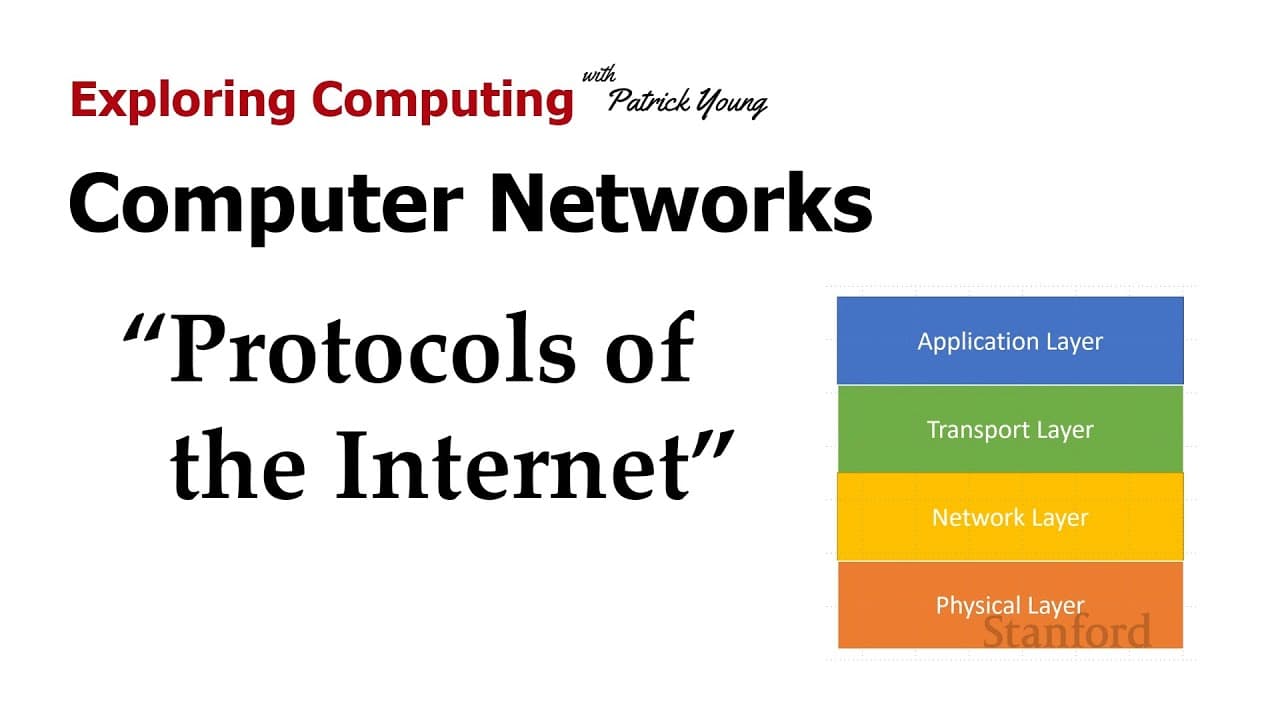
This video discusses how protocols on the internet are layered and how they work together to ensure efficient communication between devices.
Transcript
welcome to exploring computing today's video is computer networks protocols of the internet so as i alluded to in the last lecture protocols on the internet are layered and this is sometimes a little difficult to understand but it is important to understanding how the internet really works i like to teach layered protocols by analogy so let's start... Read More
Key Insights
- ❓ Protocols on the internet are layered to simplify development and improve efficiency.
- 🚚 Each layer in the protocol stack has a specific role, from physical transmission to reliable packet delivery.
- 🈸 The application layer is where user interactions occur, with various protocols for different applications.
- ❓ Packet switching is more efficient than circuit switching for telecommunications.
- 🫥 Shared lines and packet delays can introduce challenges in packet-based communication.
- 😘 Layered protocols enable developers to focus on specific functionalities without worrying about lower-level complexities.
- 👶 The physical layer requires a new definition for each new network type.
Install to Summarize YouTube Videos and Get Transcripts
Explore YouTube Video Summarizer or Get YouTube Transcript Extractor
Questions & Answers
Q: Why are protocols on the internet layered?
Protocols on the internet are layered to simplify the development of new network types and applications. Each layer handles a specific aspect of communication, allowing developers to focus on their respective functionalities.
Q: What is the purpose of the physical layer?
The physical layer determines how information is transmitted using zeros and ones and defines the physical connections between devices. It requires a new definition for each new network type.
Q: How does TCP ensure reliable packet delivery?
TCP, at the transport layer, numbers and marks each packet with source and destination IP addresses. It keeps track of packets, reorders them if necessary, and requests missing packets from the sender to ensure reliable delivery.
Q: Why is packet switching more efficient than circuit switching for telecommunications?
Packet switching, used in technologies like FaceTime and Google Hangouts, allows multiple devices to share the same lines, eliminating the need for dedicated circuits. This leads to more efficient use of resources and cost savings.
Summary & Key Takeaways
-
The internet protocol stack is a layered system that begins with the physical layer and ends with the application layer, resembling the process of shipping toys using different transportation methods.
-
Each layer in the protocol stack has a specific function, from determining how information is transmitted at the physical layer to managing packets and ensuring reliable delivery at the network and transport layers.
-
The application layer is where most user interactions occur, with various protocols for different applications like email, web browsing, and file transfer.
Read in Other Languages (beta)
Share This Summary 📚
Summarize YouTube Videos and Get Video Transcripts with 1-Click
Try YouTube Summary with ChatGPT & Claude or YouTube Transcript Generator
Explore More Summaries from Stanford Online 📚


Summarize YouTube Videos and Get Video Transcripts with 1-Click
Try YouTube Summary with ChatGPT & Claude or YouTube Transcript Generator