Newton's 2nd Law (2 of 21) Calculate Acceleration with Friction, Net Force Horizontal
TL;DR
Learn to calculate acceleration with Newton's Second Law through three examples of objects on surfaces with friction.
Transcript
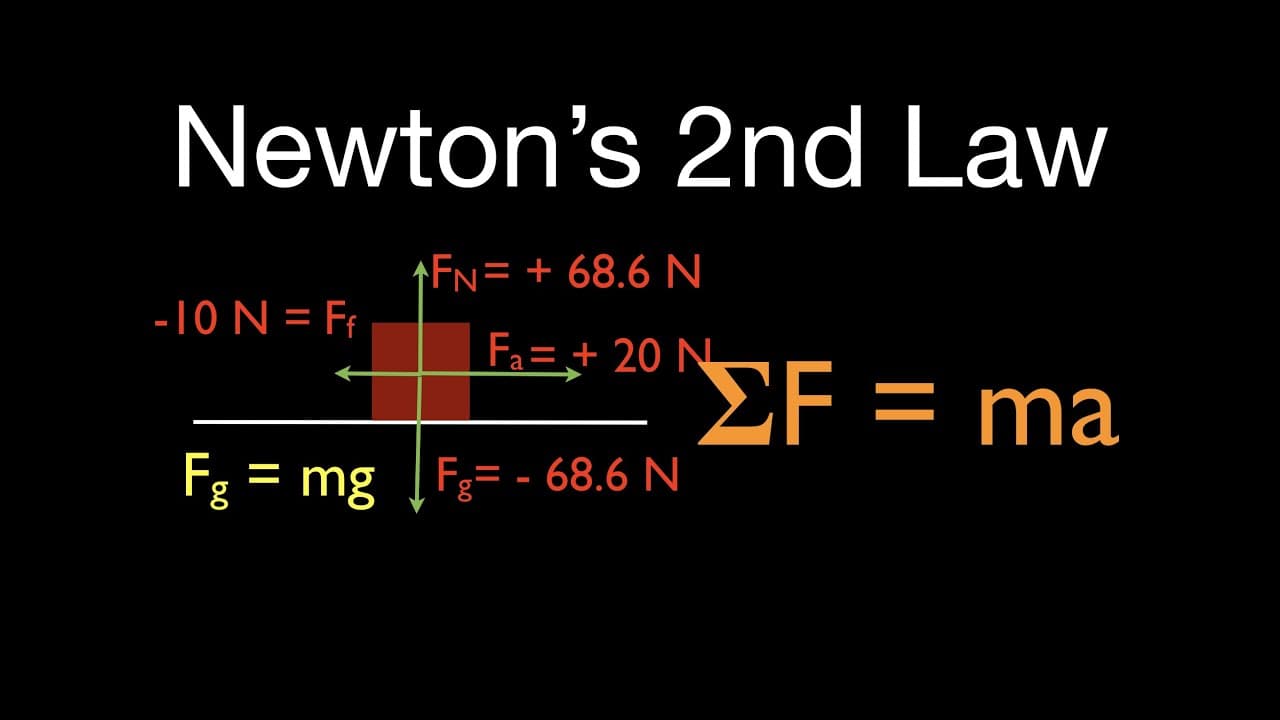
okay in today's video I'm going to go over how to use Newton's Second Law to calculate the acceleration of an object with horizontal motion that's moving across a surface with friction okay I'm going to run through three different examples and the first one says here that we have a rightward force of 20 newtons applied to a object that has a mass o... Read More
Key Insights
- 💆 Newton's Second Law relates the sum of forces to an object's mass and acceleration.
- 🧑🏭 Drawing force diagrams assists in visualizing and analyzing the various forces acting on an object.
- 🥺 Balanced forces lead to constant velocity motion, with zero acceleration.
- ❓ Friction introduces an additional force opposing the motion of an object.
- ❓ Calculating acceleration involves considering all forces, including gravitational, normal, applied, and frictional forces.
- 🚥 The coefficient of friction helps determine the frictional force along horizontal surfaces.
- ❓ Understanding the direction and magnitude of forces is crucial in accurately calculating acceleration.
Install to Summarize YouTube Videos and Get Transcripts
Explore YouTube Video Summarizer or Get YouTube Transcript Extractor
Questions & Answers
Q: What is Newton's Second Law and how is it used to calculate acceleration?
Newton's Second Law states that the sum of forces acting on an object is equal to the mass of the object multiplied by its acceleration. By analyzing and summing all forces, we can determine the acceleration of the object.
Q: Why is it essential to draw force diagrams and label forces before calculating acceleration?
Drawing force diagrams helps visualize the forces acting on an object, ensuring a comprehensive understanding of the situation. Labeling forces allows for accurate calculations and proper consideration of all forces involved.
Q: How does the presence of friction impact the calculation of acceleration?
Friction introduces an additional force that opposes the motion of an object. When calculating acceleration, the friction force needs to be considered along with other forces, as it influences the overall acceleration of the object.
Q: In what situations do we observe constant velocity, and how does this affect the calculation of acceleration?
Objects moving at a constant velocity have balanced forces acting on them. In such scenarios, the acceleration is zero, as the sum of forces equals zero. This equilibrium results in a constant velocity motion.
Summary & Key Takeaways
-
Demonstrates how to calculate acceleration using Newton's Second Law with three example problems.
-
Shows the process of drawing force diagrams, labeling forces, and calculating their magnitudes.
-
Emphasizes the importance of balanced forces for objects in constant velocity situations.
Read in Other Languages (beta)
Share This Summary 📚
Summarize YouTube Videos and Get Video Transcripts with 1-Click
Try YouTube Summary with ChatGPT & Claude or YouTube Transcript Generator
Explore More Summaries from Step by Step Science 📚

Summarize YouTube Videos and Get Video Transcripts with 1-Click
Try YouTube Summary with ChatGPT & Claude or YouTube Transcript Generator