Why Did Forever 21 Fail in Fast Fashion?
TL;DR
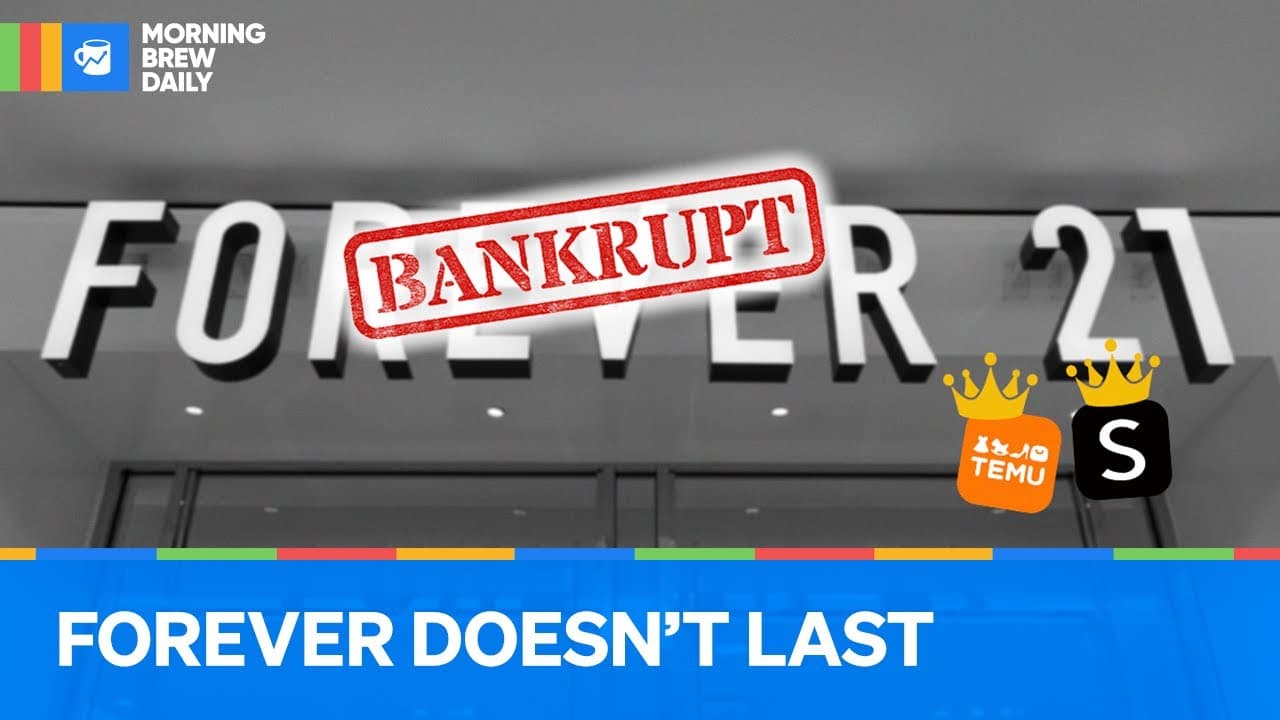
Forever 21, once a leader in fast fashion, is filing for its second bankruptcy, citing competition from Shein and Temu as major factors. The shift to online shopping and rising inflation also contributed to its downfall. The brand's liabilities far exceed its assets, signaling a grim future unless last-minute interventions occur.
Transcript
Good Morning Brew Daily Show. I'm Neal Freyman. and I'm Toby Howell. Today, nothing lasts forever. Even retailers named forever 21. Then the prebiotic soda brand Poppy is getting acquired by Pepsi for a number that has a lot of zeros behind it. It's Tuesday, March 18th. Let's ride. Good morning and happy Tuesday. There's something we need to tell y... Read More
Key Insights
- Forever 21 is filing for its second bankruptcy, closing all U.S. stores.
- The brand peaked with $4 billion in sales in 2015 but struggled with online competition.
- Shein and Temu's low prices are blamed for Forever 21's loss of its customer base.
- Forever 21's liabilities are ten times bigger than its assets.
- The pandemic accelerated the shift to online shopping, disadvantaging Forever 21.
- Inflation increased costs and reduced consumer spending on clothes.
- The brand was acquired in 2019 by a joint venture, which struggled to revive it.
- Forever 21's bankruptcy filing highlights a tariff exemption aiding Chinese competitors.
Install to Summarize YouTube Videos and Get Transcripts
Explore YouTube Video Summarizer or Get YouTube Transcript Extractor
Questions & Answers
Q: What led to Forever 21's bankruptcy?
Forever 21's bankruptcy is attributed to its inability to compete with online retailers like Shein and Temu, which offer significantly lower prices. The shift to online shopping, accelerated by the pandemic, and rising inflation, which increased operational costs and reduced consumer spending, also contributed to its financial struggles.
Q: How did Shein and Temu impact Forever 21?
Shein and Temu impacted Forever 21 by offering extremely low prices, which attracted Forever 21's core customer base. These Chinese-linked marketplaces benefited from a tariff exemption, allowing them to ship inexpensive goods to the U.S. without additional costs, making it difficult for Forever 21 to compete.
Q: What were the financial conditions of Forever 21 during its bankruptcy filing?
During its bankruptcy filing, Forever 21 revealed that its liabilities were between $1 billion and $5 billion, while its assets were only between $100 million and $500 million. This significant imbalance highlights the brand's dire financial condition, with liabilities vastly outstripping assets.
Q: What role did the pandemic play in Forever 21's decline?
The pandemic played a crucial role in Forever 21's decline by accelerating the consumer shift towards online shopping. This shift left Forever 21 at a disadvantage, as its business model was heavily reliant on physical store sales, which decreased significantly during the pandemic.
Q: How did inflation affect Forever 21?
Inflation affected Forever 21 by increasing the cost of goods and operations, which squeezed profit margins. Additionally, as inflation rose, consumers became more cautious with their spending, particularly on non-essential items like clothing, further reducing Forever 21's sales.
Q: What was the outcome of Forever 21's acquisition in 2019?
Forever 21 was acquired in 2019 by a joint venture consisting of Simon Property Group, Brookfield Property Partners, and Authentic Brands Group. However, this acquisition failed to rejuvenate the brand, as it continued to struggle with adapting to the online retail environment and competition from low-cost competitors.
Q: What is the tariff exemption mentioned in Forever 21's bankruptcy filing?
The tariff exemption mentioned in Forever 21's bankruptcy filing refers to the de minimis exemption, which allows Chinese marketplaces like Shein and Temu to ship goods valued under $800 to the U.S. without tariffs. Forever 21 executives argue that this exemption gives these competitors an unfair advantage.
Q: What is the future outlook for Forever 21?
The future outlook for Forever 21 appears bleak, with no expected interventions to save the company. The brand's liabilities far exceed its assets, and liquidation sales are anticipated. Unless there is a last-minute rescue, Forever 21 may cease operations entirely, marking the end of its presence in the fast-fashion market.
Summary & Key Takeaways
-
Forever 21 is filing for bankruptcy again, closing all its U.S. stores. The brand, which once had $4 billion in sales, couldn't keep up with online competition and rising inflation, leading to its downfall. Shein and Temu's low prices significantly impacted Forever 21's customer retention.
-
The pandemic accelerated the shift to online shopping, which Forever 21 couldn't adapt to, as its business model was focused on physical stores. Inflation further increased operational costs, causing consumers to cut back on clothing purchases.
-
Forever 21's liabilities now dwarf its assets, indicating a dire financial situation. The brand's acquisition in 2019 by a joint venture failed to revitalize it, and the company is now urging policymakers to address tariff exemptions that benefit its Chinese competitors.
Read in Other Languages (beta)
Share This Summary 📚
Summarize YouTube Videos and Get Video Transcripts with 1-Click
Try YouTube Summary with ChatGPT & Claude or YouTube Transcript Generator
Explore More Summaries from Morning Brew Daily 📚




Summarize YouTube Videos and Get Video Transcripts with 1-Click
Try YouTube Summary with ChatGPT & Claude or YouTube Transcript Generator