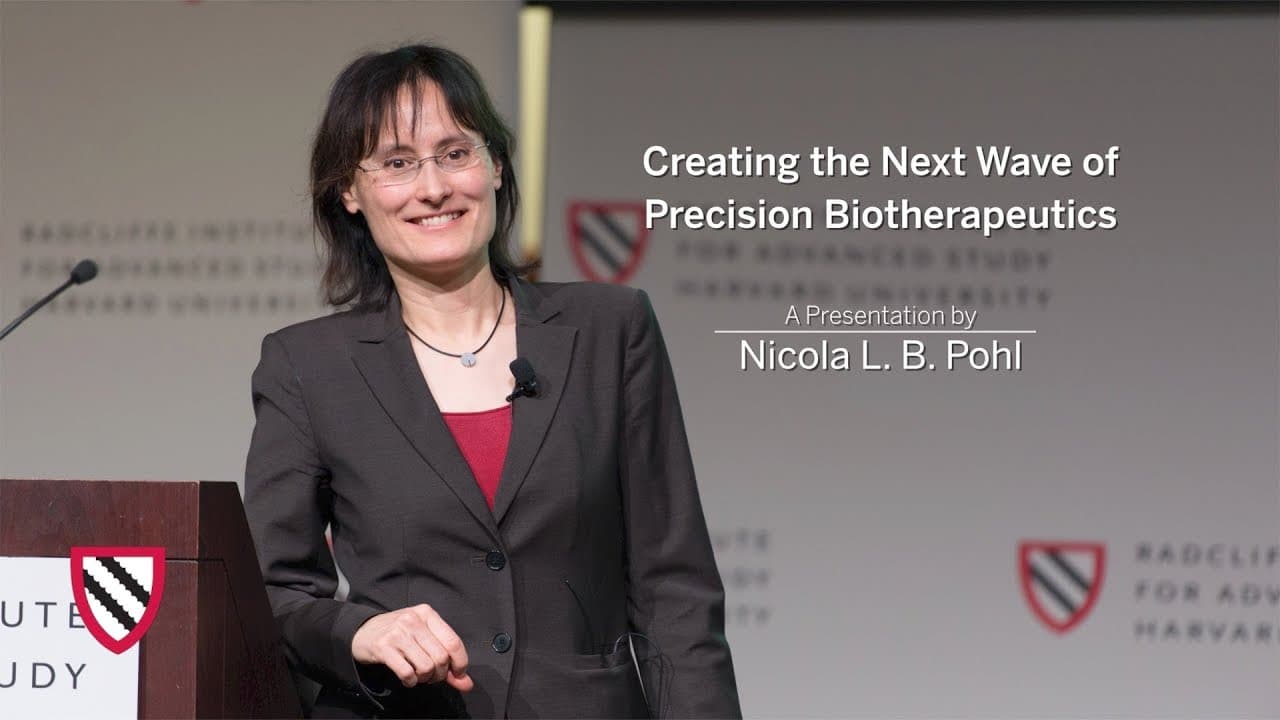
Creating the Next Wave of Precision Biotherapeutics | Nicola L. B. Pohl || Radcliffe Institute
TL;DR
This presentation highlights the progress and challenges in automating chemical synthesis for the production of precision biotherapeutics, focusing on synthesizing sugars and peptides.
Transcript
- Thank you very much. It's a pleasure being here. I was told by one of the fellow fellows yesterday, or two days ago, that I don't even understand your title. So have no fear. It was a bit of a challenge as a chemist because I'm so used to talking with structures. Structures, and the beauty of structures, is really a part of what gets us excited a... Read More
Key Insights
- ❓ Automation has revolutionized chemical synthesis, improving reproducibility and efficiency.
- ❓ The synthesis of sugars, specifically carbohydrates, has been a significant challenge due to their complex structures and variability.
- 👻 Automating sugar synthesis allows for the production of high-quality sugar-building blocks, enabling the synthesis of glycans and glycosylated peptides.
- 🤗 Integration of automated sugar and peptide synthesis opens up new opportunities for exploring the space of glycopeptides and advancing precision biotherapeutics.
Install to Summarize YouTube Videos and Get Transcripts
Explore YouTube Video Summarizer or Get YouTube Transcript Extractor
Questions & Answers
Q: What are some of the challenges in automating the synthesis of sugars?
The complexity of sugar structures and the difficulty in reproducing and analyzing them are the main challenges in automating sugar synthesis. The subtle differences between sugars in terms of their three-dimensional structure and reactivity require careful control and optimization of reaction conditions.
Q: Why is it important to automate chemical synthesis for precision biotherapeutics?
Automation improves the reproducibility and scalability of chemical synthesis, making it more accessible and cost-effective. This is particularly important for precision biotherapeutics, which require accurate and controlled synthesis of specific molecules with high precision.
Q: How does automating the synthesis of sugars and peptides contribute to the development of precision biotherapeutics?
Automating the synthesis of sugars and peptides allows for more efficient production of these molecules, making them more accessible for research and development of biotherapeutics. This, in turn, enables the exploration of glycosylation in peptides and the development of novel therapeutics with improved properties and functions.
Q: What are the potential applications of automated chemical synthesis in the pharmaceutical industry?
Automated chemical synthesis has various applications in the pharmaceutical industry, including the synthesis of small molecule therapeutics, peptides, proteins, and biotherapeutics. It enables the rapid and cost-effective production of these molecules, facilitating drug discovery, optimization, and manufacturing processes.
Summary & Key Takeaways
-
Automation has significantly improved the reproducibility and efficiency of chemical synthesis, particularly in the synthesis of sugars and peptides.
-
The synthesis of sugars, specifically carbohydrates, has historically been a challenge due to their complex structures and the difficulty in reproducing and analyzing them accurately.
-
By automating the process, researchers can improve the quality and quantity of sugar-building blocks, making the synthesis of glycans and glycosylated peptides more feasible and accessible for various applications.
-
The integration of automated sugar and peptide synthesis opens up opportunities for exploring the space of glycopeptides and generating data sets for future research and predictive modeling.
Read in Other Languages (beta)
Share This Summary 📚
Summarize YouTube Videos and Get Video Transcripts with 1-Click
Try YouTube Summary with ChatGPT & Claude or YouTube Transcript Generator
Explore More Summaries from Harvard University 📚

Summarize YouTube Videos and Get Video Transcripts with 1-Click
Try YouTube Summary with ChatGPT & Claude or YouTube Transcript Generator