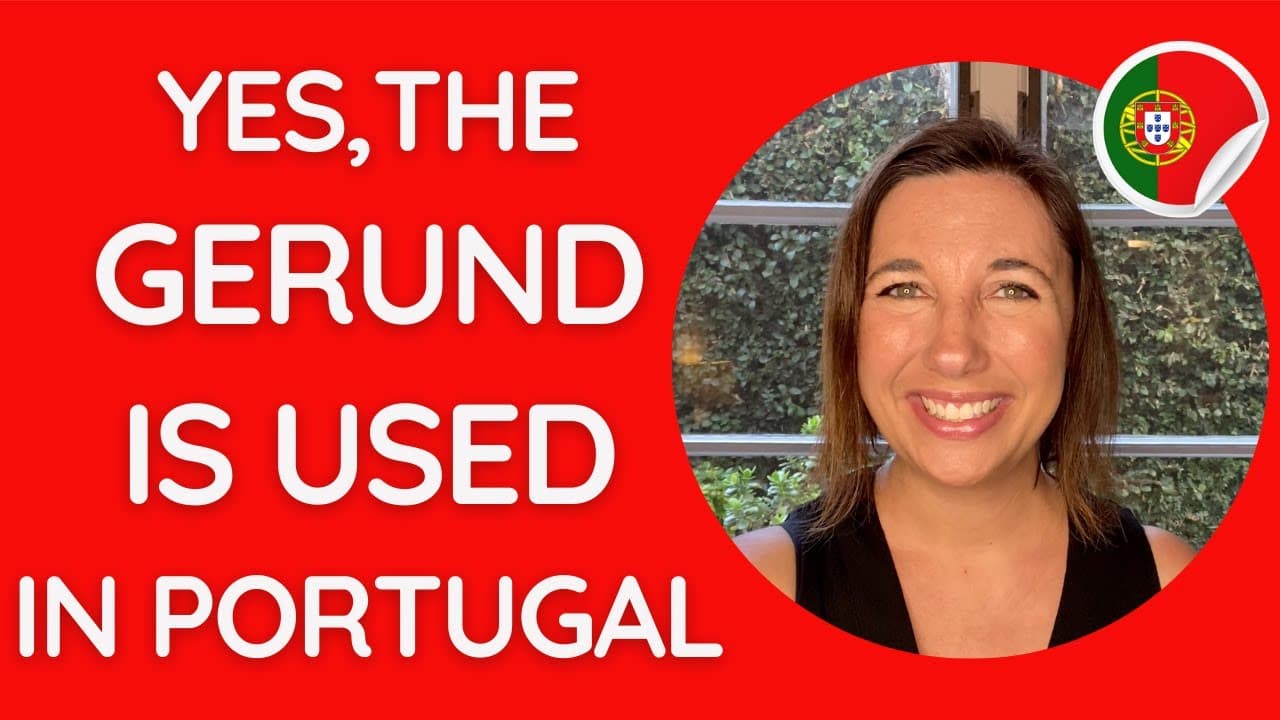
Learn When to Use the Gerund in European Portuguese.
TL;DR
Learn the uses of Gerund in European Portuguese.
Transcript
Olá a todos! Mastering a foreign language takes time. Being able to communicate in Portuguese is no different. Learners face different challenges and are often faced with several Verbal Moods and Tenses, which sometimes seem to be never ending, right? Today I bring you the Gerund. When students try to compare Brazilian Portuguese to European Po... Read More
Key Insights
- The Gerund in European Portuguese is often misunderstood as rarely used, but it is still prevalent in certain regions like Alentejo and Algarve.
- In European Portuguese, the Gerund is replaced by 'Estar a + infinitive' for the present continuous, unlike Brazilian Portuguese.
- The Gerund expresses simultaneous actions when placed next to the main verb in a sentence.
- In recipes and instructions, the Gerund is frequently used to indicate actions performed simultaneously.
- The Gerund can express cause, condition, consequence, and concession, offering versatility in sentence construction.
- With the auxiliary verb 'IR,' the Gerund indicates a progressive or anticipated action.
- Using 'IR' in the imperfect with the Gerund suggests an action that nearly occurred.
- Combining the Gerund with 'VIR' shows a durative action developing towards the current moment.
Install to Summarize YouTube Videos and Get Transcripts
Explore YouTube Video Summarizer or Get YouTube Transcript Extractor
Questions & Answers
Q: Why is the Gerund often associated with Brazilian Portuguese?
The Gerund is associated with Brazilian Portuguese because it is used similarly to the English Present Continuous tense. In Brazilian Portuguese, phrases like 'Estou indo' ('I’m going') use the Gerund, whereas European Portuguese typically uses 'Estar a + infinitive.' This difference highlights the Gerund's prominence in Brazilian Portuguese.
Q: How is the Gerund formed in Portuguese?
In Portuguese, the Gerund is formed by replacing the 'R' at the end of the infinitive form of a verb with 'NDO.' For example, 'falar' (to speak) becomes 'falando' (speaking). This simple transformation allows verbs to express ongoing actions, similar to the '-ing' form in English.
Q: In which regions of Portugal is the Gerund still commonly used?
The Gerund is still commonly used in regions such as Alentejo and the Algarve. Despite the general preference for 'Estar a + infinitive' in European Portuguese, these areas maintain the traditional use of the Gerund, reflecting regional linguistic variations within Portugal.
Q: What are some main uses of the Gerund in European Portuguese?
The Gerund in European Portuguese is primarily used to express simultaneous actions, replace conjunctions like 'e,' and indicate cause, condition, consequence, and concession. It offers flexibility in constructing sentences and is particularly useful in instructions and recipes to denote concurrent actions.
Q: How does the Gerund express a progressive action with the verb 'IR'?
When used with the auxiliary verb 'IR,' the Gerund indicates a durative action that progresses over time or anticipates a future action. This combination allows speakers to convey ongoing processes or actions that are expected to occur, adding depth to temporal expressions in European Portuguese.
Q: What is the significance of using the Gerund with 'VIR'?
Using the Gerund with the verb 'VIR' signifies a durative action that gradually develops towards the current moment. This construction helps describe processes or actions that unfold over time, emphasizing their progression and eventual culmination, thus enriching narrative and descriptive language.
Q: How can the Gerund express concession in a sentence?
The Gerund can express concession by following the word 'mesmo,' which means 'even' in English. This usage allows speakers to highlight an action or condition that persists despite other factors, providing a nuanced way to convey exceptions or unexpected continuities in European Portuguese.
Q: Why is it important to understand the use of the Gerund in Portuguese?
Understanding the use of the Gerund in Portuguese is crucial for mastering the language's verbal nuances. It enables learners to construct complex sentences, express simultaneous actions, and convey various temporal and causal relationships, thereby enhancing both written and spoken communication skills in European Portuguese.
Summary & Key Takeaways
-
The video clarifies the use of the Gerund in European Portuguese, debunking the misconception that it's rarely used. It highlights its prevalence in specific regions and explains its grammatical applications.
-
The Gerund can replace conjunctions, express simultaneous actions, and show causation, condition, consequence, and concession, making it a versatile tool in the language.
-
Practical examples demonstrate how the Gerund is used with auxiliary verbs like 'IR' and 'VIR' to describe ongoing or anticipated actions, enriching learners' understanding of European Portuguese.
Read in Other Languages (beta)
Share This Summary 📚
Summarize YouTube Videos and Get Video Transcripts with 1-Click
Try YouTube Summary with ChatGPT & Claude or YouTube Transcript Generator
Explore More Summaries from Learn European Portuguese Online 📚


Summarize YouTube Videos and Get Video Transcripts with 1-Click
Try YouTube Summary with ChatGPT & Claude or YouTube Transcript Generator