Determining if a function is invertible | Mathematics III | High School Math | Khan Academy
TL;DR
Explore the concept of invertibility in functions and how it relates to the mapping between domains and ranges.
Transcript
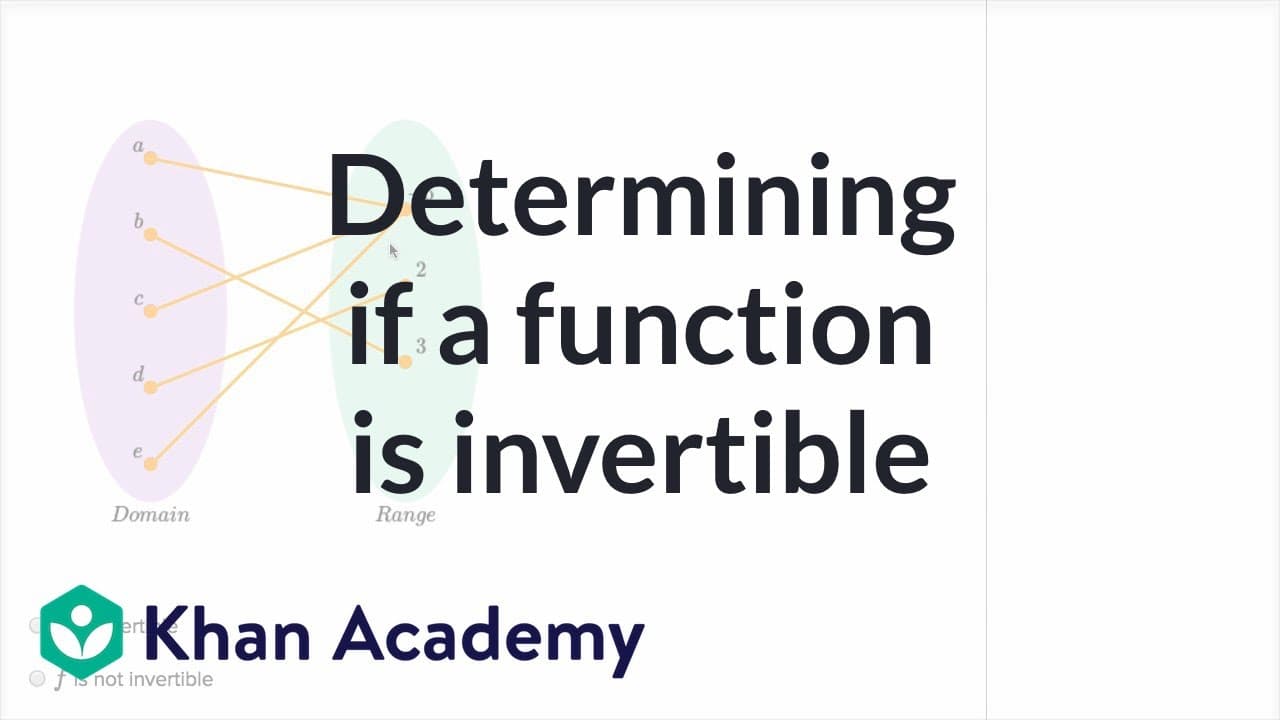
- [Voiceover] So if x is equal to a then, so if we input a into our function then we output -6. f of a is -6. We input b we get three, we input c we get -6, we input d we get two, we input e we get -6. Alright, so let's see what's going on over here. Let me scroll down a little bit more. So in this purple oval, this is representing the domain of ou... Read More
Key Insights
- 🧡 Functions map inputs from a domain to outputs in a range.
- 🧡 Invertibility depends on the existence of a one-to-one mapping between the domain and the range.
- 🚱 Multiple inputs mapping to the same output make a function non-invertible.
- 👻 An invertible function allows for the creation of an inverse function that performs the reverse mapping.
- 🔠 Invertible functions have a unique output for each input, while non-invertible functions may have multiple outputs for the same input.
- 🔠 Mapping diagrams can visually represent the relationship between inputs and outputs.
- 🍧 For a function to be invertible, it must satisfy the condition of having a unique mapping from each input to the output.
Install to Summarize YouTube Videos and Get Transcripts
Explore YouTube Video Summarizer or Get YouTube Transcript Extractor
Questions & Answers
Q: What does it mean for a function to be invertible?
A function is invertible if each input in its domain maps to a unique output in the range. It allows for the creation of an inverse function that performs the reverse mapping.
Q: Why is it problematic for multiple inputs to map to the same output?
If multiple inputs map to the same output, it becomes impossible to create an inverse function because it would violate the rule of a function only mapping to one output. The function loses its one-to-one correspondence.
Q: Can an invertible function still have multiple outputs mapping to the same input?
Yes, a function can have multiple outputs mapping to the same input while still being invertible. The crucial factor is that each input has a unique output, not the other way around.
Q: How can you tell if a function is invertible from a mapping diagram?
In a mapping diagram, if each member of the domain maps to a unique member of the range, and there are no two mappings from the domain to the same member of the range, then the function is invertible.
Summary & Key Takeaways
-
The video explains the concept of a function, where inputs from a domain are mapped to outputs in the range.
-
Invertibility of a function is determined by whether there is a one-to-one mapping between the domain and range.
-
If multiple inputs from the domain map to the same output in the range, the function is not invertible.
Read in Other Languages (beta)
Share This Summary 📚
Summarize YouTube Videos and Get Video Transcripts with 1-Click
Try YouTube Summary with ChatGPT & Claude or YouTube Transcript Generator
Explore More Summaries from Khan Academy 📚



Summarize YouTube Videos and Get Video Transcripts with 1-Click
Try YouTube Summary with ChatGPT & Claude or YouTube Transcript Generator