Symbolic Microprogram - Micro Programed Control Unit - Computer Organization and Architecture
TL;DR
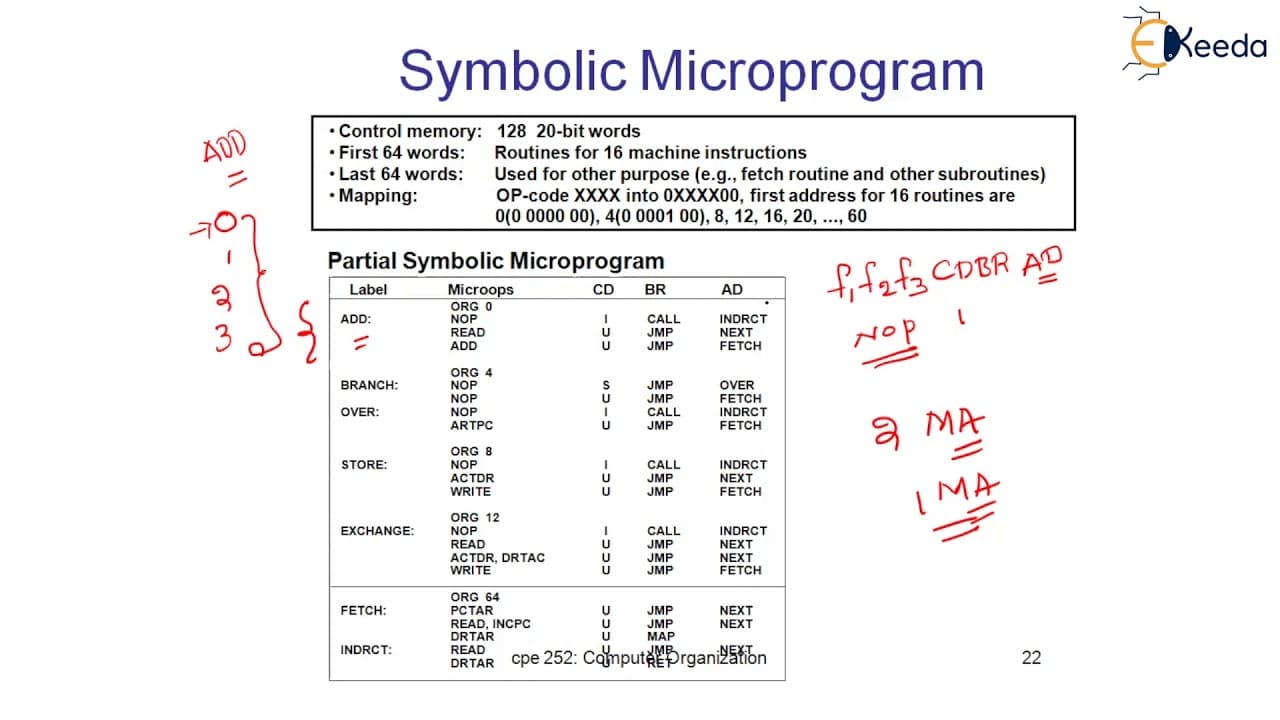
This session explains the sequence of operations involved in a symbolic and binary microprogram for performing addition operations using a microprogrammed control unit.
Transcript
hello everyone in this session we are going to understand a symbolic micro program for addition operation let us say the current instruction that has been fetched from the main memory is an edition instruction you know that during the edition instruction we need to face the operand from the main memory into the data register and finally the operati... Read More
Key Insights
- 🦠 The microprogrammed control unit performs a sequence of micro-instructions to execute addition operations.
- ♿ The addressing mode of the operand determines the number of memory accesses required.
- 🦠 The micro-instructions involve fetching the operand, performing the addition operation, and transferring the result to the accumulator.
- 🤬 The symbolic microprogram can be represented in binary, with symbols replaced by their binary equivalents for more efficient execution.
- 🎮 The control unit includes routines for fetching, executing, and returning from indirect routines.
- 🎮 The design of the microprogrammed control unit is crucial for efficient and accurate addition operation execution.
- 🎮 The microprogrammed control unit ensures the proper sequencing of operations during addition execution.
Install to Summarize YouTube Videos and Get Transcripts
Explore YouTube Video Summarizer or Get YouTube Transcript Extractor
Questions & Answers
Q: What is the purpose of a microprogrammed control unit in performing addition operations?
A microprogrammed control unit is responsible for executing a sequence of micro-instructions that perform the necessary operations for addition, such as fetching the operand and performing the addition operation.
Q: How does the control unit determine the addressing mode of the operand?
The most significant digit of the operand determines the addressing mode. If it is 0, the operand is in direct address mode. If it is 1, the operand is in indirect address mode.
Q: What is the difference in memory accesses between direct and indirect addressing modes?
In direct addressing mode, only one memory access is required to fetch the operand. In indirect addressing mode, two memory accesses are required: one to fetch the address of the operand and another to fetch the actual operand.
Q: What are the micro-instructions involved in performing the addition operation?
The micro-instructions include fetching the operand, performing the addition operation between the data register and accumulator, and transferring the result to the accumulator.
Summary & Key Takeaways
-
The session discusses the steps involved in performing addition operations using a microprogrammed control unit, including fetching the instruction, mapping it to the control memory, and executing the micro-routine.
-
It explains how to determine the addressing mode of the operand (direct or indirect) and the number of memory accesses required based on the mode.
-
The session also covers the micro-instructions for fetching the operand, performing the addition operation, and transferring the result to the accumulator.
Read in Other Languages (beta)
Share This Summary 📚
Summarize YouTube Videos and Get Video Transcripts with 1-Click
Try YouTube Summary with ChatGPT & Claude or YouTube Transcript Generator
Explore More Summaries from Ekeeda 📚






Summarize YouTube Videos and Get Video Transcripts with 1-Click
Try YouTube Summary with ChatGPT & Claude or YouTube Transcript Generator