Products
Features
YouTube Video Summarizer
Summarize YouTube videos
Web & PDF Highlighter
Highlight web pages & PDFs
Chat with PDF
Ask any PDF questions with AI
Ask AI Clone
Chat with your highlights & memories
Audio Transcriber
Transcribe audio files to text
Glasp Reader
Read and highlight articles
Kindle Highlight Export
Export your Kindle highlights
Idea Hatch
Hatch ideas from your highlights
Integrations
Obsidian Plugin
Notion Integration
Pocket Integration
Instapaper Integration
Medium Integration
Readwise Integration
Snipd Integration
Hypothesis Integration
Apps & Extensions
Chrome Extension
Safari Extension
Edge Add-ons
Firefox Add-ons
iOS App
Android App
Discover
Discover
Ideas
Discover new ideas and insights
Articles
Curated articles and insights
Books
Book recommendations by great minds
Posts
Essays and notes from readers
Quotes
Inspiring quotes collection
Videos
Curated videos and summaries
Explore Glasp
Glasp Story
How we grew from 0 to 3 million users
Glasp Newsletter
Weekly insights and updates
Glasp Talk
Interview series with great minds
Glasp Blog
Latest news and articles
Glasp Use Cases
Learn how others use Glasp
Build & Support
Glasp API
Access Glasp's API for developers
MCP Connector
Connect Glasp to Claude & ChatGPT
Community
Glasp Reddit Community
Students
Student discount and benefits
FAQs
Frequently Asked Questions
AboutPricing
DashboardLog inSign up

Capacitors (4 of 9) Calculating the Capacitance of a Capacitor, An Explanation
101.3K views
•
February 20, 2016
by
Step by Step Science
YouTube video player
Capacitors (4 of 9) Calculating the Capacitance of a Capacitor, An Explanation

TL;DR

Understand how to calculate capacitance using simple equations and factors affecting it.

Transcript

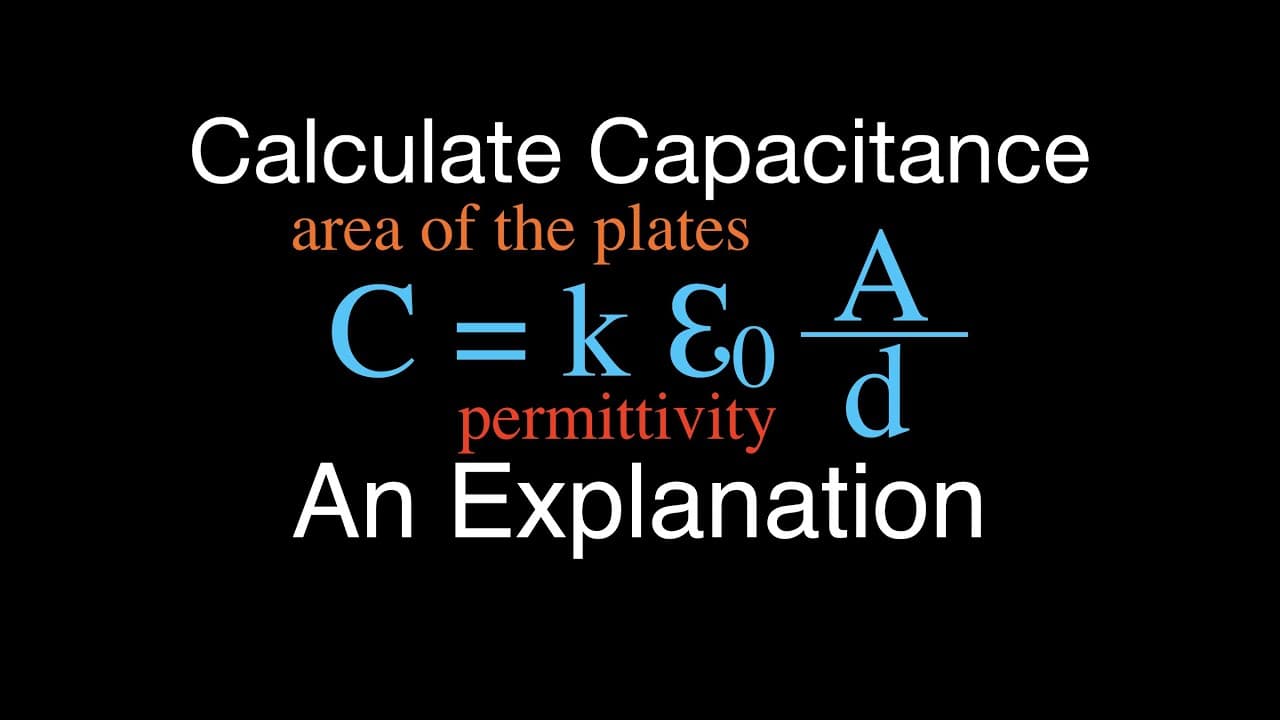
okay in today's video I'm going to go over an explanation how we calculate the capacitance of a capacitor and before we do that I'm going to go over a brief explanation of this equation this is great and we used to calculate the capacitance of a capacitor okay the equation is simply C is equal to K epsilon naught divided by a times a divided by D o... Read More

Key Insights

  • 🍽️ Capacitance calculation involves dielectric constant, permittivity of free space, plate area, and plate distance.
  • 😎 Dielectric materials like glass or paper have varying dielectric constants affecting capacitance.
  • 🥶 Permittivity of free space is a universal constant influencing capacitance calculations.
  • 🍽️ Area of plates directly impacts capacitance, with larger areas storing more charge.
  • 🍽️ Plate distance inversely affects capacitance, closer plates result in higher capacitance.
  • 🍽️ Capacitance calculations may vary with or without a dielectric material between plates.
  • ❓ Examples demonstrating capacitance calculations provide practical insight into the concept.

Install to Summarize YouTube Videos and Get Transcripts

Explore YouTube Video Summarizer or Get YouTube Transcript Extractor

Questions & Answers

Q: What is the equation used to calculate the capacitance of a capacitor?

The equation is C = Kε₀A/D which considers dielectric constant, permittivity of free space, area, and distance between plates.

Q: How does the dielectric constant affect the capacitance of a capacitor?

The capacitance is directly proportional to the dielectric constant, meaning as K increases, the capacitance increases.

Q: What is the role of permittivity of free space in capacitance calculation?

The permittivity of free space, ε₀, acts as a constant of proportionality in the capacitance equation, maintaining the relationship between charge and voltage.

Q: Explain how the area and distance between plates influence capacitance.

Capacitance increases with an increase in plate area (A) and decreases with a larger distance (D) between plates due to the storing capacity of charges.

Summary & Key Takeaways

  • Capacitance of a capacitor is calculated using C = Kε₀A/D equation.

  • Factors like dielectric constant, permittivity of free space, area, and distance affect capacitance.

  • Examples of capacitance calculations with and without dielectric are demonstrated.


Read in Other Languages (beta)

English

Share This Summary 📚

Summarize YouTube Videos and Get Video Transcripts with 1-Click

Download browser extensions on:

Try YouTube Summary with ChatGPT & Claude or YouTube Transcript Generator

Explore More Summaries from Step by Step Science 📚
Electric Power (1 of 3) and Watts, An Explanation thumbnail
Electric Power (1 of 3) and Watts, An Explanation
Step by Step Science
Newton's 2nd Law (7 of 21) Atwood Machine, Acceleration & Tension (revised) thumbnail
Newton's 2nd Law (7 of 21) Atwood Machine, Acceleration & Tension (revised)
Step by Step Science
How to Solve Systems of Linear Equations with Substitution thumbnail
How to Solve Systems of Linear Equations with Substitution
Step by Step Science
How to Calculate Torque When Force Isn't Perpendicular thumbnail
How to Calculate Torque When Force Isn't Perpendicular
Step by Step Science
Making YOU the Scientist: Freezing Point Depression and Phase Changes thumbnail
Making YOU the Scientist: Freezing Point Depression and Phase Changes
Step by Step Science
How to Write Chemical Formulas for Ionic Compounds thumbnail
How to Write Chemical Formulas for Ionic Compounds
Step by Step Science

Summarize YouTube Videos and Get Video Transcripts with 1-Click

Download browser extensions on:

Try YouTube Summary with ChatGPT & Claude or YouTube Transcript Generator

Apps & Extensions

  • Chrome Extension
  • Safari Extension
  • Edge Add-ons
  • Firefox Add-ons
  • iOS App
  • Android App

Key Features

  • YouTube Video Summarizer
  • Web & PDF Summarizer
  • Web & PDF Highlighter
  • Chat with PDF
  • Ask AI Clone
  • Audio Transcriber
  • Glasp Reader
  • Kindle Highlight Export
  • Idea Hatch

Integrations

  • Obsidian Plugin
  • Notion Integration
  • Pocket Integration
  • Instapaper Integration
  • Medium Integration
  • Readwise Integration
  • Snipd Integration
  • Hypothesis Integration

More Features

  • APIs
  • MCP Connector
  • Blog & Post
  • Embed Links
  • Image Highlight
  • Personality Test
  • Quote Shots
  • Open Graph Checker

Company

  • About us
  • Our Story
  • Blog
  • Community
  • FAQs
  • Job Board
  • Newsletter
  • Pricing
Terms

•

Privacy

•

Guidelines

© 2026 Glasp Inc. All rights reserved.