Partial derivatives and graphs
TL;DR
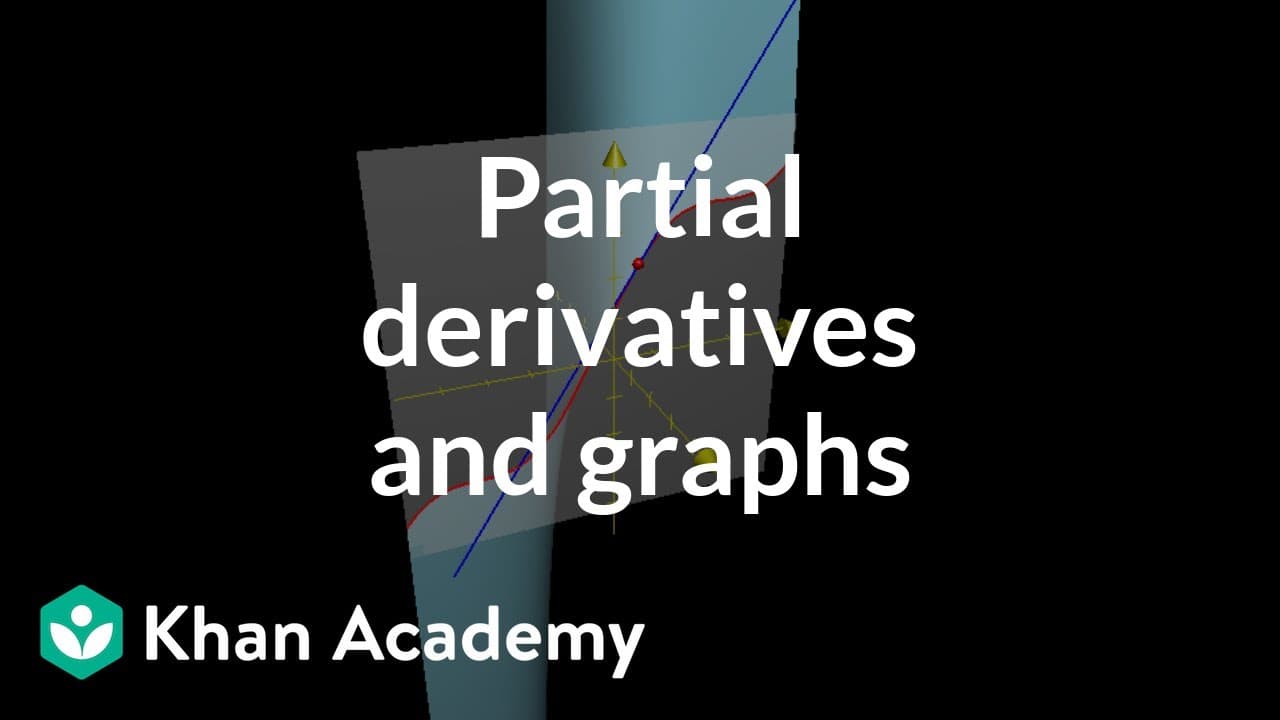
The partial derivative of a two-variable function can be interpreted as the slope of the function when one variable is held constant, or when the function is sliced by a plane representing a constant value of one variable.
Transcript
- [Voiceover] Hello everyone. So I have here the graph of a two-variable function and I'd like to talk about how you can interpret the partial derivative of that function. So specifically, the function that you're looking at is f of x, y is equal to x squared times y plus sine of y. And the question is, if I take the partial derivative of this func... Read More
Key Insights
- ❓ The partial derivative of a two-variable function can be interpreted as the slope of the function when one variable is treated as a constant.
- 😥 Slicing the function's graph with a plane representing a constant value of one variable helps visualize the points where that variable remains constant.
- 🫥 The partial derivative can also be interpreted as the slope of the tangent line at a specific point on the graph.
- 🫡 The partial derivative with respect to one variable shows how the function changes in the direction of the other variable.
Install to Summarize YouTube Videos and Get Transcripts
Explore YouTube Video Summarizer or Get YouTube Transcript Extractor
Questions & Answers
Q: How is the partial derivative interpreted when one variable is treated as a constant?
When one variable is treated as a constant, the partial derivative represents the slope of the function at a specific point on the graph, showing how the function changes in the direction of the other variable.
Q: What does it mean to slice the graph with a plane representing a constant value of one variable?
Slicing the graph with a plane representing a constant value of one variable allows us to visualize the points on the graph where that variable remains constant. This helps in interpreting the partial derivative as the slope of the resulting curve.
Q: Can the partial derivative be interpreted as the slope of the tangent line?
Yes, as the partial derivative represents the slope of the function when one variable is held constant, it can be interpreted as the slope of the tangent line at a specific point on the graph.
Q: How does the partial derivative change when the function is sliced with a plane representing a constant value of the other variable?
When the function is sliced with a plane representing a constant value of the other variable, the partial derivative represents the slope of the resulting curve. This shows how the function changes in the direction of the variable being held constant.
Summary & Key Takeaways
-
The video discusses how to interpret the partial derivative of a two-variable function at a specific point on the graph.
-
When taking the partial derivative with respect to one variable, the other variable is treated as a constant, and the derivative is calculated accordingly.
-
The partial derivative can be interpreted as the slope of the function when sliced by a plane representing a constant value of one variable.
Read in Other Languages (beta)
Share This Summary 📚
Summarize YouTube Videos and Get Video Transcripts with 1-Click
Try YouTube Summary with ChatGPT & Claude or YouTube Transcript Generator
Explore More Summaries from Khan Academy 📚



Summarize YouTube Videos and Get Video Transcripts with 1-Click
Try YouTube Summary with ChatGPT & Claude or YouTube Transcript Generator