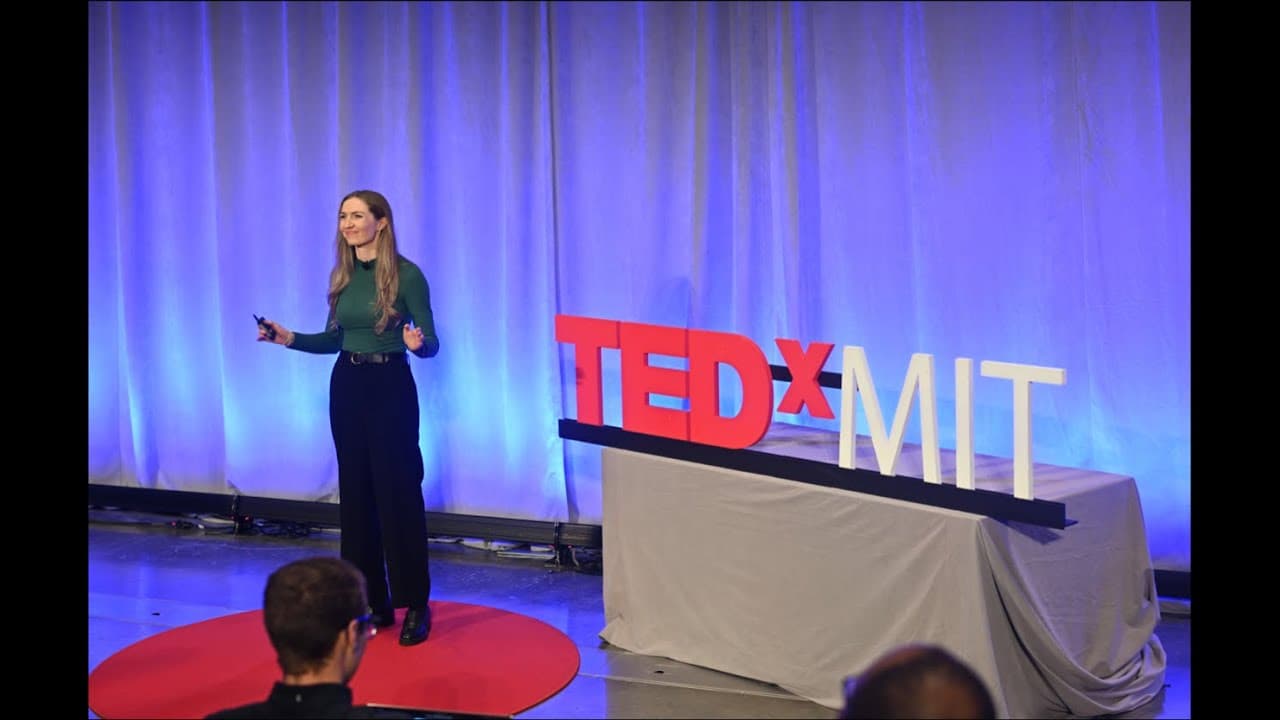
Collaborative Vision Systems for Space Exploration | Annika Thomas | TEDxMIT
TL;DR
In order for robots to work together on tasks in space missions and other applications, they need to learn how to build maps of the environment and align those maps with other robots.
Transcript
2 years from now humans will return to the moon for the first time since 1972 and within two decades humans will set foot on Mars for the very first time but they won't be alone alongside our astronauts will be a team of advanced robots designed to ass assist and extend uh the research that our astronauts are conducting and to help in tasks that co... Read More
Key Insights
- 🤖 Humans will return to the moon and go to Mars accompanied by advanced robots for assistance and research.
- 🤖 Robots need to learn how to build meaningful maps and align them with others to work together effectively.
- 😥 Mapping involves creating 3D models of distinctive points, while alignment relies on geometric consistency for a shared understanding.
- 🍁 Segmentation is important for compact and shareable maps that can withstand visual changes.
- 🤖 Collaborative mapping benefits multi-agent teams of robots, including ground robots and drones.
- 👾 This technology has applications in space exploration, but also in hazardous environments on Earth, such as search and rescue operations and autonomous driving.
Install to Summarize YouTube Videos and Get Transcripts
Explore YouTube Video Summarizer or Get YouTube Transcript Extractor
Questions & Answers
Q: How do robots build maps of their environment?
Robots build maps by identifying distinctive points in images, such as object edges or corners, and tracking them across different frames. These points are then used to create a 3D model of the environment.
Q: Why is it important for robots to align their maps with each other?
Aligning maps allows robots to have a shared understanding of the environment. By using geometric consistency, they can rotate and translate their maps to match each other, enabling collaboration and communication between robots.
Q: What advantages does segmentation offer in environment representations?
Segmentation, the process of separating objects in an image, allows robots to focus on the underlying structure of the environment, which is robust to visual changes. This helps create compact and shareable 3D maps.
Q: How can multi-agent teams of drones benefit from collaborative mapping?
When drones have a collective understanding of the environment, they can plan paths, react to objects, and avoid collisions. This technology is useful for exploring new environments and can be extended to other complex scenarios on Earth.
Summary & Key Takeaways
-
Humans are planning to return to the moon and set foot on Mars in the coming years, and advanced robots will accompany them to assist in research and dangerous tasks.
-
To enable robots to work together, they need to learn how to build meaningful maps of the environment and align their maps with each other.
-
Mapping the environment involves creating 3D models of distinctive points, while aligning maps relies on geometric consistency to create a collective understanding.
Read in Other Languages (beta)
Share This Summary 📚
Summarize YouTube Videos and Get Video Transcripts with 1-Click
Try YouTube Summary with ChatGPT & Claude or YouTube Transcript Generator
Explore More Summaries from TEDx Talks 📚





Summarize YouTube Videos and Get Video Transcripts with 1-Click
Try YouTube Summary with ChatGPT & Claude or YouTube Transcript Generator