Introduction to the doppler effect | Mechanical waves and sound | Physics | Khan Academy
TL;DR
This video explains how the position and motion of wave sources can affect the location of crests and the perceived frequency of the waves.
Transcript
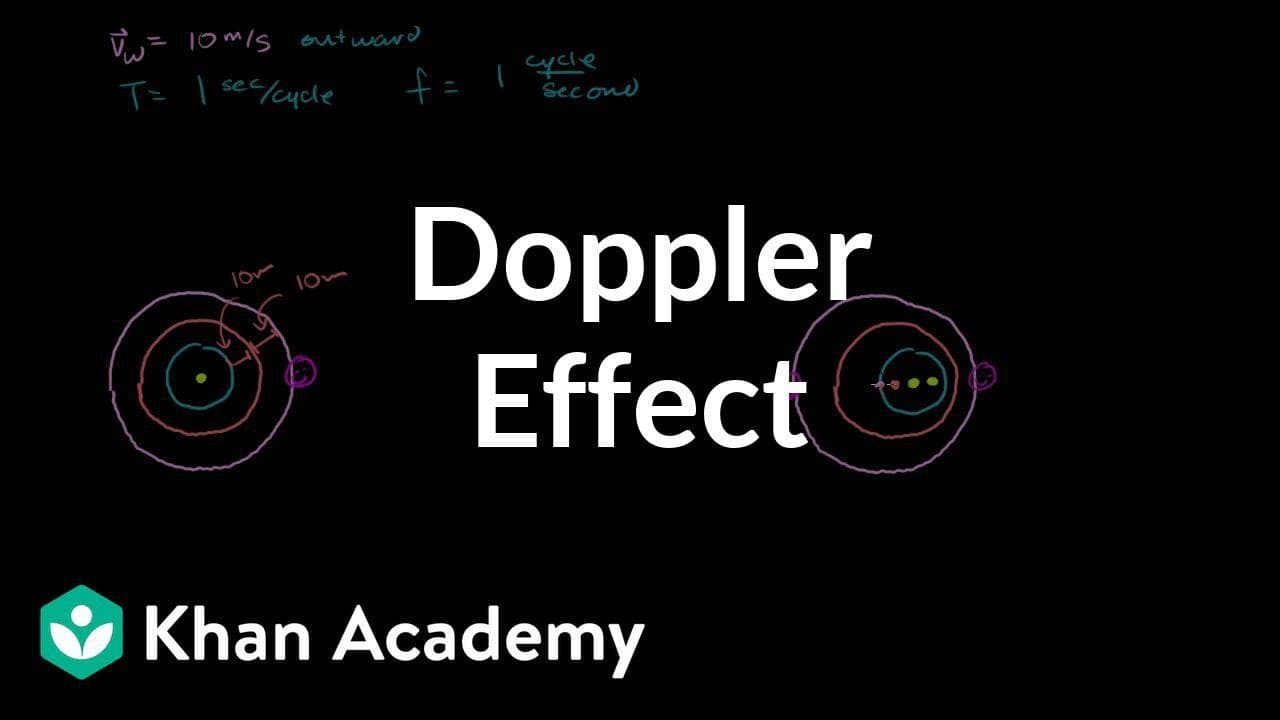
What we're going to do in this video is think about two wave sources. But one of them is going to be stationary and the other one is going to be moving. And just to have a concrete number, it's moving at 5 meters per second to the right. And what we're going to think about is where are the crests of the wave that it's been releasing for the last 3 ... Read More
Key Insights
- 👋 The location of crests emitted by stationary and moving wave sources differ due to the relative motion.
- 👋 The perceived frequency of waves changes depending on the observer's position and motion of the wave source.
- 👋 The Doppler effect explains the perceived frequency shift in waves caused by the motion between the source and observer.
Install to Summarize YouTube Videos and Get Transcripts
Explore YouTube Video Summarizer or Get YouTube Transcript Extractor
Questions & Answers
Q: How does the motion of wave sources affect the location of crests?
The crests emitted by a stationary source move radially outward, while the crests emitted by a moving source are located 10 meters radially outward from its current position.
Q: How does the perceived frequency change based on the observer's position and motion of the wave source?
When the wave source is moving towards the observer, the perceived frequency is higher due to the closer spacing of the crests. Conversely, when the wave source is moving away, the perceived frequency is lower due to the wider spacing of the crests.
Q: What is the significance of the Doppler effect in this context?
The Doppler effect explains the perceived frequency shift in waves due to the motion between the source and observer. It causes an increase in frequency when the source is approaching and a decrease when moving away.
Q: How does the wavelength of the wave change in relation to the motion of the source?
The wavelength is affected by the motion of the source. When the source is moving towards the observer, the wavelength is shorter, and when it is moving away, the wavelength is longer.
Summary & Key Takeaways
-
The video explores two wave sources, one stationary and one moving at a velocity of 5 meters per second. Both sources emit waves at a velocity of 10 meters per second with a period of 1 second per cycle.
-
The crests emitted by the stationary source move radially outward, whereas the crests emitted by the moving source are located 10 meters radially outward from its position.
-
The perceived frequency of the waves differs depending on the observer's position and relative motion to the wave sources, resulting in higher frequencies when the source is moving towards the observer and lower frequencies when the source is moving away.
Read in Other Languages (beta)
Share This Summary 📚
Summarize YouTube Videos and Get Video Transcripts with 1-Click
Try YouTube Summary with ChatGPT & Claude or YouTube Transcript Generator
Explore More Summaries from Khan Academy 📚



Summarize YouTube Videos and Get Video Transcripts with 1-Click
Try YouTube Summary with ChatGPT & Claude or YouTube Transcript Generator