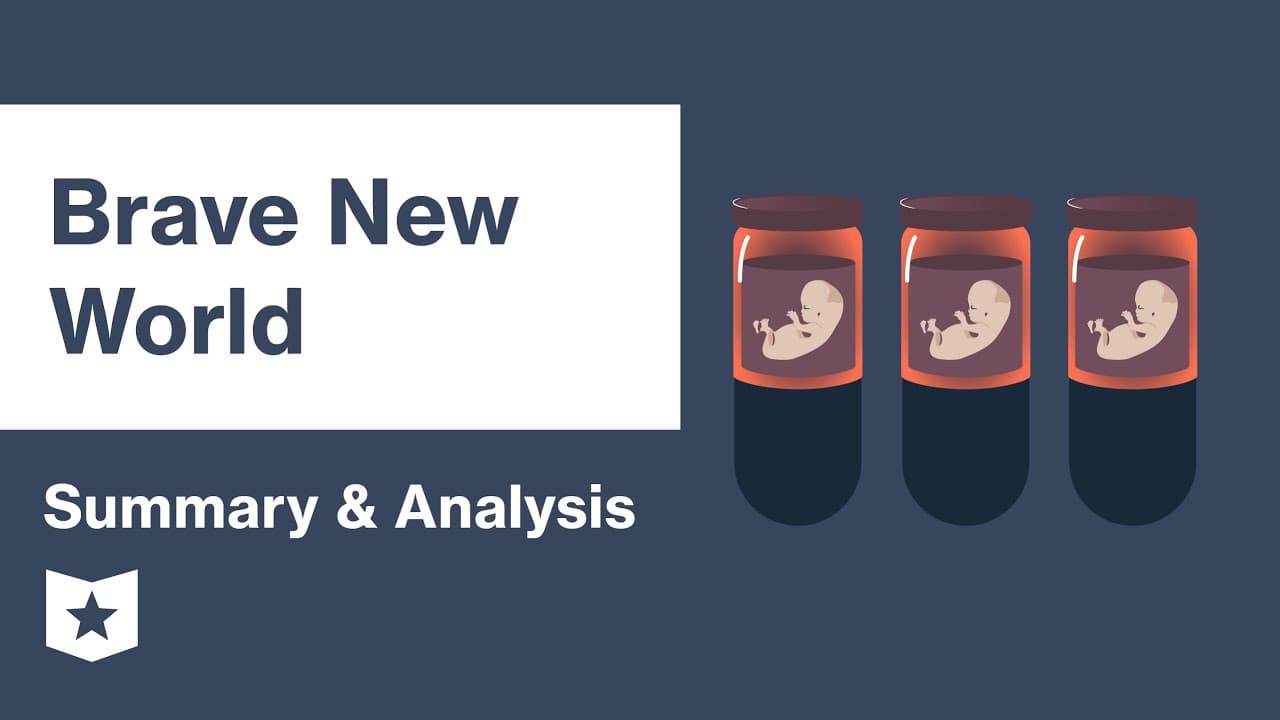
Brave New World | Summary & Analysis | Aldous Huxley
TL;DR
Aldous Huxley's Brave New World critiques societal norms through a dystopian lens, exploring themes of oppression, consumerism, and control.
Transcript
Aldous Huxley's novel of 1932 brave new world imagined a perfect world of peace and stability engineered through pleasure consumerism and the rigid class hierarchy required to sustain it we see in action how people can be trained to love their oppression and thrive on the very technology that turns off their thinking in this way Huxley gives us a p... Read More
Key Insights
- ❓ Huxley used satire to critique societal norms like consumerism and social conditioning.
- 🇨🇷 The novel explores themes of oppression, identity, and the cost of stability.
- 🌍 Brave New World presents a dystopian world controlled through genetic modification and class stratification.
- 🤬 Symbols like the Model T and Soma represent themes of technology and control.
- ⚖️ The story challenges the balance between individualism and societal conformity.
- 😌 The novel's relevance lies in its exploration of mass production, conditioning, and global governance.
- ❓ Aldous Huxley's critique of consumerism and oppression remains relevant in modern society.
Install to Summarize YouTube Videos and Get Transcripts
Explore YouTube Video Summarizer or Get YouTube Transcript Extractor
Questions & Answers
Q: How does Huxley use satire in Brave New World?
Huxley employs satire to criticize societal aspects like big government, materialism, and social conditioning by creating a plausible but exaggerated benevolent dictatorship.
Q: What are some key symbols in Brave New World?
Symbols like the letter T representing Ford's mass production and Soma representing control through happiness showcase Huxley's commentary on technology and societal control.
Q: How does Brave New World explore the theme of identity?
The caste system in the novel predestines individuals, stifling personal identity and emphasizing conformity through genetic engineering and conditioning.
Q: Is Brave New World a dystopia or utopia?
The novel presents a world of pleasure and stability at the cost of freedom, blurring the lines between utopia and dystopia by showcasing the consequences of oppressive societal control.
Summary & Key Takeaways
-
Huxley's novel explores a future society engineered for stability through pleasure and a rigid class hierarchy.
-
Characters are conditioned from birth to conform to societal norms like consumerism and promiscuity.
-
The story follows characters like John the Savage who challenge the oppressive world state through individualism.
Read in Other Languages (beta)
Share This Summary 📚
Summarize YouTube Videos and Get Video Transcripts with 1-Click
Try YouTube Summary with ChatGPT & Claude or YouTube Transcript Generator
Explore More Summaries from Course Hero 📚

Summarize YouTube Videos and Get Video Transcripts with 1-Click
Try YouTube Summary with ChatGPT & Claude or YouTube Transcript Generator