Monopolist optimizing price: Dead weight loss | Microeconomics | Khan Academy
TL;DR
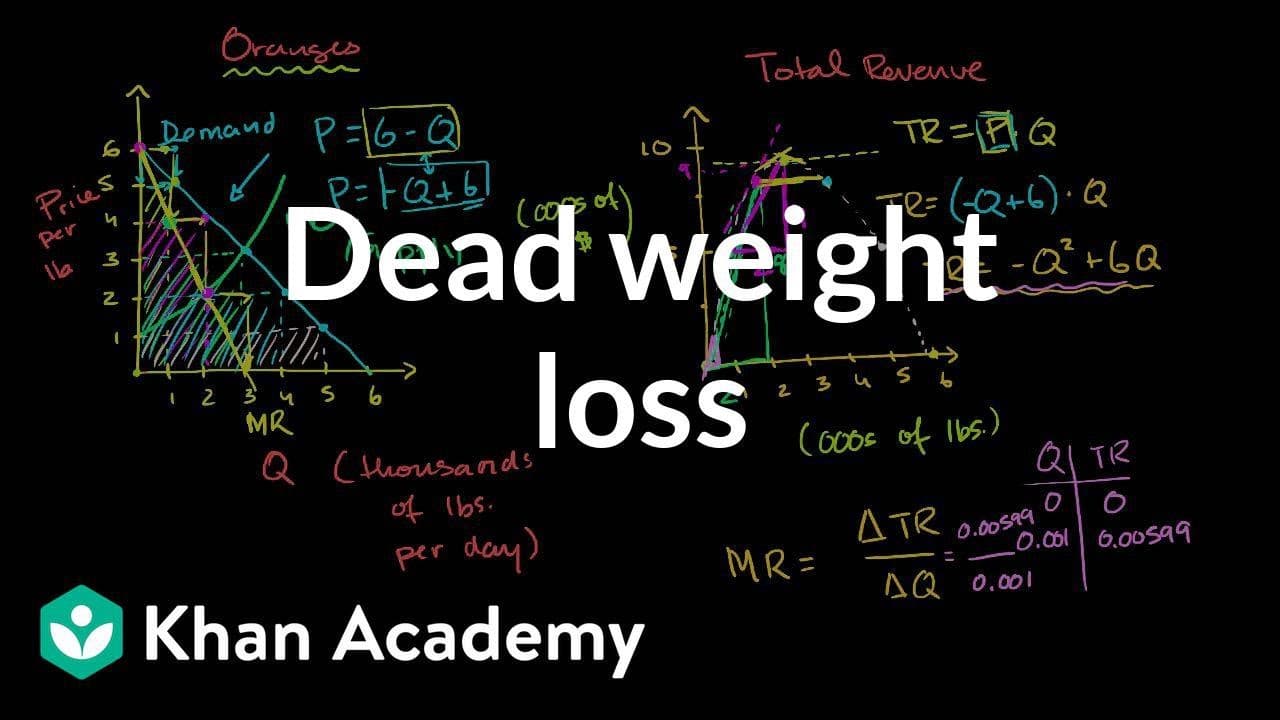
Monopolistic pricing leads to a different equilibrium compared to perfect competition, resulting in a dead weight loss and increased producer surplus at the expense of consumer surplus.
Transcript
Based on what we've done in the last 2 videos we've been able to figure out what the marginal revenue curve looks like for the monopolist year, for the monopolist in the orange market and this is what we got. Right over here, it was a line with a slope twice as steep as the slope of the demand curve, we'll see that's actually generalizable. There's... Read More
Key Insights
- 🥺 Monopolistic pricing has a different equilibrium compared to perfect competition, leading to a dead weight loss and decreased social welfare.
- ⚾ A monopolist's marginal revenue curve is downward-sloping, reflecting the monopolist's ability to influence the price based on their production level.
- 🇨🇷 The optimal quantity for a monopolist to produce is where the marginal revenue curve intersects the marginal cost curve.
- ❓ Monopolistic pricing increases producer surplus but decreases consumer surplus, resulting in a redistribution of value within the market.
- 🌸 Dead weight loss represents the loss in total surplus that occurs when a market is not operating under perfect competition.
- ❓ The impact of monopolistic pricing can vary depending on the specific industry or situation, but generally, it is not beneficial for society as a whole.
- 😫 Monopolists have the ability to set prices and determine their production level, giving them significant market power.
Install to Summarize YouTube Videos and Get Transcripts
Explore YouTube Video Summarizer or Get YouTube Transcript Extractor
Questions & Answers
Q: How does the marginal revenue curve differ for monopolists compared to perfect competition?
The monopolist's marginal revenue curve is downward-sloping and twice as steep as the demand curve. In perfect competition, the marginal revenue curve is constant and equal to the equilibrium price.
Q: Why does monopolistic pricing result in a dead weight loss?
Monopolistic pricing leads to a different equilibrium from perfect competition, causing a dead weight loss. This loss occurs because the price and quantity chosen by the monopolist do not align with the price and quantity that would maximize social welfare.
Q: How does the monopolist determine the optimal quantity to produce?
The monopolist chooses the quantity where the marginal revenue curve intersects the marginal cost curve. Producing before this point would generate more revenue than cost, while producing beyond it would result in higher cost than revenue.
Q: What is the impact of monopolistic pricing on consumer and producer surplus?
Monopolistic pricing increases producer surplus, as the monopolist can charge a higher price. However, consumer surplus decreases, resulting in a dead weight loss. This loss represents the value that could have been gained if the market operated under perfect competition.
Summary & Key Takeaways
-
Monopolists have a downward-sloping marginal revenue curve, which is different from the constant marginal revenue curve in perfect competition.
-
To maximize profit, monopolists must consider both revenue and cost. The optimal quantity to produce is where the marginal revenue curve intersects the marginal cost curve.
-
Monopolistic pricing leads to a dead weight loss, as the equilibrium price and quantity are different from perfect competition, resulting in decreased social welfare.
Read in Other Languages (beta)
Share This Summary 📚
Summarize YouTube Videos and Get Video Transcripts with 1-Click
Try YouTube Summary with ChatGPT & Claude or YouTube Transcript Generator
Explore More Summaries from Khan Academy 📚



Summarize YouTube Videos and Get Video Transcripts with 1-Click
Try YouTube Summary with ChatGPT & Claude or YouTube Transcript Generator