Products
Features
YouTube Video Summarizer
Summarize YouTube videos
Web & PDF Highlighter
Highlight web pages & PDFs
Chat with PDF
Ask any PDF questions with AI
Ask AI Clone
Chat with your highlights & memories
Audio Transcriber
Transcribe audio files to text
Glasp Reader
Read and highlight articles
Kindle Highlight Export
Export your Kindle highlights
Idea Hatch
Hatch ideas from your highlights
Integrations
Obsidian Plugin
Notion Integration
Pocket Integration
Instapaper Integration
Medium Integration
Readwise Integration
Snipd Integration
Hypothesis Integration
Apps & Extensions
Chrome Extension
Safari Extension
Edge Add-ons
Firefox Add-ons
iOS App
Android App
Discover
Discover
Ideas
Discover new ideas and insights
Articles
Curated articles and insights
Books
Book recommendations by great minds
Posts
Essays and notes from readers
Quotes
Inspiring quotes collection
Videos
Curated videos and summaries
Explore Glasp
Glasp Newsletter
Weekly insights and updates
Glasp Talk
Interview series with great minds
Glasp Blog
Latest news and articles
Glasp Use Cases
Learn how others use Glasp
Build & Support
Glasp API
Access Glasp's API for developers
MCP Connector
Connect Glasp to Claude & ChatGPT
Community
Glasp Reddit Community
Students
Student discount and benefits
FAQs
Frequently Asked Questions
AboutPricing
DashboardLog inSign up

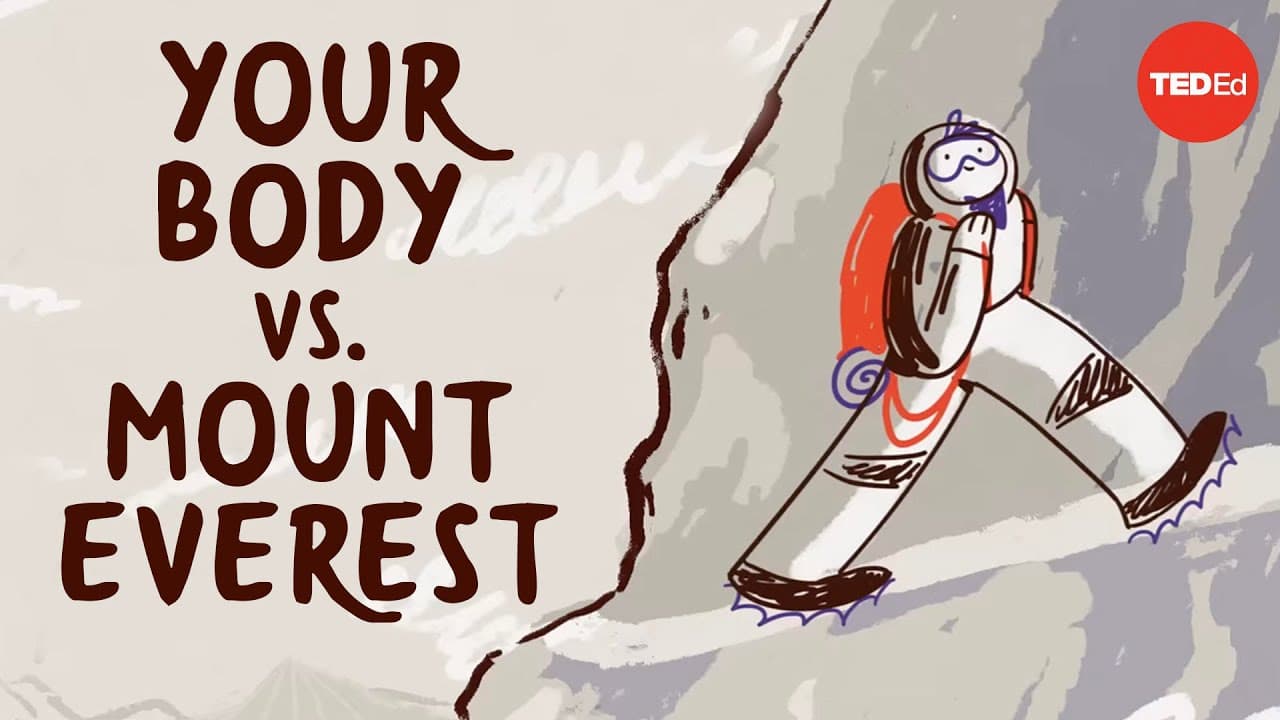
What happens to your body at the top of Mount Everest - Andrew Lovering
1.3M views
•
June 28, 2022
by
TED-Ed
YouTube video player
What happens to your body at the top of Mount Everest - Andrew Lovering

TL;DR

Adapting to high altitudes involves physiological changes like increased heart rate and hemoglobin levels to carry more oxygen.

Transcript

If someone teleported from sea level to the top of Mt. Everest, things would go bad fast. At an altitude of 8,848 meters, barometric pressure is approximately 33% of what it is at sea level. This means there's significantly less oxygen in the air, and our teleported individual would likely suffocate in minutes. However, for people that make this sa... Read More

Key Insights

  • ✋ Altitude sickness can occur due to oxygen deprivation at high altitudes.
  • 🥰 The body adapts by increasing heart rate, breathing, and hemoglobin levels.
  • 🥺 Extended acclimatization leads to further adaptations for efficient oxygen distribution.
  • ✋ Risks associated with high altitudes include AMS, HACE, and HAPE.
  • 🖐️ Genetics can play a role in reducing minor altitude sickness risks.
  • ✋ Proper acclimatization is crucial before ascending to higher altitudes.
  • ✋ Climbers have pushed past human limitations to reach high altitudes.

Install to Summarize YouTube Videos and Get Transcripts

Explore YouTube Video Summarizer or Get YouTube Transcript Extractor

Questions & Answers

Q: How does the body adapt to high altitudes?

The body initially increases heart rate and breathing to counter oxygen deprivation, while over time, hemoglobin levels rise for more efficient oxygen distribution.

Q: What are the risks associated with high altitude climbing?

Climbers face risks of altitude sickness, such as AMS, HACE, and HAPE, which can be life-threatening if not addressed promptly.

Q: How do genetics play a role in adapting to high altitudes?

Some individuals with genetic advantages from high-altitude living can have a reduced risk of minor altitude sickness, but even they are not immune to severe conditions like HACE and HAPE.

Q: Why is it important to acclimatize before ascending to higher altitudes?

Proper acclimatization allows the body to make physiological adaptations like increased hemoglobin levels and efficient oxygen distribution, reducing the risk of altitude sickness.

Summary & Key Takeaways

  • At high altitudes, the lack of oxygen can cause altitude sickness, but the body can adapt over time.

  • Initially, the body increases heart rate and breathing to counter oxygen deprivation.

  • Extended acclimatization leads to higher hemoglobin levels and efficient oxygen distribution.


Read in Other Languages (beta)

English

Share This Summary 📚

Summarize YouTube Videos and Get Video Transcripts with 1-Click

Download browser extensions on:

Try YouTube Summary with ChatGPT & Claude or YouTube Transcript Generator

Explore More Summaries from TED-Ed 📚
Why do we dream? - Amy Adkins thumbnail
Why do we dream? - Amy Adkins
TED-Ed
3 tips to boost your confidence - TED-Ed thumbnail
3 tips to boost your confidence - TED-Ed
TED-Ed
What is bipolar disorder? - Helen M. Farrell thumbnail
What is bipolar disorder? - Helen M. Farrell
TED-Ed
If superpowers were real: Immortality - Joy Lin thumbnail
If superpowers were real: Immortality - Joy Lin
TED-Ed
Can you solve the unstoppable blob riddle? - Dan Finkel thumbnail
Can you solve the unstoppable blob riddle? - Dan Finkel
TED-Ed
Can you solve the river crossing riddle? - Lisa Winer thumbnail
Can you solve the river crossing riddle? - Lisa Winer
TED-Ed

Summarize YouTube Videos and Get Video Transcripts with 1-Click

Download browser extensions on:

Try YouTube Summary with ChatGPT & Claude or YouTube Transcript Generator

Apps & Extensions

  • Chrome Extension
  • Safari Extension
  • Edge Add-ons
  • Firefox Add-ons
  • iOS App
  • Android App

Key Features

  • YouTube Video Summarizer
  • Web & PDF Summarizer
  • Web & PDF Highlighter
  • Chat with PDF
  • Ask AI Clone
  • Audio Transcriber
  • Glasp Reader
  • Kindle Highlight Export
  • Idea Hatch

Integrations

  • Obsidian Plugin
  • Notion Integration
  • Pocket Integration
  • Instapaper Integration
  • Medium Integration
  • Readwise Integration
  • Snipd Integration
  • Hypothesis Integration

More Features

  • APIs
  • MCP Connector
  • Blog & Post
  • Embed Links
  • Image Highlight
  • Personality Test
  • Quote Shots

Company

  • About us
  • Blog
  • Community
  • FAQs
  • Job Board
  • Newsletter
  • Pricing
Terms

•

Privacy

•

Guidelines

© 2026 Glasp Inc. All rights reserved.