Wake and Wake Formation - Compressible Flow - Fluid Mechanics
TL;DR
This video explains the concept of wake formation around curved surfaces and its effects on the boundary layer.
Transcript
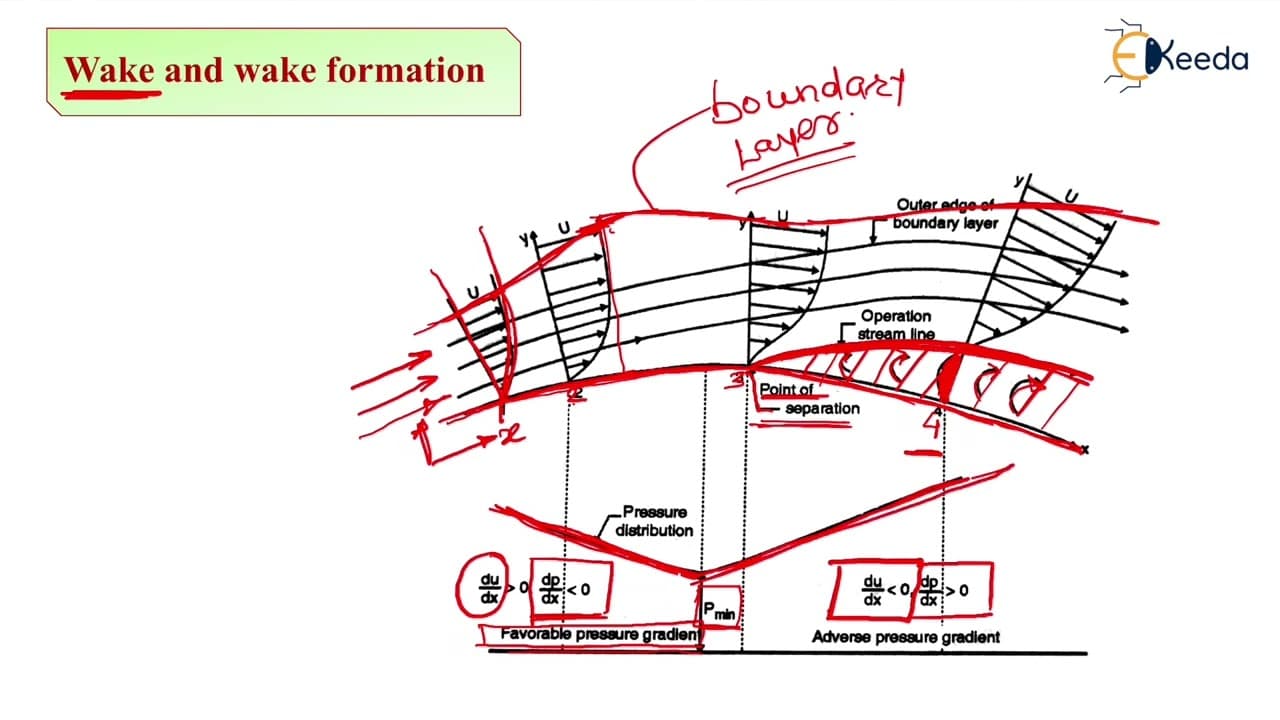
hello friends in this video we are going to study the new concept in boundary layer that is wake and its formation so let's start with video we are going to study the topic wake and its formation this wake and wake formation occurs around a curved surface when exposed to the fluid flow say for example this is the surface of either sphere or any oth... Read More
Key Insights
- 🥺 Wake formation occurs when fluid flows around curved surfaces, leading to the separation of fluid from the surface.
- 😘 The point of separation is where fluid separates from the object's boundary, resulting in minimal drag forces and low pressure.
- 👻 Wakes are recirculation regions behind the surface that grow due to diffusion and allow the entry of other fluid waves.
- ❎ The velocity distribution has a parabolic nature in the boundary layer, while it becomes negative in the wake region.
- 😥 Pressure distribution decreases up to the point of separation and then increases in the wake region.
- 🙃 Wake formation affects both drag and lift forces, creating pressure differences between upstream and downstream sides.
- ❓ The effects of pressure gradient on the boundary layer depend on the curvature and can result in gradual velocity increase or retardation.
Install to Summarize YouTube Videos and Get Transcripts
Explore YouTube Video Summarizer or Get YouTube Transcript Extractor
Questions & Answers
Q: What is wake formation?
Wake formation occurs around curved surfaces when fluid flows around them, leading to the separation of fluid from the surface and the formation of recirculation regions known as wakes.
Q: What happens at the point of separation?
At the point of separation, no drag forces act on the fluid, causing the pressure to reach its minimum value. This separation leads to the formation of wakes behind the surface.
Q: How does wake formation affect pressure distribution?
The pressure decreases up to the point of separation and then increases in the wake region. This pressure difference creates higher pressure zones upstream and lower pressure zones downstream.
Q: What are the effects of pressure gradient on the boundary layer?
Depending on the curvature, three cases are possible: gradual increase in velocity and drop in pressure, flow retardation and pressure increase, and continuous retardation with opposite flow in the wake region.
Summary & Key Takeaways
-
The video discusses the formation of wakes around curved surfaces when exposed to fluid flow.
-
It explains the velocity distribution and boundary layer thickness along the surface.
-
The video also covers the point of separation, pressure distribution, and the formation of recirculation regions called wakes.
Read in Other Languages (beta)
Share This Summary 📚
Summarize YouTube Videos and Get Video Transcripts with 1-Click
Try YouTube Summary with ChatGPT & Claude or YouTube Transcript Generator
Explore More Summaries from Ekeeda 📚





Summarize YouTube Videos and Get Video Transcripts with 1-Click
Try YouTube Summary with ChatGPT & Claude or YouTube Transcript Generator