Learn JWT in 10 Minutes with Express, Node, and Cookie Parser
TL;DR
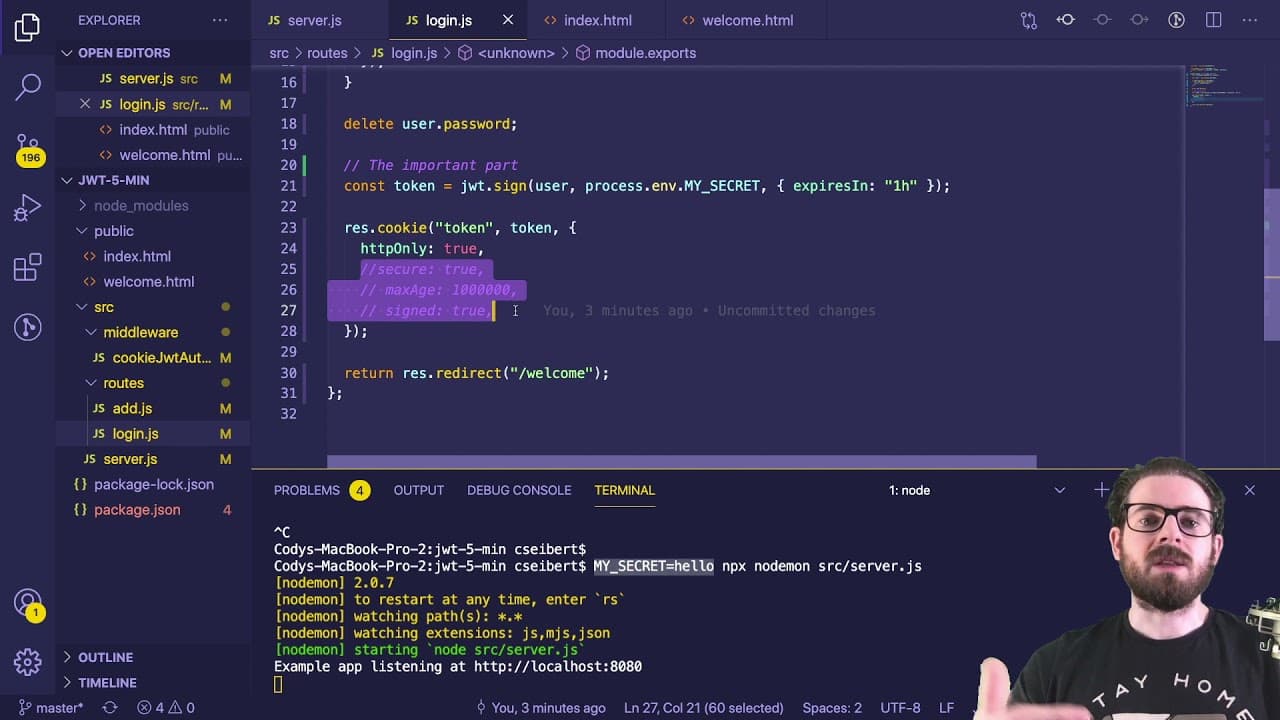
This video explains how to implement JWT authentication in a Node and Express application.
Transcript
hey everyone i hope you guys are having a great day welcome back to another webdav junkie video and so in this video i want to give you a five minute overview of how you can use jwt with an example of using a node in express but you can take these ideas and apply to whatever language you want like python and django php and laravel but let's just di... Read More
Key Insights
- 👤 JWT is a decentralized authentication method enabling stateless authentication in web applications, simplifying user session management.
- 👤 Implementing an expiration policy for JWT tokens is essential for enhancing security and ensuring that users regularly authenticate themselves.
- 🥠 The cookie management during the authentication process ensures that tokens are securely transmitted with each request, minimizing security risks.
- 😒 The use of libraries for signing and verifying JWT tokens simplifies the implementation process, allowing developers to focus on application logic.
- 🤩 Secure handling of the secret key used for signing JWTs is crucial; it should not be exposed or hardcoded within the application.
- 🤩 Understanding the components of JWT is key for developers as it aids in debugging and validating the token's authenticity.
- 👤 Token authentication can significantly improve user experience by reducing the frequency of logins while maintaining security.
Install to Summarize YouTube Videos and Get Transcripts
Explore YouTube Video Summarizer or Get YouTube Transcript Extractor
Questions & Answers
Q: What is the primary purpose of using JWT in web applications?
JWT, or JSON Web Token, is used to securely transmit information between parties as a JSON object. It's commonly employed for authentication, allowing users to verify their identity and gain access to protected resources without needing to resubmit their credentials frequently.
Q: How does the token signing process work in the example provided?
In the application, after a successful login, the server retrieves the user's data and calls the JWT sign function, which creates a token by combining the user's information with a secret key and generates a hash. This token is then sent back to the client for future authenticated requests.
Q: Why is it important to set an expiration time for JWT tokens?
Setting an expiration time helps enhance security by minimizing the risk of token misuse. By limiting how long a token is valid, you reduce the window of opportunity for attackers to use stolen tokens, encouraging users to log in more frequently and thereby reducing potential exposure.
Q: What happens if a token expires or is invalid?
If a token is expired or invalid, any attempted access to a protected route will usually redirect the user back to the login page after clearing the token cookie. This helps maintain secure sessions and protect user data from unauthorized access.
Q: How can JWT tokens be structured, and what components do they have?
JWT tokens consist of three main parts: a header that typically identifies the signing algorithm, a payload that contains the claims or user information, and a signature created by encoding the header and payload with a secret key. This structure allows for easy verification of token integrity.
Q: What role does the cookie play in the authentication process?
The cookie stores the JWT after it is generated, allowing the browser to include the token in subsequent requests to secured endpoints. This way, the server can verify the user's identity without the need for resending credentials each time.
Q: Why is using HttpOnly cookies recommended for storing JWTs?
HttpOnly cookies help protect tokens by preventing client-side scripts from accessing them, thereby reducing the risk of cross-site scripting (XSS) attacks. This feature adds an extra layer of security to your application by limiting exposure to potential vulnerabilities.
Q: How can developers debug and inspect JWT tokens?
Developers can use online tools like jwt.io to decode and inspect JWT tokens. By pasting the token into such tools, users can view its header, payload, and signature components, helping them understand the token's structure and validate it against expected values.
Summary & Key Takeaways
-
The video presents a quick overview of how to use JSON Web Tokens (JWT) within a Node and Express application for user authentication, focusing on a login route and a secured add route.
-
The JWT signing process is detailed, including how the server checks user credentials, signs a token, and sets an HTTP-only cookie for secure communication in future requests.
-
Additional insights are shared regarding how JWT tokens are structured, their expiration, and ways to handle token validation and invalidation.
Read in Other Languages (beta)
Share This Summary 📚
Summarize YouTube Videos and Get Video Transcripts with 1-Click
Try YouTube Summary with ChatGPT & Claude or YouTube Transcript Generator
Explore More Summaries from Web Dev Cody 📚


Summarize YouTube Videos and Get Video Transcripts with 1-Click
Try YouTube Summary with ChatGPT & Claude or YouTube Transcript Generator