Electromagnetic Induction (3 of 15) Faraday's Law, An Explanation, No. 1
TL;DR
Faraday's Law states induced voltage equals change in flux over time, influenced by coil area, magnetic field strength, time, and number of windings.
Transcript
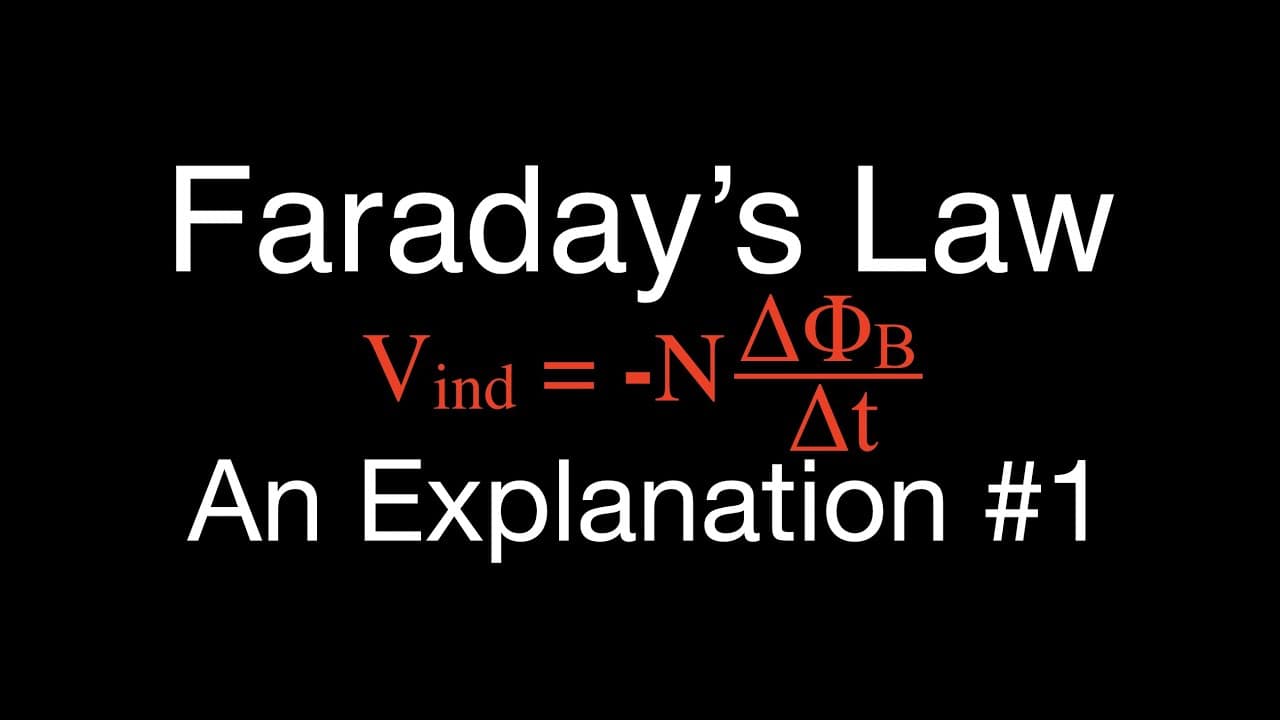
okay that's right you guessed it in today's video we're going to be talking about an explanation of Faraday's law and this is the equation we use for Faraday's law this is Faraday's law it says that the induced voltage or the induced EMF is equal to minus n times the change in the flux divided by the change in the time okay so this is Faraday's law... Read More
Key Insights
- ⌛ Faraday's Law relates induced voltage in a coil to the change in magnetic flux over time.
- 🧑🏭 The equation for Faraday's Law includes factors like coil area, magnetic field strength, time, and number of windings.
- 🧑🏭 A direct relationship exists between induced voltage and factors like coil area and magnetic field strength.
- ⌛ There is an inverse relationship between induced voltage and time duration.
- ❓ Lenz's Law complements Faraday's Law by defining the direction of induced current.
- ❓ Understanding the principles of Faraday's Law is crucial in analyzing electromagnetic induction scenarios.
- ⚡ Changing the number of windings in a coil significantly impacts the induced voltage magnitude.
Install to Summarize YouTube Videos and Get Transcripts
Explore YouTube Video Summarizer or Get YouTube Transcript Extractor
Questions & Answers
Q: What is Faraday's Law and how does it explain induced voltage in a coil?
Faraday's Law states that changing magnetic flux in a coil induces a voltage, determined by factors like coil area, magnetic field strength, and time. It defines the relationship between these variables in generating an induced voltage.
Q: How does Faraday's Law relate to Lenz's Law?
Faraday's Law and Lenz's Law are interrelated concepts in electromagnetism. Lenz's Law states that the direction of the induced current opposes the change in magnetic flux, which is reflected in the negative sign in Faraday's Law's formula.
Q: What is the significance of the number of windings in Faraday's Law?
The number of windings in a coil affects the induced voltage directly. Increasing the number of windings results in a higher induced voltage, showcasing the importance of this factor in electromagnetic induction.
Q: How do changes in magnetic field strength, area, time, and number of windings impact induced voltage?
Changing the magnetic field strength or area within a coil, altering the time duration, or increasing the number of windings affects the magnitude of induced voltage in accordance with direct or inverse relationships specified by Faraday's Law.
Summary & Key Takeaways
-
Faraday's Law explains how an induced voltage is generated in a coil by changing magnetic flux over time.
-
Factors affecting induced voltage include coil area, magnetic field strength, time, and number of windings.
-
Changing these factors alters the induced voltage according to direct or inverse relationships.
Read in Other Languages (beta)
Share This Summary 📚
Summarize YouTube Videos and Get Video Transcripts with 1-Click
Try YouTube Summary with ChatGPT & Claude or YouTube Transcript Generator
Explore More Summaries from Step by Step Science 📚

Summarize YouTube Videos and Get Video Transcripts with 1-Click
Try YouTube Summary with ChatGPT & Claude or YouTube Transcript Generator