Rectangular Cavity Resonator - Microwave Resonators - Microwave Engineering
TL;DR
This video discusses rectangular cavity resonators in microwave engineering, covering their construction, electromagnetic field equations, excitation techniques, and resonant frequency calculation.
Transcript
click the bell icon to get latest videos from akira hello friends i welcome you all to this video we are with the chapter of microwave resonators in the subject microwave engineering so far in this chapter we have dealt with the parallel and series type of resonant circuits involving certain lumped elements and now we also have analyzed the short c... Read More
Key Insights
- 😚 Rectangular cavity resonators are created by closing both ends of a rectangular waveguide with short-circuiting plates.
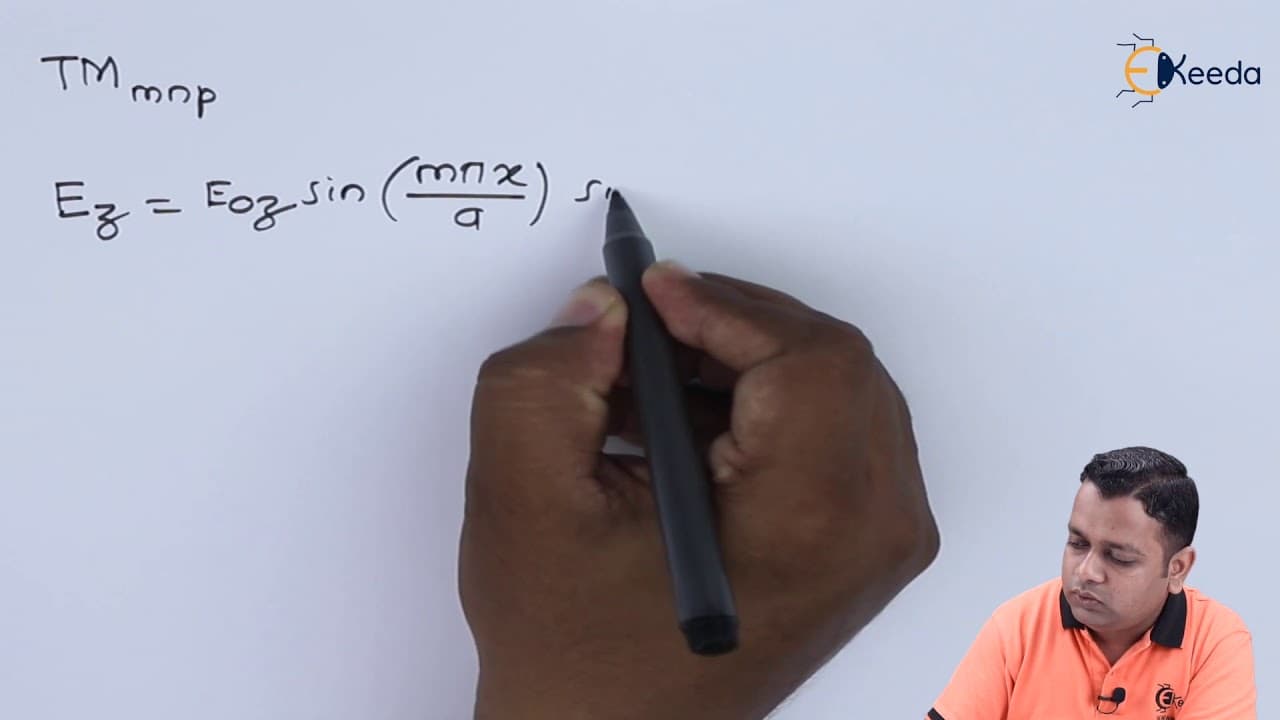
- 🏑 The electromagnetic field equations for TE and TM modes in rectangular cavity resonators involve trigonometric functions for different directions.
- ❓ The resonant frequency of rectangular cavity resonators can be calculated using the dimensions of the cavity.
Install to Summarize YouTube Videos and Get Transcripts
Explore YouTube Video Summarizer or Get YouTube Transcript Extractor
Questions & Answers
Q: How are rectangular cavity resonators created from a rectangular waveguide?
Rectangular cavity resonators are created by closing both ends of a rectangular waveguide with short-circuiting plates, leaving a hollow space inside for resonance.
Q: What are the electromagnetic field equations for transverse electric (TE) mode in rectangular cavity resonators?
The electromagnetic field equations for TE mode in rectangular cavity resonators involve trigonometric functions for the X and Y directions and a sine function for the Z direction, with the constants M, N, and P representing the number of hop cycles in each direction.
Q: How is the resonant frequency of rectangular cavity resonators calculated?
The resonant frequency (F) of rectangular cavity resonators is calculated using the dimensions of the cavity (A, B, and D) and the constants M, N, and P. The equation is F = 1 / (2π sqrt(με)) * sqrt((M²/A²) + (N²/B²) + (P²/D²)).
Q: What are the excitation techniques for rectangular cavity resonators?
Two excitation techniques for rectangular cavity resonators are RF coaxial coupling and input from the top wall of the cavity. These techniques allow for the introduction of microwave energy into the resonator.
Summary & Key Takeaways
-
The video introduces rectangular cavity resonators, which are created by closing both ends of a rectangular waveguide with short-circuiting plates.
-
The electromagnetic field equations for transverse electric (TE) and transverse magnetic (TM) modes in rectangular cavity resonators are explained.
-
The resonant frequency of rectangular cavity resonators can be calculated using the dimensions of the cavity.
-
Two excitation techniques for rectangular cavity resonators, RF coaxial coupling and input from the top wall, are discussed.
Read in Other Languages (beta)
Share This Summary 📚
Summarize YouTube Videos and Get Video Transcripts with 1-Click
Try YouTube Summary with ChatGPT & Claude or YouTube Transcript Generator
Explore More Summaries from Ekeeda 📚



Summarize YouTube Videos and Get Video Transcripts with 1-Click
Try YouTube Summary with ChatGPT & Claude or YouTube Transcript Generator