What Is Electrolysis and How Does It Work?
TL;DR
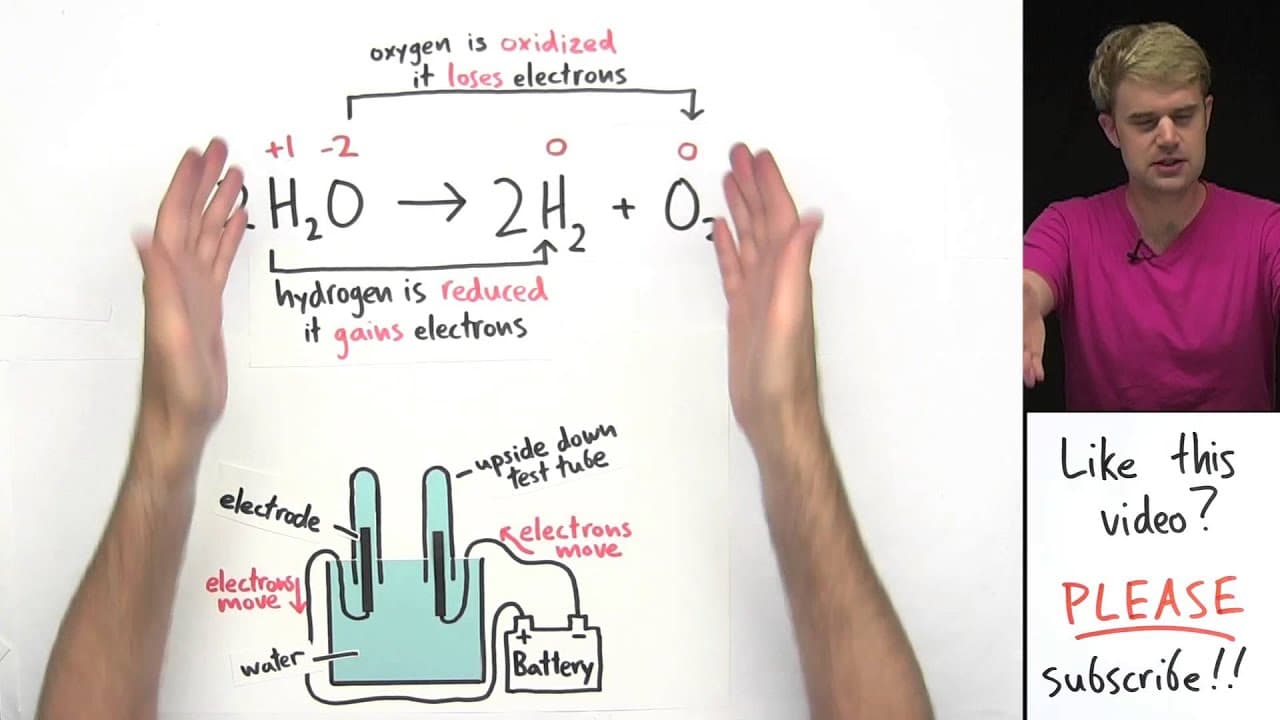
Electrolysis is a process that uses electricity to drive a non-spontaneous chemical reaction, breaking compounds like sodium chloride into sodium metal and chlorine gas or water into hydrogen and oxygen gases. It occurs in an electrolytic cell, with reduction happening at the cathode (where electrons are gained) and oxidation at the anode (where electrons are lost).
Transcript
let's talk about the chemical process of electrolysis I wanted to try to write the simplest definition that I could so here's what I came up with electrolysis is a process where electricity is used to make a chemical change happen that wouldn't happen otherwise so we have some kind of a chemical change that doesn't happen on its own but then we can... Read More
Key Insights
- 😒 Electrolysis is a process that uses electricity to induce non-spontaneous chemical reactions.
- 🍳 It is commonly used to break down compounds into their constituent elements.
- 🫢 In the electrolysis of sodium chloride, sodium metal and chlorine gas are produced.
- 🫢 In the electrolysis of water, hydrogen gas and oxygen gas are produced in a ratio of 2:1.
- 🔋 Electrolysis requires an electrolytic cell with electrodes (anode and cathode) connected to a battery.
- 😚 The cathode is the site of reduction, where electrons are gained, while the anode is the site of oxidation, where electrons are lost.
- ❓ The process of electrolysis is not spontaneous and requires external electrical energy.
Install to Summarize YouTube Videos and Get Transcripts
Explore YouTube Video Summarizer or Get YouTube Transcript Extractor
Questions & Answers
Q: What is electrolysis?
Electrolysis is a process that employs electricity to bring about a chemical change that would not occur naturally. It is often used to break down compounds into their constituent elements.
Q: How is electrolysis used to break down sodium chloride?
In the electrolysis of sodium chloride, the compound is split into sodium metal and chlorine gas. Sodium gains electrons (reduction) at the cathode, while chlorine loses electrons (oxidation) at the anode.
Q: Why is it necessary to use electricity in electrolysis?
The chemical reactions involved in electrolysis, such as the decomposition of sodium chloride, do not occur spontaneously. Electricity is utilized to force these reactions to happen by supplying the necessary energy.
Q: What are the key components of an electrolytic cell?
An electrolytic cell used for electrolysis consists of a container filled with the compound to be electrolyzed, electrodes (anode and cathode) connected to a battery, and an electrolyte (such as sulfuric acid) to allow the flow of electricity.
Q: Why do we get more hydrogen gas than oxygen gas in the electrolysis of water?
The balanced chemical equation for the electrolysis of water shows a ratio of two hydrogen molecules (H2) to one oxygen molecule (O2). This means that for every two hydrogen molecules produced, only one oxygen molecule is formed, resulting in a higher yield of hydrogen gas.
Summary & Key Takeaways
-
Electrolysis is a process that uses electricity to induce a chemical change that wouldn't happen naturally.
-
It is commonly used to break down compounds into their elemental components, such as sodium chloride into sodium metal and chlorine gas, or water into hydrogen gas and oxygen gas.
-
The process involves the transfer of electrons from the cathode (site of reduction) to the anode (site of oxidation) in an electrolytic cell.
Read in Other Languages (beta)
Share This Summary 📚
Summarize YouTube Videos and Get Video Transcripts with 1-Click
Try YouTube Summary with ChatGPT & Claude or YouTube Transcript Generator
Explore More Summaries from Tyler DeWitt 📚

Summarize YouTube Videos and Get Video Transcripts with 1-Click
Try YouTube Summary with ChatGPT & Claude or YouTube Transcript Generator