Atomic Number, Mass Number, and Net Charge
TL;DR
This content discusses the characteristics of atoms, including atomic number and mass number, as well as explaining net charge and the concept of ions.
Transcript
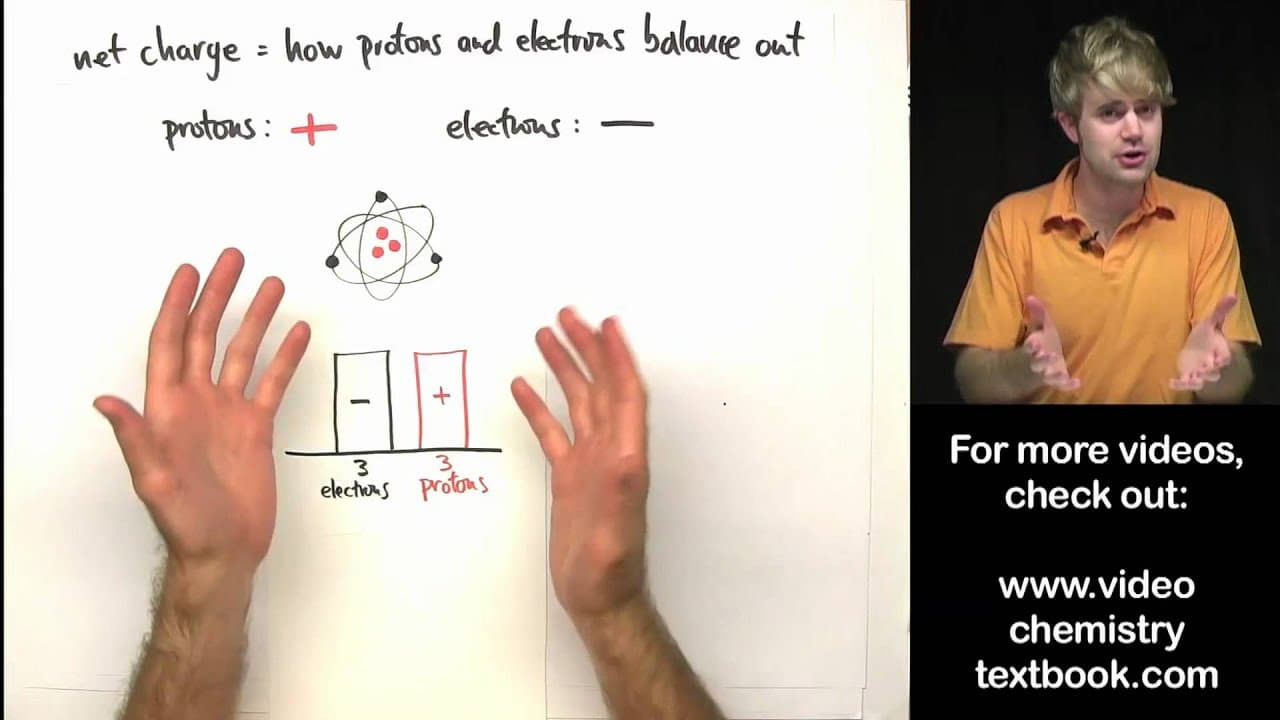
here's a diagram of an atom it's not perfectly accurate but for what we need right now it's going to do just fine so in this lesson we're going to look at characteristics that we can use to describe atoms like this one you know if somebody asked you to describe a person chances are you'd use characteristics like the color of their hair the color of... Read More
Key Insights
- 🫀 The atomic number determines the type of atom and its position on the periodic table.
- 🫀 Mass number is the sum of protons and neutrons, representing an atom's atomic mass.
- 😐 Net charge is the result of an imbalance between protons and electrons, determining whether an atom is neutral or an ion.
- 😑 Ions can be positively or negatively charged, depending on the excess or deficiency of electrons.
- 🫀 Atoms with a net charge are referred to as ions, while neutral atoms have no net charge.
- 🈂️ Protons have a positive charge, electrons have a negative charge, and neutrons have no charge.
- 🫀 The net charge of an atom can be calculated by comparing the number of protons and electrons.
Install to Summarize YouTube Videos and Get Transcripts
Explore YouTube Video Summarizer or Get YouTube Transcript Extractor
Questions & Answers
Q: What is the atomic number of an atom and why is it important?
The atomic number is the number of protons in an atom's nucleus. It is crucial because it determines the type of atom and its position in the periodic table.
Q: How is mass number different from atomic number?
Mass number is the sum of protons and neutrons in an atom's nucleus. It helps determine an atom's atomic mass and is not the same as the atomic number.
Q: How do protons and electrons balance each other out in an atom?
Protons have a positive charge, while electrons have a negative charge. If an atom has the same number of protons and electrons, they balance each other out, resulting in a neutral atom.
Q: What is an ion, and how is it different from a neutral atom?
An ion is an atom that has a net charge. It can be positive or negative, depending on the imbalance between protons and electrons. A neutral atom has no net charge.
Summary & Key Takeaways
-
Atoms can be described using characteristics such as atomic number, which is the number of protons in the nucleus.
-
Mass number refers to the number of protons and neutrons in an atom.
-
Net charge is determined by the balance between protons and electrons, and atoms with a net charge are called ions.
Read in Other Languages (beta)
Share This Summary 📚
Summarize YouTube Videos and Get Video Transcripts with 1-Click
Try YouTube Summary with ChatGPT & Claude or YouTube Transcript Generator
Explore More Summaries from Tyler DeWitt 📚
Summarize YouTube Videos and Get Video Transcripts with 1-Click
Try YouTube Summary with ChatGPT & Claude or YouTube Transcript Generator