What Are Vector Databases and Their Uses?
TL;DR
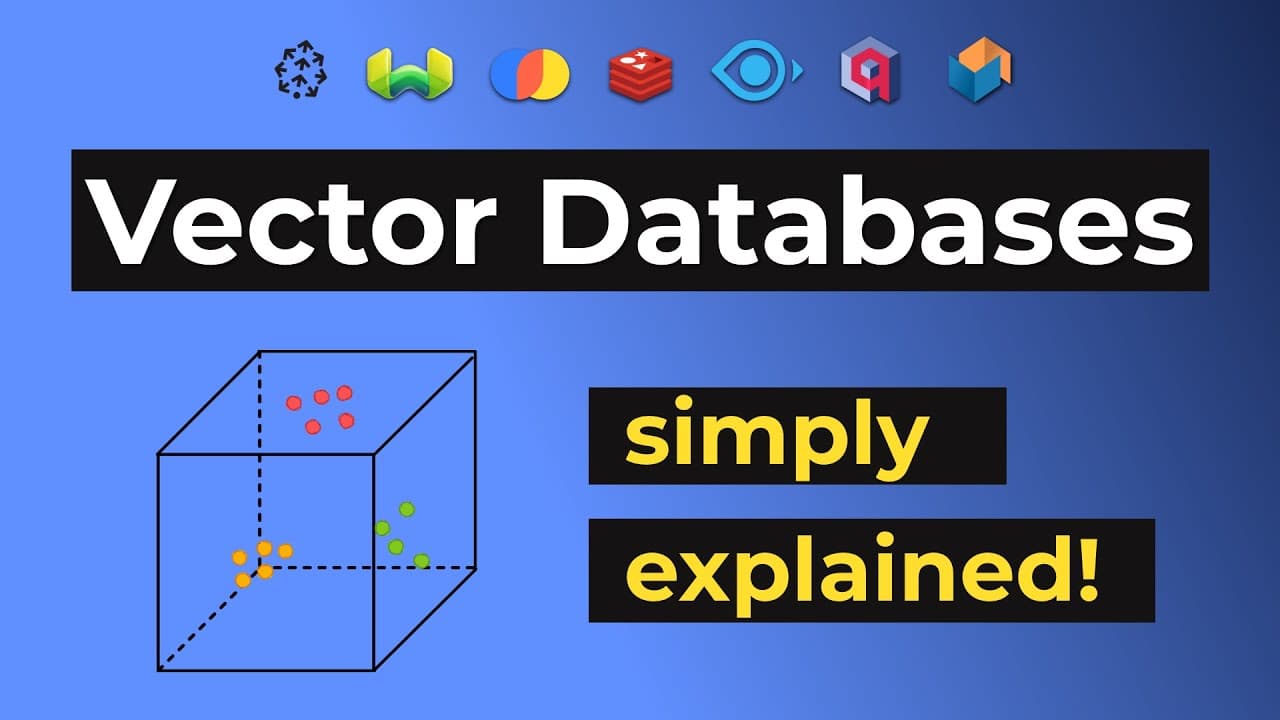
Vector databases enable the storage and fast retrieval of vector embeddings, which represent unstructured data like images and text. They employ indexing for efficient searching and are used in applications such as semantic search, similarity searches, and enhancing large language models with long-term memory.
Transcript
recently Vector databases got a lot of Fame with companies raising hundreds of millions of dollars to build them and people calling it a new kind of database for the AI era on the other hand for many projects it might be an Overkill solution and using a traditional database or even just a numpy ND array might work just fine but there is no doubt th... Read More
Key Insights
- 🙈 Vector databases are gaining popularity and funding, seen as a crucial tool for the AI era.
- 🍵 Over 80% of data is unstructured, making traditional databases inefficient for handling it.
- 👻 Vector embeddings allow for the representation of unstructured data in a numeric form.
- 👨🔬 Indexing is necessary to enable efficient search processes in vector databases.
- 👨🔬 Applications of vector databases include equipping language models, semantic search, similarity search, and recommendation engines.
Install to Summarize YouTube Videos and Get Transcripts
Explore YouTube Video Summarizer or Get YouTube Transcript Extractor
Questions & Answers
Q: Why is it challenging to store unstructured data like images or audio in a relational database?
Unstructured data like images or audio cannot be easily fitted into a relational database because pixel values or audio data alone cannot be used to search for similar items. Manual assignment of tags or attributes is often required.
Q: How do vector embeddings work?
Vector embeddings are numerical representations of data that capture its characteristics. They can be calculated for single words, sentences, or even entire images using machine learning models.
Q: Why are indexes necessary in vector databases?
Indexes are crucial for efficient searching in vector databases. They map vectors to a new data structure that enables faster search processes based on distance metrics, making large-scale searches feasible.
Q: What are some practical use cases for vector databases?
Some use cases include equipping large language models with long-term memory, semantic search based on meaning or context, similarity search for multimedia data, and recommendation engines for personalized suggestions.
Key Insights:
- Vector databases are gaining popularity and funding, seen as a crucial tool for the AI era.
- Over 80% of data is unstructured, making traditional databases inefficient for handling it.
- Vector embeddings allow for the representation of unstructured data in a numeric form.
- Indexing is necessary to enable efficient search processes in vector databases.
- Applications of vector databases include equipping language models, semantic search, similarity search, and recommendation engines.
- Popular vector databases include Pinecone, vva8, Chroma, Redis, Cool.trans, Milvus, and Vespa AI.
Summary & Key Takeaways
-
Vector databases store vector embeddings, which are numerical representations of data generated by machine learning models.
-
These databases are essential for efficient searching and retrieval, as they use indexes to map vectors and enable fast search processes.
-
Vector databases have various applications, such as equipping large language models with long-term memory, semantic search, similarity search for multimedia data, and recommendation engines.
Read in Other Languages (beta)
Share This Summary 📚
Summarize YouTube Videos and Get Video Transcripts with 1-Click
Try YouTube Summary with ChatGPT & Claude or YouTube Transcript Generator
Explore More Summaries from AssemblyAI 📚






Summarize YouTube Videos and Get Video Transcripts with 1-Click
Try YouTube Summary with ChatGPT & Claude or YouTube Transcript Generator