How Should U.S. Respond to China, Russia, Iran, North Korea?
TL;DR
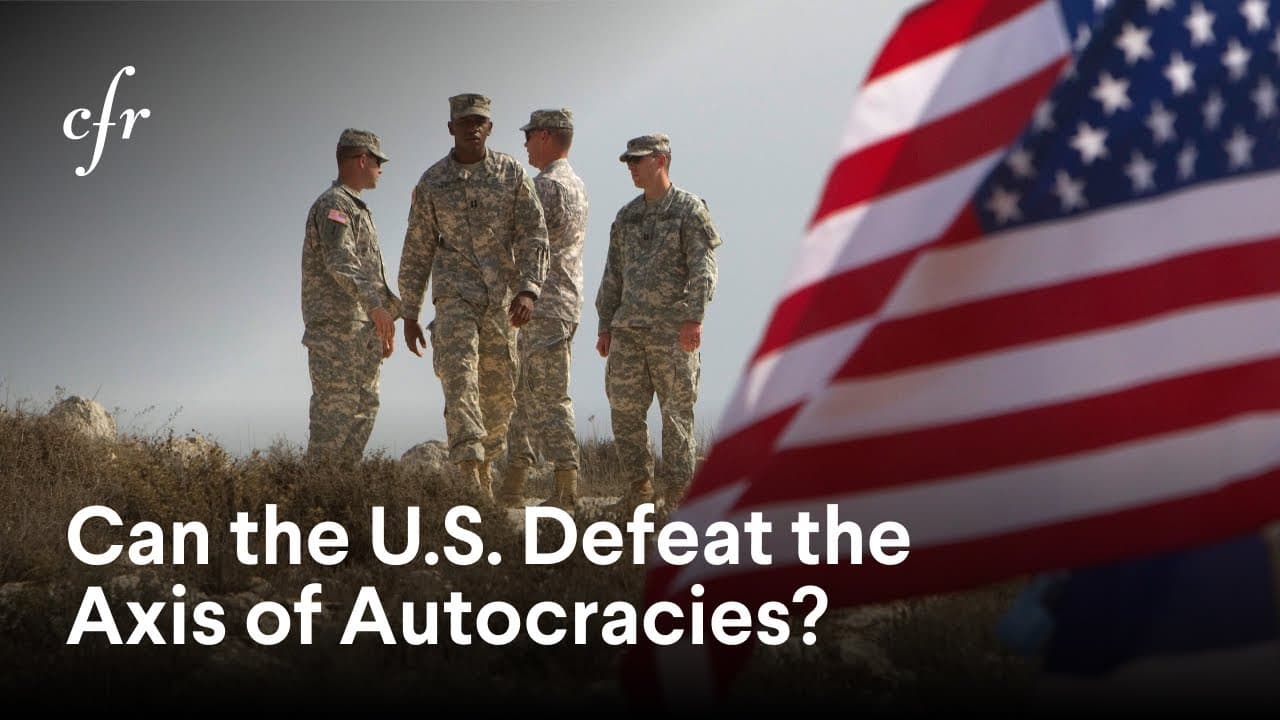
The U.S. faces a complex challenge from the alignment of China, Russia, Iran, and North Korea. This alignment, referred to as the Axis of Autocracies, requires a nuanced response that considers the evolving global power dynamics and the internal policies of these nations. The U.S. must balance its foreign policy approach, considering both traditional alliances and new geopolitical realities.
Transcript
NOSSEL: (Off mic)—Suzanne Nossel. I’m delighted to be here. I’m presiding over this discussion with Heather Conley and Ivo Daalder. We’re going to bring home this fascinating seminar that’s been taking place this afternoon. Just to kick it off for both of you, do you think this notion of a kind of quadrangle of authoritarian powers—China, Russia... Read More
Key Insights
- The alignment of China, Russia, Iran, and North Korea is referred to as the Axis of Autocracies.
- The U.S. must reconsider its traditional alliances and strategies in response to this new geopolitical challenge.
- Power is not just a resource but a relationship, requiring nuanced diplomatic strategies.
- The Biden administration's approach differs from previous administrations, focusing less on internal state characteristics.
- A multipolar world is emerging, with shifting alliances and power dynamics.
- European countries are reevaluating their roles and alliances in response to the U.S. and China.
- The U.S. must address internal political polarization to effectively engage in global diplomacy.
- Immigration and demographic changes are critical factors influencing global economic and political landscapes.
Install to Summarize YouTube Videos and Get Transcripts
Explore YouTube Video Summarizer or Get YouTube Transcript Extractor
Questions & Answers
Q: How should the U.S. respond to the alignment of China, Russia, Iran, and North Korea?
The U.S. should adopt a nuanced foreign policy that considers the evolving power dynamics and the internal characteristics of these nations. This includes strengthening traditional alliances, engaging in multilateral diplomacy, and addressing internal political polarization to effectively project power and influence on the global stage.
Q: What is the Axis of Autocracies?
The Axis of Autocracies refers to the alignment and cooperation between China, Russia, Iran, and North Korea. This group poses a strategic challenge to U.S. national security and global influence, requiring a reevaluation of traditional alliances and foreign policy strategies.
Q: Why is understanding power as a relationship important?
Understanding power as a relationship highlights the importance of diplomatic engagement and alliance-building. Power is not just a resource to be accumulated but involves complex interactions and dependencies between nations. This perspective is crucial for effectively navigating global geopolitical challenges.
Q: How does the Biden administration's approach differ from previous administrations?
The Biden administration focuses less on the internal characteristics of states and more on balancing power dynamics. This approach contrasts with previous administrations that emphasized values-based alliances and democratic norms, reflecting a shift towards a more pragmatic and multipolar foreign policy.
Q: What role do European countries play in the current geopolitical landscape?
European countries are reevaluating their roles and alliances in response to the U.S. and China's shifting power dynamics. They are exploring new partnerships and strategies to maintain security and economic stability, often balancing between traditional alliances and emerging global realities.
Q: How does political polarization affect U.S. foreign policy?
Political polarization complicates U.S. foreign policy by creating inconsistencies and unpredictability in international engagements. It undermines bipartisan support for strategic initiatives, making it challenging to maintain stable alliances and effectively project power on the global stage.
Q: Why is immigration important for global economic and political landscapes?
Immigration is crucial for addressing demographic challenges in advanced democracies. It provides skilled labor necessary for economic growth and innovation. As populations age and birth rates decline, attracting talent through immigration becomes vital for sustaining economic and political influence globally.
Q: What challenges do advanced democracies face regarding demographics?
Advanced democracies face challenges such as aging populations and declining birth rates, which threaten economic stability and growth. To address these challenges, countries must compete for skilled immigrants to maintain a dynamic workforce and sustain their economic and political influence.
Summary & Key Takeaways
-
The U.S. faces a strategic challenge from the Axis of Autocracies, comprising China, Russia, Iran, and North Korea. This alignment necessitates a reevaluation of U.S. foreign policy and alliances, considering both traditional and emerging power dynamics. The discussion explores how the U.S. can respond to these threats while maintaining its global influence and security.
-
Panelists highlight the importance of understanding power as a relationship, not just a resource. The U.S. must engage diplomatically, balancing its approach between traditional alliances and new geopolitical realities. This includes addressing internal political polarization and ensuring effective governance to maintain global leadership.
-
The discussion also emphasizes the role of immigration and demographic shifts in shaping global economic and political landscapes. As advanced democracies face demographic challenges, the competition for talent and skilled immigration becomes increasingly important. The U.S. must navigate these complexities to sustain its economic and political influence.
Read in Other Languages (beta)
Share This Summary 📚
Summarize YouTube Videos and Get Video Transcripts with 1-Click
Try YouTube Summary with ChatGPT & Claude or YouTube Transcript Generator
Explore More Summaries from Council on Foreign Relations 📚


Summarize YouTube Videos and Get Video Transcripts with 1-Click
Try YouTube Summary with ChatGPT & Claude or YouTube Transcript Generator