Numerical of Chapter 5 - Ground Water and Well Hydraulics - Water Resource Engineering 1
TL;DR
This video discusses numerical problems related to groundwater analysis, including determining the coefficient of permeability and calculating specific yield and volume of recharge.
Transcript
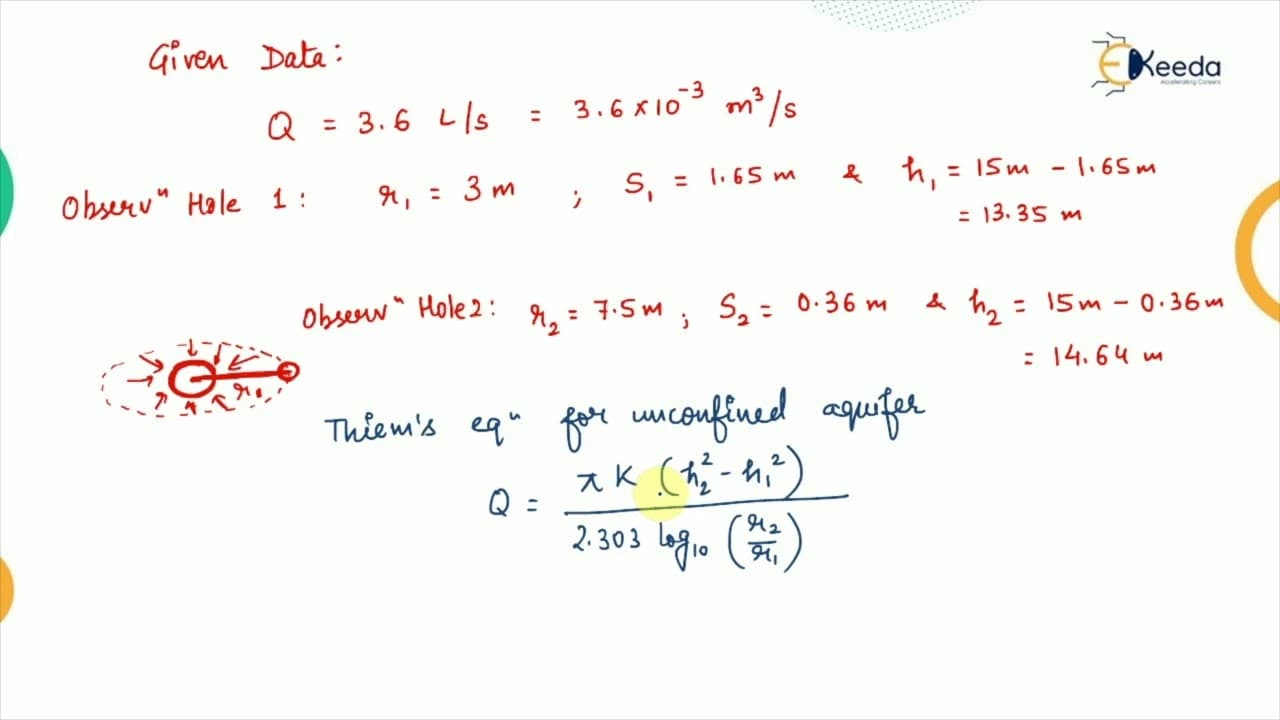
hello everyone in this video we are going to solve numericals based on the chapter that we have discussed that is the groundwater so let's start of the first problem that says a pumping test was made in a medium which is composed of the sand and gravel and it is carried out up to a depth of 15 meter after which a bed of clay was encountered the nor... Read More
Key Insights
- ⛽ Pumping tests are essential for evaluating aquifer characteristics such as permeability and storage capacity.
- ❓ Observation wells provide data on drawdown and are used to calculate parameters like hydraulic conductivity.
- 💦 The cone of depression is formed when water is pumped at a faster rate than it can be recharged, causing the water table to drop.
- 🔇 The specific yield of an aquifer represents the ratio of extracted water volume to the total volume of the aquifer material.
- 🔇 Calculating the volume of recharge during the monsoon season involves multiplying the specific yield by the increase in water table height and the total volume of the aquifer material.
- ❓ The coefficient of permeability is determined using the Thiem's equation and observation well data.
- ❓ The specific yield and coefficient of permeability are important parameters for groundwater resource management.
Install to Summarize YouTube Videos and Get Transcripts
Explore YouTube Video Summarizer or Get YouTube Transcript Extractor
Questions & Answers
Q: What is the purpose of a pumping test in groundwater analysis?
A pumping test is conducted to evaluate the characteristics of an aquifer, such as its permeability and storage capacity. It involves pumping water from a well and measuring changes in water levels and flow rates to gather data for analysis.
Q: How are observation wells used in groundwater analysis?
Observation wells are strategically placed near pumping wells to monitor changes in water levels during a pumping test. By measuring the drawdown in water levels at different distances from the pumped well, important parameters like hydraulic conductivity or coefficient of permeability can be determined.
Q: What is the cone of depression in groundwater analysis?
The cone of depression is a cone-shaped area that forms in the water table around a pumping well. It occurs when water is extracted faster than it can recharge, causing the water table to drop and creating a depression in the shape of a cone.
Q: How is the specific yield of an aquifer calculated?
The specific yield of an aquifer is calculated by dividing the volume of water extracted from the voids (empty spaces) in the aquifer during pumping by the total volume of the aquifer material. It is expressed as a decimal or a percentage.
Summary & Key Takeaways
-
The video solves numerical problems related to groundwater analysis, focusing on topics such as pumping tests, unconfined aquifers, and cone of depression.
-
Detailed calculations are provided for determining the coefficient of permeability based on observation well data.
-
Another problem involves calculating the specific yield of an unconfined aquifer and determining the volume of recharge during the monsoon season.
Read in Other Languages (beta)
Share This Summary 📚
Summarize YouTube Videos and Get Video Transcripts with 1-Click
Try YouTube Summary with ChatGPT & Claude or YouTube Transcript Generator
Explore More Summaries from Ekeeda 📚





Summarize YouTube Videos and Get Video Transcripts with 1-Click
Try YouTube Summary with ChatGPT & Claude or YouTube Transcript Generator