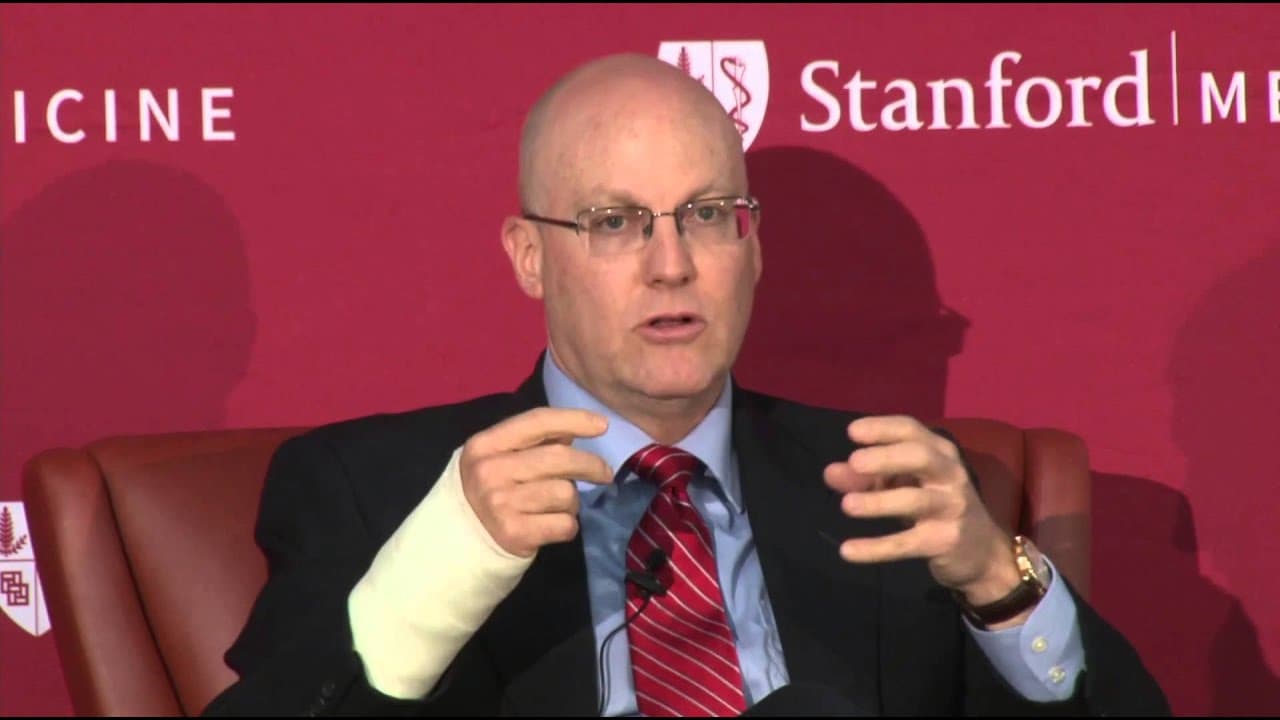
Stanford Health Policy Forum: The Problem of Prescription Opioids
TL;DR
The panelists discuss the growing prescription opioid epidemic in the US and the challenges faced by healthcare providers in treating pain while also addressing the risks of addiction and misuse.
Transcript
All right. Good afternoon, everybody, and welcome to another edition of the Stanford Health Policy Forum. My name is Keith Humphreys. I chair the advisory group for the forum, which also includes Drs. Mary Goldstein Ann Arvin, Doug Owens, Dan Kessler, and Rob Kocher. We hold these events two or three times a year to provide education and initiate d... Read More
Key Insights
- 👨🎨 There is a need for a cultural shift in the management of pain, with a focus on understanding the complexities of addiction and the risks associated with opioids.
- 🤳 Multidisciplinary approaches, including non-pharmacological treatments and self-management strategies, are crucial in effectively managing pain.
- 🤞 Precision medicine and prevention strategies offer hope for more personalized and proactive pain management.
- 😨 Access to comprehensive pain care is a challenge, with barriers related to reimbursement and limited availability of alternative treatments.
- 🪡 Greater education and monitoring are needed for healthcare providers to prevent overprescription and misuse of opioids.
- 🖐️ Naloxone plays a vital role in preventing opioid overdose deaths and should be made more accessible.
Install to Summarize YouTube Videos and Get Transcripts
Explore YouTube Video Summarizer or Get YouTube Transcript Extractor
Questions & Answers
Q: What is the role of primary care physicians in the prescription opioid epidemic?
Primary care physicians are often the ones prescribing opioids, but there is a need for better education and monitoring to prevent overprescription and misuse.
Q: What are the challenges in accessing comprehensive pain care?
There are barriers such as reimbursement issues and limited access to non-pharmacological treatments. Efforts should be made to break down these barriers and integrate team-based care into healthcare systems.
Q: Can you explain the concept of naloxone and its role in preventing opioid overdoses?
Naloxone is an opioid receptor antagonist that can reverse the effects of an opioid overdose. It is a valuable tool in preventing fatalities and should be made more accessible to patients and their families.
Q: Should there be more restrictions on opioid prescriptions?
It is suggested that there should be consistency in prescribing practices and access to prescriptions drug monitoring programs. Additionally, education and monitoring should be mandated for healthcare providers who prescribe opioids.
Summary & Key Takeaways
-
The panel discusses the cultural transformation that has led to the overprescription of opioids, driven by the desire to alleviate pain. However, this has also led to an epidemic of opioid misuse and addiction.
-
The role of primary care physicians in prescribing opioids and the need for better education and monitoring is highlighted.
-
The panel emphasizes the importance of a multidisciplinary approach to pain management, including non-pharmacological treatments and self-management strategies.
-
The challenges of access to comprehensive pain care and reimbursement for alternative treatments are discussed.
-
The potential of precision medicine and prevention strategies is highlighted, along with the need for more research and data collection.
-
The concept of "opioid refugees" is presented, referring to patients who are struggling to obtain opioids due to increased restrictions and regulations.
Read in Other Languages (beta)
Share This Summary 📚
Summarize YouTube Videos and Get Video Transcripts with 1-Click
Try YouTube Summary with ChatGPT & Claude or YouTube Transcript Generator
Explore More Summaries from Stanford 📚





Summarize YouTube Videos and Get Video Transcripts with 1-Click
Try YouTube Summary with ChatGPT & Claude or YouTube Transcript Generator