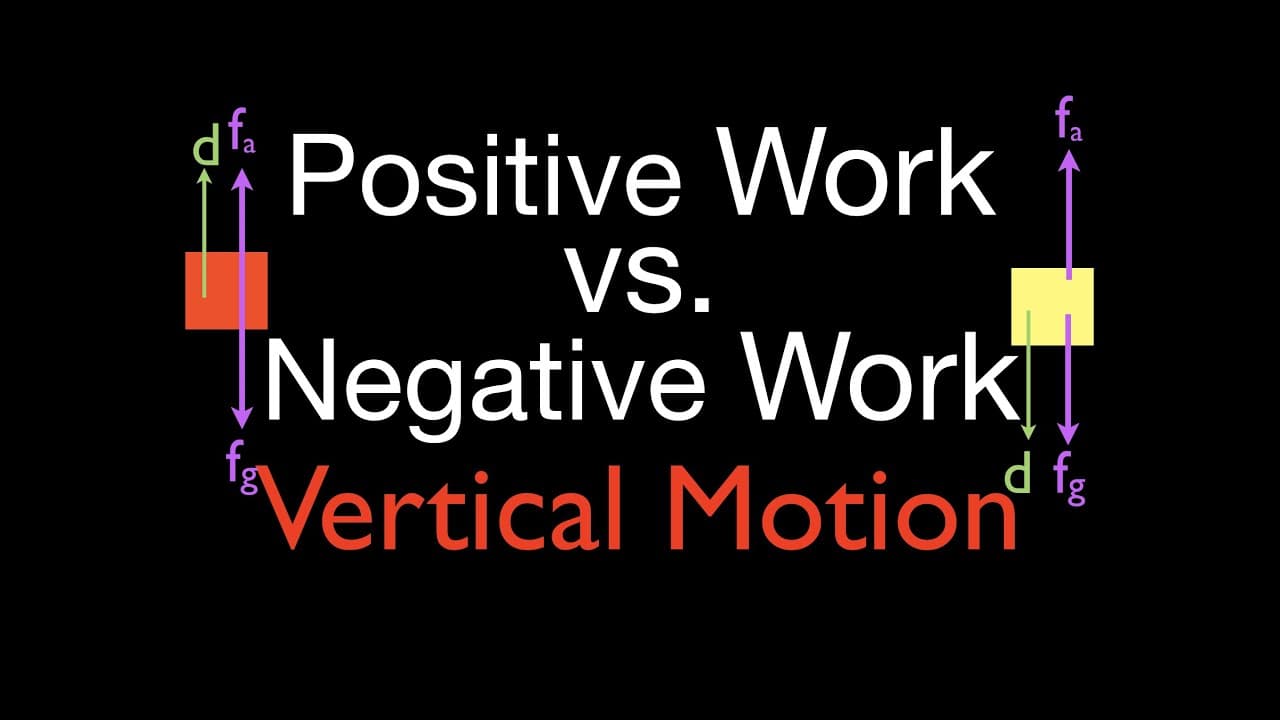
Energy, Work & Power (15 of 31) Positive Work vs. Negative Work for Vertical Motion
TL;DR
Explanation of how positive and negative work is done in vertical motion scenarios.
Transcript
okay in today's video we're gonna go with in between negative and positive work and this video we're gonna talk about vertical motion in the previous video we went over the typically negative positive work for horizontal motion you can link to that video right here if you're interested in horizontal motion but this one vertical motion is going to b... Read More
Key Insights
- 💦 The angle between force and displacement determines whether work is positive or negative in vertical motion scenarios.
- 💪 Work is calculated using the formula Work = Force x Distance x Cosine(Theta), considering the angle between force and displacement.
- 💦 Raising an object results in positive work done by applied force and negative work by gravity, while lowering an object reverses the work done by each force.
- 💦 Understanding positive and negative work in vertical motion is crucial for grasping energy dynamics in physics.
- 💦 The relationship between force, displacement, and angle plays a significant role in determining the nature of work done in vertical motion.
- 💦 Positive work adds energy to the system, while negative work removes energy, affecting the overall dynamics of vertical motion scenarios.
- 💦 Gravity often plays a role in exerting negative work during vertical motion, contrasting the positive work done by applied force.
Install to Summarize YouTube Videos and Get Transcripts
Explore YouTube Video Summarizer or Get YouTube Transcript Extractor
Questions & Answers
Q: What determines whether work is positive or negative in vertical motion scenarios?
The angle between the force and displacement determines whether work is positive or negative. If the force acts in the same direction as displacement, it's positive work, while if they are in opposite directions, it's negative work.
Q: How is work calculated for applied force and gravitational force in vertical motion?
The work done by each force is calculated using the formula Work = Force x Distance x Cosine(Theta), where Theta is the angle between force and displacement.
Q: What happens to work done when raising an object versus lowering it in vertical motion?
When raising an object, you do positive work while gravity does negative work. When lowering an object, you do negative work, and gravity does positive work, extracting energy from the system.
Q: How do positive and negative work concepts apply to vertical motion in physics?
Positive work is done when energy is added to the system, while negative work indicates energy being taken out of the system, crucial in understanding the dynamics of vertical motion.
Summary & Key Takeaways
-
The video explains the concept of positive and negative work in vertical motion scenarios.
-
Positive work is done when the force acts in the same direction as the displacement, while negative work is done when the force acts in the opposite direction.
-
Work calculations for applied force and gravitational force when raising or lowering an object are detailed.
Read in Other Languages (beta)
Share This Summary 📚
Summarize YouTube Videos and Get Video Transcripts with 1-Click
Try YouTube Summary with ChatGPT & Claude or YouTube Transcript Generator
Explore More Summaries from Step by Step Science 📚
Summarize YouTube Videos and Get Video Transcripts with 1-Click
Try YouTube Summary with ChatGPT & Claude or YouTube Transcript Generator