Wie man Generative KI-Anwendungen erstellt
TL;DR
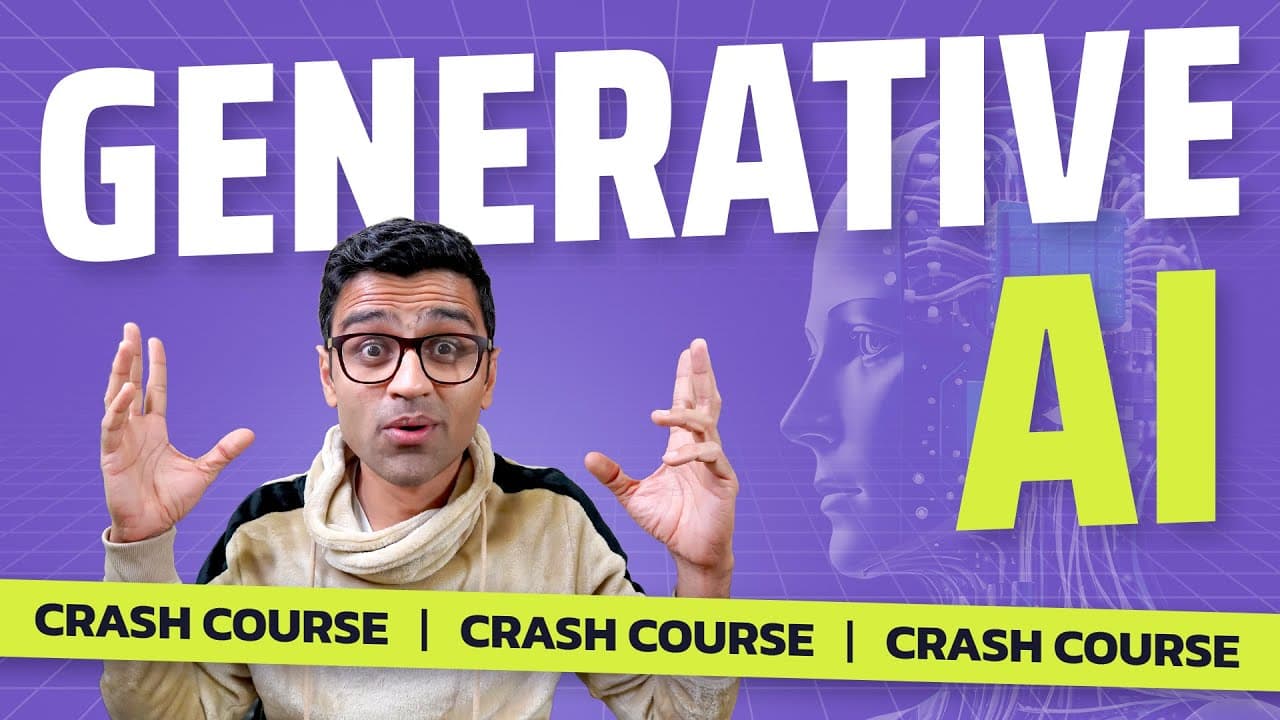
Generative KI revolutioniert die Erstellung neuer Inhalte wie Texte, Bilder und Musik. Dieser Kurs behandelt die Grundlagen der generativen KI, zeigt den Einsatz von LangChain für die Entwicklung maßgeschneiderter Anwendungen und demonstriert, wie man Projekte wie Q&A-Systeme umsetzt. Es wird erläutert, wie man bestehende Modelle nutzen und Daten effizient bereitstellen kann.
Transcript
welcome to this generative AI mini course first we will understand the Gen AI fundamentals then we will learn Lang chain which is a python framework used for building gen application and in the end we will build two endtoend gen AI projects the first project will be using commercial GPT model where we will build equity news research tool the second... Read More
Key Insights
- 💁 Generative AI is revolutionizing content creation across various formats, leveraging complex models beyond traditional statistical methods.
- 👨🔬 Practical applications of generative AI include equity research and Q&A tools, demonstrating its utility in real-world scenarios.
- 🛃 The integration of frameworks like LangChain streamlines development processes for custom AI applications, providing necessary components and structure.
- 🖐️ Embeddings play a pivotal role in transforming text into numerical forms that facilitate advanced AI operations, such as searching and clustering.
- ℹ️ Retrieval Augmented Generation (RAG) enhances LLMs by connecting them to external data sources for more informed responses.
- 🏛️ Understanding the evolution of neural networks, from classical methods to transformers, is essential for grasping current AI capabilities.
- ❓ Few-shot learning strategies can effectively improve LLM performance by providing contextual training examples to refine output accuracy.
Install to Summarize YouTube Videos and Get Transcripts
Explore YouTube Video Summarizer or Get YouTube Transcript Extractor
Questions & Answers
Q: What distinguishes generative AI from non-generative AI?
Generative AI focuses on producing new content, such as images and text, while non-generative AI is used for analytical tasks like diagnosing diseases based on data, wherein it does not create new outputs, just processes the existing data to provide insights.
Q: How does the LangChain framework simplify the development of generative AI applications?
LangChain simplifies application development by providing a structured approach to integrate various large language models (LLMs) and tools, allowing developers to build custom applications that can interact with AI models efficiently, facilitating tasks like data retrieval and prompt engineering.
Q: Can you explain the concept of embeddings in the context of AI?
Embeddings in AI represent words or phrases as numerical vectors in a lower-dimensional space. They capture semantic meaning and relationships, enabling models to perform tasks like similarity measurement and clustering more effectively than using raw text.
Q: What are the two main types of neural network models discussed in the content?
The content discusses two primary types of neural networks: classical models used in statistical machine learning and more complex models like recurrent neural networks (RNNs) and transformers, which excel in handling sequential data and generating content.
Q: How does retrieval augmented generation (RAG) improve AI's ability to answer queries?
RAG improves AI responses by allowing the model to retrieve relevant information from external databases to enhance the context provided with the input query, which significantly aids in referencing up-to-date information and accurate answers.
Q: What project examples are given for generative AI applications?
The content details two generative AI project examples: building an equity news research tool using a commercial GPT model and creating a Q&A tool for the retail industry using an open-source model, demonstrating practical AI applications.
Q: What challenges can LLMs encounter, and how are they mitigated?
LLMs may misunderstand queries or make inaccurate assumptions based on incomplete context. These issues can be mitigated through few-shot learning, where the model is trained with examples to ensure it aligns more closely with user expectations and corrects its output.
Q: Why is a vector database essential for AI applications?
A vector database is crucial as it enables efficient storage and retrieval of high-dimensional data representations (embeddings). It allows AI systems to quickly find relevant information based on semantic similarity, improving the performance and responsiveness of applications.
Summary & Key Takeaways
-
The content covers the fundamentals of generative AI, contrasting it with non-generative AI, and emphasizes its role in creating new content such as text, images, and audio.
-
It explores key components of generative AI applications, focusing on frameworks like LangChain for building tailored AI applications, including constructing Q&A systems and equity research tools.
-
The narrative also guides readers through practical implementations of generative AI, incorporating existing models, data handling methods, and UI development for effective interaction.
Read in Other Languages (beta)
Share This Summary 📚
Summarize YouTube Videos and Get Video Transcripts with 1-Click
Try YouTube Summary with ChatGPT & Claude or YouTube Transcript Generator
Explore More Summaries from codebasics 📚




Summarize YouTube Videos and Get Video Transcripts with 1-Click
Try YouTube Summary with ChatGPT & Claude or YouTube Transcript Generator