From Mesh To Yarn... In Real Time! 🧶
TL;DR
New technique combines fast mesh simulations with yarn-level cloth details, achieving real-time simulations with high-frequency details.
Transcript
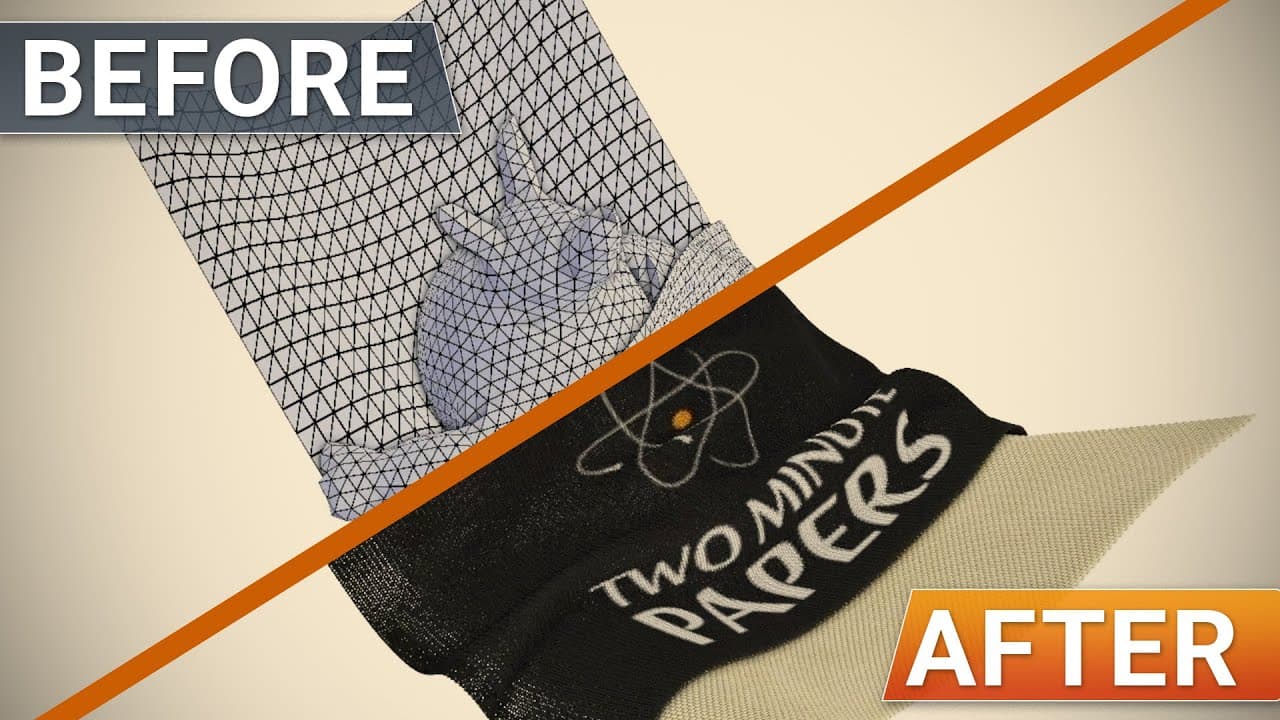
Dear Fellow Scholars, this is Two Minute Papers with Dr. Károly Zsolnai-Fehér. This is not some hot new Two Minute Papers merchandise - this is what a new cloth simulation paper is capable of doing today. So good! And today, we are also going to see how to put back the holes into holey geometry, and do it quickly! But wait a second, that is impossi... Read More
Key Insights
- 🐎 Previous cloth simulation techniques had limitations, either sacrificing speed or detail.
- 👚 The new technique marries fast mesh simulations with yarn-level cloth details, achieving real-time simulations with realistic and detailed cloth behavior.
- 🏃 The simulation runs on both the processor and the graphics card, resulting in simulation timings in the order of milliseconds.
- 👂 Highly detailed garments with tens of millions of vertices can be simulated in real-time.
- 🥺 The technique preserves holey geometry and achieves proper tension between yarns, leading to more realistic cloth behavior.
- ✋ The simulation technique successfully handles high-frequency details, highlighting its effectiveness.
- 👨🔬 The research presented in the video is an important contribution to the field of cloth simulation.
Install to Summarize YouTube Videos and Get Transcripts
Explore YouTube Video Summarizer or Get YouTube Transcript Extractor
Questions & Answers
Q: How does the new technique combine fast mesh simulations with yarn-level cloth details?
The technique starts with a fast mesh simulation and adds the proper tension between yarns to achieve realistic cloth behavior. It also simulates how the garment interacts with a virtual body in a simulated world.
Q: Is the new technique computationally efficient?
Yes, the mesh part of the simulation runs on the processor, while the yarn part runs on the graphics card. This allows for real-time simulations, even for garments with millions of vertices. The technique is only slowed down when dealing with extremely detailed garments.
Q: What are the benefits of the new technique?
The technique allows for real-time yarn-level simulations, preserving holey geometry and achieving high-frequency details. It is a significant advancement in cloth simulation, offering both speed and realism.
Q: Who developed this new technique?
The technique was developed by a team led by first author Georg Sperl, who is currently a PhD student. The team's work showcases their expertise in cloth simulation and their ability to make important contributions to the field.
Summary & Key Takeaways
-
Previous cloth simulation techniques were either fast but lacked holey geometry, or detailed but computationally expensive.
-
This new technique marries fast mesh simulations with yarn-level cloth details, resulting in realistic and detailed cloth simulations in real time.
-
The simulation runs on both the processor and the graphics card, achieving simulation timings in the order of milliseconds even for highly detailed garments.
Read in Other Languages (beta)
Share This Summary 📚
Summarize YouTube Videos and Get Video Transcripts with 1-Click
Try YouTube Summary with ChatGPT & Claude or YouTube Transcript Generator
Explore More Summaries from Two Minute Papers 📚





Summarize YouTube Videos and Get Video Transcripts with 1-Click
Try YouTube Summary with ChatGPT & Claude or YouTube Transcript Generator