Compound inequalities 2 | Linear inequalities | Algebra I | Khan Academy
TL;DR
Learn how to solve inequalities with two constraints by isolating the variable and analyzing the range that satisfies both conditions.
Transcript
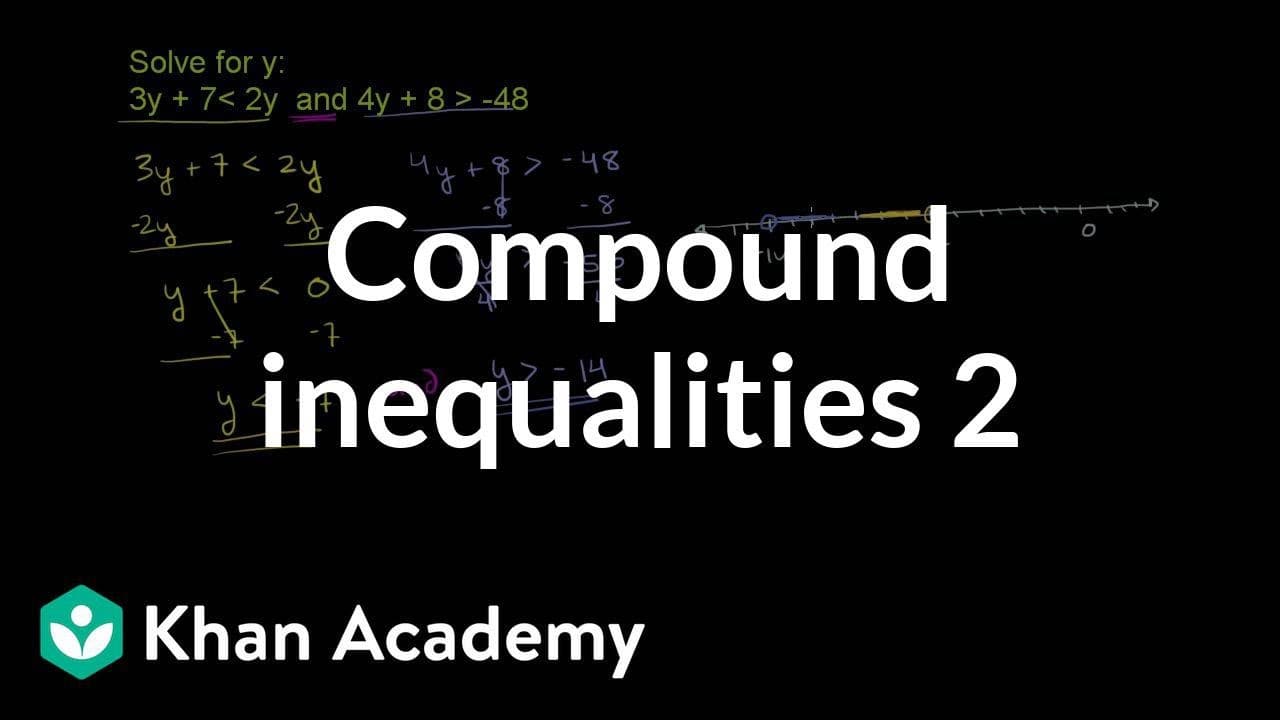
Solve for y. We have 3y plus 7 is less than 2y and 4y plus 8 is greater than negative 48. So we have to find all the y's that meet both of these constraints. So let's just solve for y in each of the constraints and just remember that this "and" is here. So we have 3y plus 7 is less than 2y. So let's isolate the y's on the left-hand side. So let's g... Read More
Key Insights
- ❓ Solving inequalities with two constraints involves isolating the variable and simplifying equations for each constraint.
- 😆 The "and" keyword is used to ensure that a solution satisfies both constraints simultaneously.
- 🏙️ Graphically representing the solutions on a number line helps visualize the range of valid values for 'y'.
- 😀 Solutions that do not overlap indicate no common values for 'y' that satisfy both constraints.
- 🏙️ Solutions that overlap on the number line represent the range of valid values for 'y' that meet both conditions.
- ✔️ Verifying solutions involves substituting 'y' into both inequalities and checking if the statements hold true.
- 🫥 The solutions to inequalities with two constraints can be compared and checked on a number line to validate the range of valid values.
Install to Summarize YouTube Videos and Get Transcripts
Explore YouTube Video Summarizer or Get YouTube Transcript Extractor
Questions & Answers
Q: How do you solve inequalities with two constraints?
To solve inequalities with two constraints, isolate the variable in each inequality and simplify the equations. Then, determine the range of values that satisfy both conditions.
Q: What happens if the solutions to both constraints do not overlap?
If the solutions to both constraints do not overlap, it means there is no value for 'y' that satisfies both conditions simultaneously. In this case, there is no solution.
Q: Why is it important to use the "and" keyword when solving inequalities with two constraints?
The "and" keyword signifies that the solution must meet both constraints simultaneously. By using "and," we ensure that the solutions comply with both conditions.
Q: How can we verify if a solution satisfies both constraints?
To verify if a solution satisfies both constraints, substitute the value of 'y' into both inequalities and check if the statements hold true. If both inequalities are true, the solution is valid.
Summary & Key Takeaways
-
The video explains how to solve inequalities with two constraints in order to find the values of 'y' that meet both conditions.
-
For each constraint, the video demonstrates isolating the variable and simplifying the equation to determine the range of valid values for 'y'.
-
By graphing the solutions on a number line, it becomes clear that 'y' must be greater than negative 14 and less than negative 7 to satisfy both constraints.
Read in Other Languages (beta)
Share This Summary 📚
Summarize YouTube Videos and Get Video Transcripts with 1-Click
Try YouTube Summary with ChatGPT & Claude or YouTube Transcript Generator
Explore More Summaries from Khan Academy 📚



Summarize YouTube Videos and Get Video Transcripts with 1-Click
Try YouTube Summary with ChatGPT & Claude or YouTube Transcript Generator