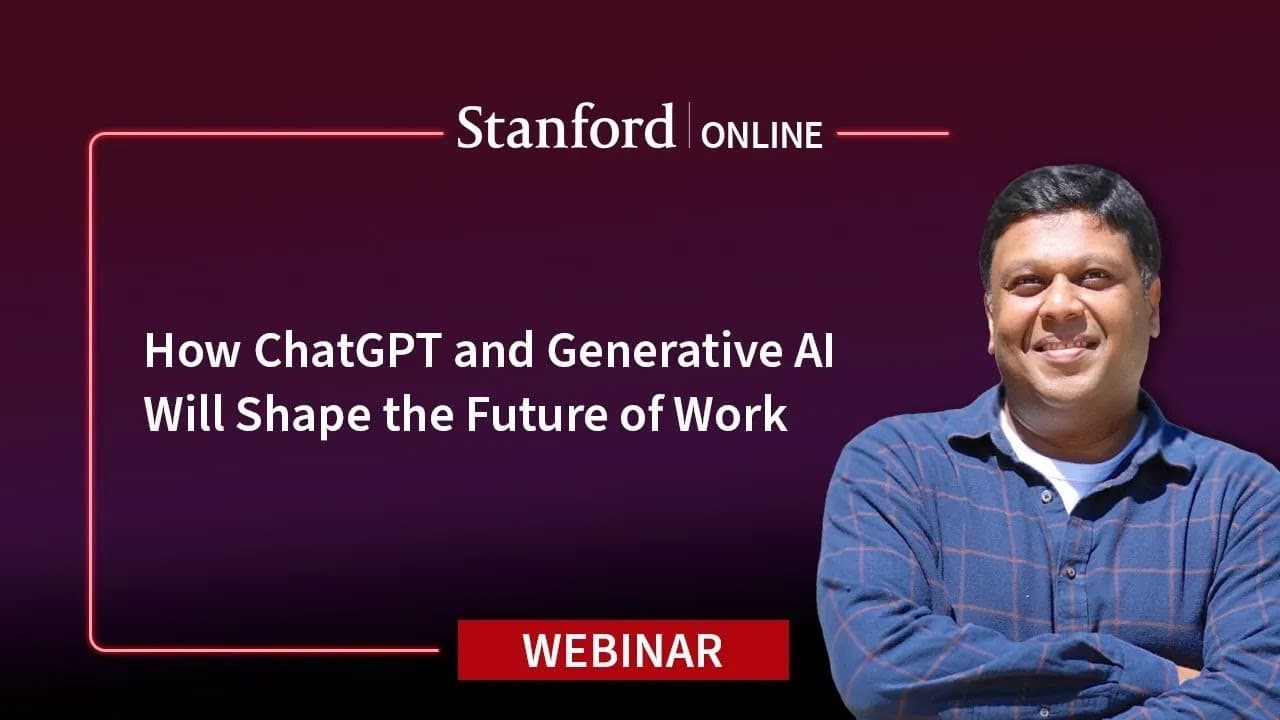
Stanford Webinar - How ChatGPT and Generative AI Will Shape the Future of Work
TL;DR
Generative AI has the potential to generate content and extract information, but there are risks of hallucination, copyright concerns, privacy issues, and limitations in numerical reasoning.
Transcript
um arvind is assistant professor of management science and engineering at Stanford University he is a member of the center of work technology and organization the Stanford technology Ventures program and a faculty affiliate of the institute for human-centered artificial intelligence um his current research focuses on human AI augmentation in the wo... Read More
Key Insights
- 🧡 Generative AI can generate personalized content and summarize information, offering a range of applications in various industries.
- ❓ Industries heavily reliant on texts, images, and language are experiencing significant impact and benefits from generative AI.
- ✳️ Risks associated with generative AI include the production of incorrect or made-up content, copyright and intellectual property concerns, privacy issues, and limitations in numerical reasoning.
- 🖐️ Managers play a crucial role in driving the adoption and experimentation of generative AI in the workplace.
- ❓ Overcoming resistance to generative AI requires starting with tasks that employees dislike, mapping task dependencies, and emphasizing opportunities for reskilling and upskilling.
- 👨🔬 Prompt engineering, rather than using search keywords, is crucial for effectively utilizing generative AI chatbots.
- 👋 An understanding of generative AI and the ability to write good prompts is essential for professionals in any field.
Install to Summarize YouTube Videos and Get Transcripts
Explore YouTube Video Summarizer or Get YouTube Transcript Extractor
Questions & Answers
Q: What are the two main categories of generative AI?
Generative AI can be used for generating content (images, videos, music) and extracting/summarizing/predicting information from various data sources.
Q: How is generative AI being used in different industries?
Industries such as legal, advertising, and creative fields are already using generative AI for tasks like generating contracts, designing graphics, and creating slogans for clients.
Q: What are the risks associated with generative AI?
The risks include the possibility of generating incorrect or made-up content (hallucination), copyright and intellectual property concerns, privacy issues, and limitations in numerical reasoning.
Q: How can organizations overcome resistance to using generative AI?
Starting with tasks that employees dislike and want to automate or augment, mapping task dependencies, and emphasizing reskilling and upskilling opportunities can help overcome resistance and drive adoption of generative AI.
Summary & Key Takeaways
-
Generative AI encompasses two broad categories: generating content (images, videos, music, etc.) and extracting/summarizing/predicting information from text and other data sources.
-
Industries like legal, advertising, and creative fields are already benefiting from generative AI, while organizations are also using it for internal purposes such as employee surveys.
-
Risks associated with generative AI include hallucination (producing incorrect or made-up content), copyright and intellectual property concerns, privacy issues, and limitations in numerical reasoning.
Read in Other Languages (beta)
Share This Summary 📚
Summarize YouTube Videos and Get Video Transcripts with 1-Click
Try YouTube Summary with ChatGPT & Claude or YouTube Transcript Generator
Explore More Summaries from Stanford Online 📚

Summarize YouTube Videos and Get Video Transcripts with 1-Click
Try YouTube Summary with ChatGPT & Claude or YouTube Transcript Generator