Golden ratio to find radius of moon | Similarity | Geometry | Khan Academy
TL;DR
The dimensions of the Earth and the moon form a golden triangle, represented by the golden ratio (phi), which has interesting mathematical properties and can be observed in various aspects of nature.
Transcript
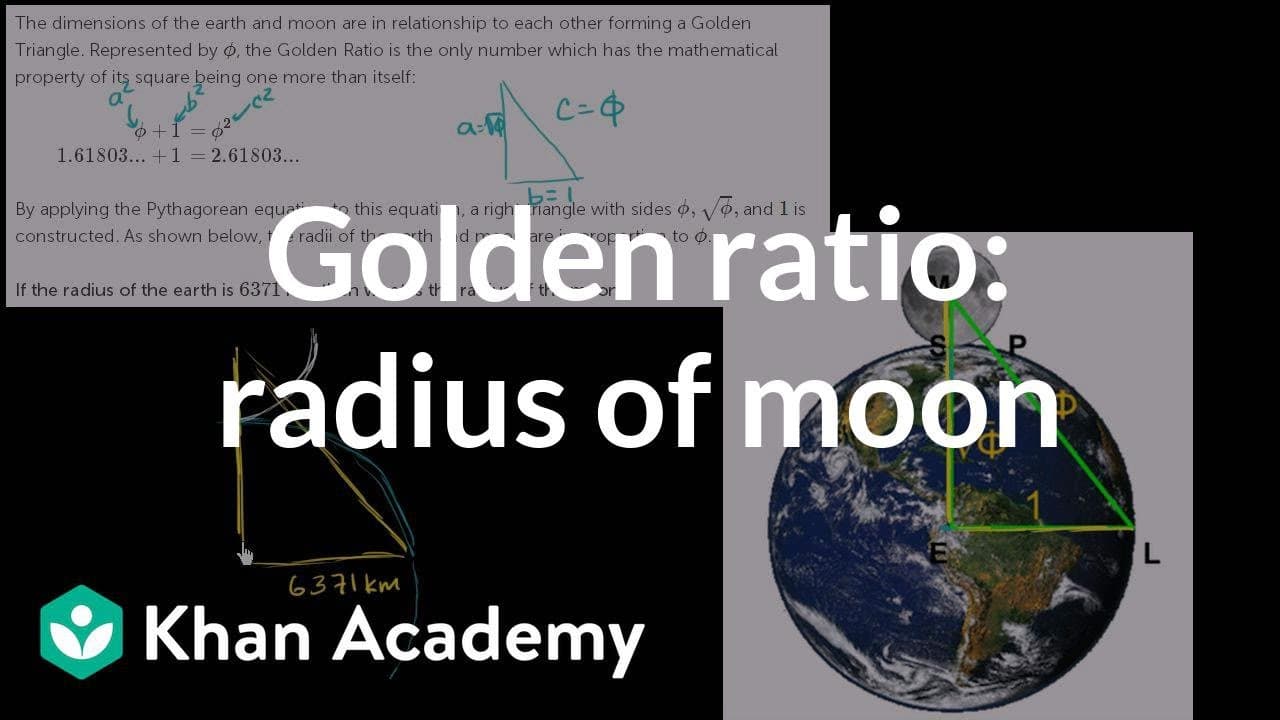
The dimensions of the Earth and moon are in relationship to each other forming a golden triangle. Represented by phi, the golden ratio is the only number which has the mathematical property of its square being one more than itself. And there's a whole video on phi on the Khan Academy, and I suggest you watch it. It will give you chills. And if you ... Read More
Key Insights
- 🥳 The golden ratio (phi) is a fascinating number with mathematical significance.
- 🥳 The radii of the Earth and moon form a golden triangle, showing a connection to the golden ratio.
- 🥳 The presence of the golden ratio in nature highlights the underlying harmony and balance in the universe.
- 🥳 The golden ratio has applications in art, architecture, and design.
- 🥳 Understanding the relationship between the Earth, moon, and the golden ratio can evoke a sense of awe and wonder about the universe.
- 🥳 The golden ratio can be expressed in various forms, including the ratio of line segments, spiral patterns, and mathematical equations.
- 🥳 The golden ratio is not limited to Earth and moon; it can be found in various natural and man-made structures.
Install to Summarize YouTube Videos and Get Transcripts
Explore YouTube Video Summarizer or Get YouTube Transcript Extractor
Questions & Answers
Q: What is the golden ratio, and why is it significant?
The golden ratio, also known as phi, is a number that has unique mathematical properties. Its square is one more than itself, making it intriguing in various fields of study, including mathematics, art, and nature.
Q: How are the Earth, moon, and the golden ratio related?
The radii of the Earth and the moon form a golden triangle, with the ratio of the sum of their radii to the Earth's radius being equal to the square root of phi. This suggests a remarkable relationship between these celestial bodies and the golden ratio.
Q: What is the significance of the golden ratio in nature?
The presence of the golden ratio in nature is often considered aesthetically pleasing and can be observed in the proportions of flowers, seashells, and other natural phenomena. It is believed to represent a harmonious balance.
Q: How can the golden ratio be applied in mathematics?
The golden ratio can be used in various mathematical equations, geometry, and patterns. It has connections to Fibonacci numbers, fractals, and even the spiral shape of galaxies.
Summary & Key Takeaways
-
The golden ratio (phi) is a unique number that has the mathematical property of its square being one more than itself.
-
The radii of the Earth and the moon are in proportion to phi, forming a golden triangle.
-
By applying the Pythagorean equation, a right triangle with sides proportional to phi and 1 is constructed.
Read in Other Languages (beta)
Share This Summary 📚
Summarize YouTube Videos and Get Video Transcripts with 1-Click
Try YouTube Summary with ChatGPT & Claude or YouTube Transcript Generator
Explore More Summaries from Khan Academy 📚



Summarize YouTube Videos and Get Video Transcripts with 1-Click
Try YouTube Summary with ChatGPT & Claude or YouTube Transcript Generator