Balancing another combustion reaction | Chemical reactions | High school chemistry | Khan Academy
TL;DR
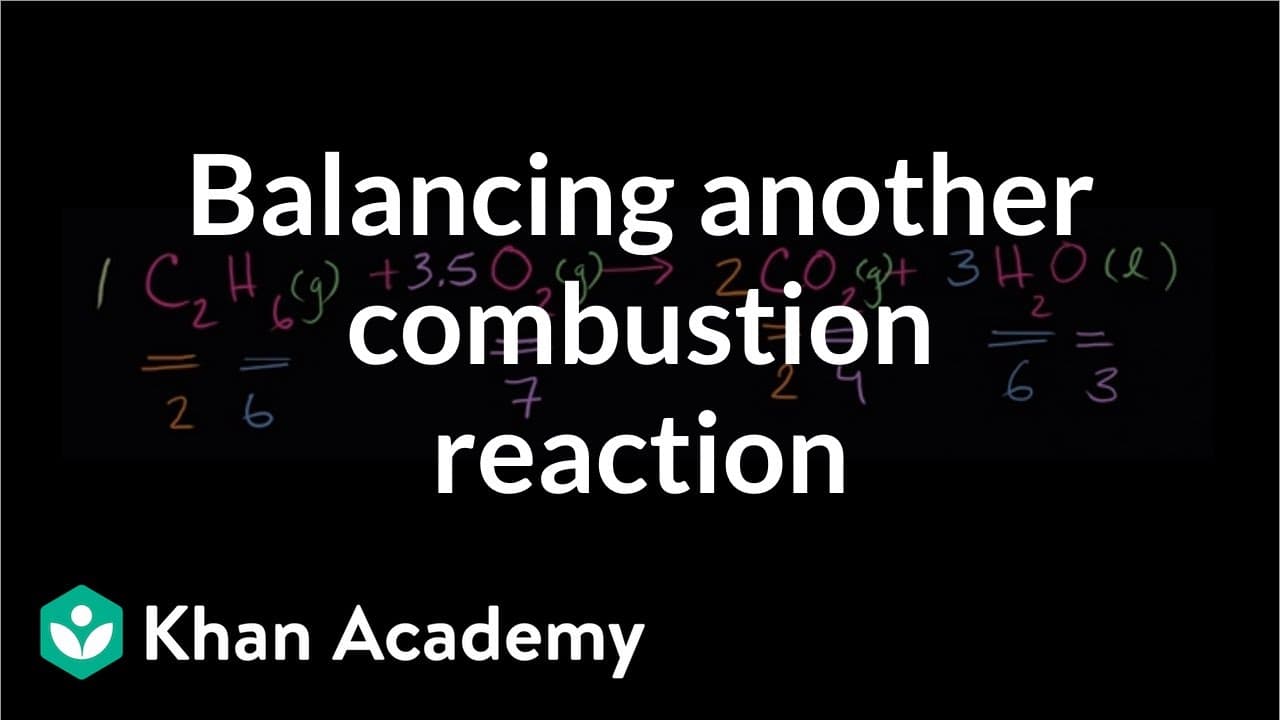
Learn how to balance a combustion reaction involving ethane by adjusting coefficients and using whole numbers.
Transcript
- All right now we have another combustion reaction. Instead of ethylene, we now have ethane, C2H6, has two carbons and six hydrogen atoms in each molecule of ethane, and it is reacting. It's ethane gas, it is reacting with molecular oxygen in gaseous form and they combust to form carbon dioxide gas and liquid water, and like we've seen in previous... Read More
Key Insights
- ⚖️ Combustion reactions involving complex molecules like ethane can be balanced by adjusting coefficients and using whole numbers.
- ⚖️ Balancing elements such as carbon and hydrogen first can make it easier to balance oxygen later.
- ✖️ Multiplying coefficients by two is a common technique to achieve whole number coefficients in chemical equations.
- ❓ Balanced chemical equations provide an accurate representation of the reactants and products involved in a reaction.
- 🙃 Balancing a combustion reaction helps ensure conservation of mass, with the same number of each type of atom on both sides.
- 👻 Having whole number coefficients allows for a clearer understanding and communication of the chemical reaction.
- ⚖️ The principles of balancing chemical equations apply to various types of reactions, not just combustion reactions.
Install to Summarize YouTube Videos and Get Transcripts
Explore YouTube Video Summarizer or Get YouTube Transcript Extractor
Questions & Answers
Q: How can you tell if a chemical equation is balanced or unbalanced?
A chemical equation is unbalanced if the numbers of atoms of each element are not equal on both sides. This can be determined by comparing the coefficients of the elements in the reactants and products.
Q: Why is it important to save oxygen balancing for last?
Saving oxygen balancing for last is beneficial because adjusting the number of oxygen molecules can affect the number of carbon and hydrogen atoms. By balancing other elements first, it is easier to make specific changes to the oxygen coefficients without impacting the overall balance of the equation.
Q: What is the purpose of multiplying coefficients by two to achieve whole numbers?
Multiplying coefficients by two ensures that the equation has whole number coefficients, which is the standard representation. Whole numbers are preferred over fractions or decimals because they provide a clearer and more concise representation of the chemical reaction.
Q: How do you balance the combustion reaction involving ethane, oxygen, carbon dioxide, and water?
Start by balancing hydrogen atoms, followed by carbon atoms. Finally, balance oxygen atoms. Multiply the coefficients by two to achieve whole numbers and maintain overall balance.
Summary & Key Takeaways
-
The provided content explains how to balance a combustion reaction involving ethane, oxygen, carbon dioxide, and water.
-
The chemical equation is initially unbalanced, with unequal numbers of carbon, hydrogen, and oxygen atoms on each side.
-
By adjusting the coefficients and multiplying them by two, the equation can be balanced with whole number coefficients.
Read in Other Languages (beta)
Share This Summary 📚
Summarize YouTube Videos and Get Video Transcripts with 1-Click
Try YouTube Summary with ChatGPT & Claude or YouTube Transcript Generator
Explore More Summaries from Khan Academy 📚



Summarize YouTube Videos and Get Video Transcripts with 1-Click
Try YouTube Summary with ChatGPT & Claude or YouTube Transcript Generator