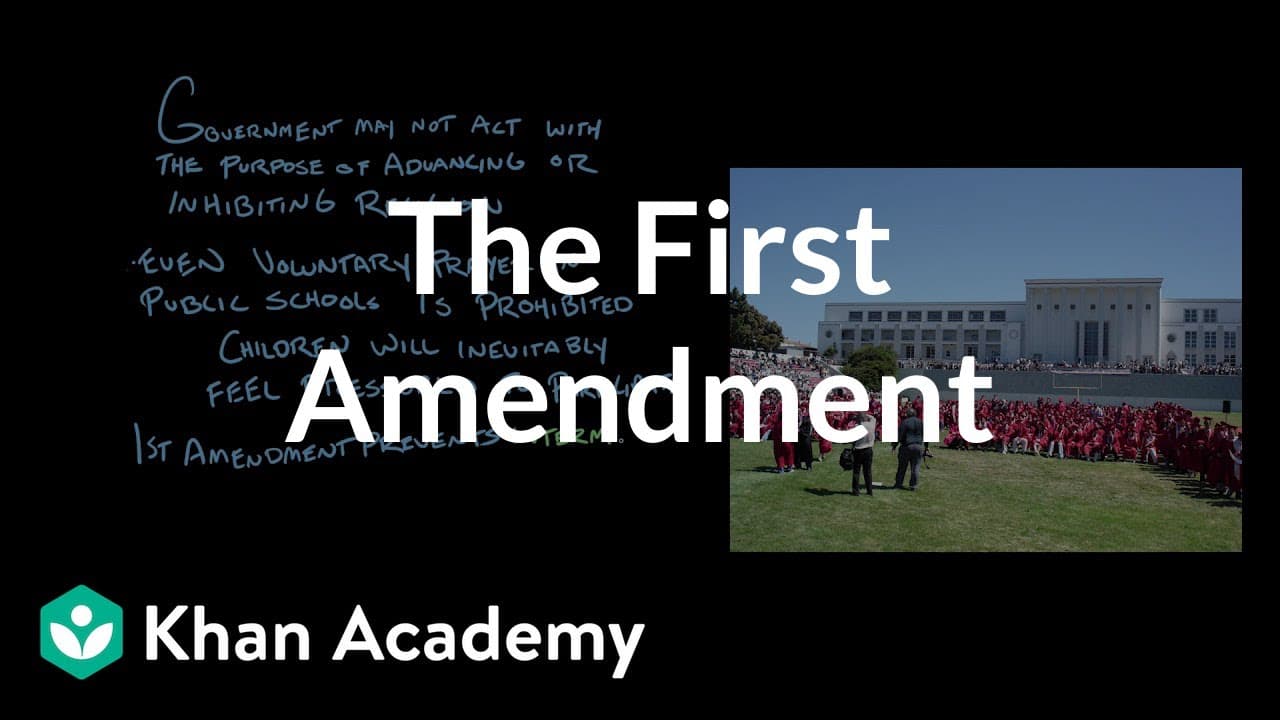
The First Amendment | The National Constitution Center | US government and civics | Khan Academy
TL;DR
The First Amendment protects important rights such as freedom of speech, religion, and assembly, but there are limitations to these freedoms.
Transcript
- [Kim] Hi, this is Kim from Khan Academy, and today I'm learning more about the First Amendment to the US Constitution. The First Amendment is one of the most important amendments to the Constitution, if not the most important. It reads, "Congress shall make no law respecting "an establishment of religion, or prohibiting the free "exercise thereof... Read More
Key Insights
- 😯 The First Amendment protects fundamental rights such as freedom of speech, religion, assembly, and petitioning the government for redress of grievances.
- 😑 The framers included these rights in response to historical restrictions on speech, press, and religion in Europe.
- 😯 There are limitations to these freedoms, with the government being able to restrict speech that incites illegal activity or is deemed obscene.
- 😑 Freedom of speech and freedom of the press were highly valued by the framers as they enable the spread of ideas and played a crucial role in the American Revolution.
- 🗯️ The Establishment Clause prevents the government from establishing a state religion, while the Free Exercise Clause ensures the right to practice any religion.
- 👻 Freedom of assembly allows citizens to gather peacefully, but the government can regulate the time, place, and manner of assemblies.
- 💱 Petitioning the government involves advocating for change and seeking redress for grievances.
Install to Summarize YouTube Videos and Get Transcripts
Explore YouTube Video Summarizer or Get YouTube Transcript Extractor
Questions & Answers
Q: What was the historical background behind the inclusion of the First Amendment in the Constitution?
The framers wanted to prevent the restrictions on speech, press, and religion that existed in Europe by safeguarding these freedoms in the US.
Q: Are there any limitations to freedom of speech?
Yes, the government can restrict speech if there is a compelling interest, such as incitement to imminent illegal activity or obscenity.
Q: How does freedom of speech differ from freedom of the press?
Freedom of speech pertains to individual expression, whereas freedom of the press refers to using technology, like the printing press, to disseminate ideas to a wider audience.
Q: What does the Establishment Clause of the First Amendment prevent?
The Establishment Clause prevents the government from enacting laws with the purpose of advancing religion and from establishing a state religion.
Q: Can the government restrict freedom of assembly?
The government can regulate the time, place, and manner of assembly, but it generally must provide government property, like sidewalks and parks, for speech purposes.
Q: How is freedom of speech and assembly balanced with public safety concerns?
Laws that regulate speech based on content are generally unconstitutional, but regulations on time, place, and manner may be permissible if they serve important government purposes.
Q: How can individuals petition the government for redress of grievances?
Petitioning the government can involve testifying before legislative bodies, communicating with representatives, or advocating for policy changes through speech and expression.
Q: Does the First Amendment apply to private institutions like universities?
No, the First Amendment applies only to government entities. Private institutions, like universities, have the discretion to regulate speech within their boundaries.
Summary & Key Takeaways
-
The First Amendment was included in the US Constitution to safeguard essential liberties, including freedom of speech and freedom of the press.
-
Freedom of speech was highly valued by the framers, especially when coupled with the freedom of the press, as it allowed for the dissemination of ideas on a large scale.
-
The First Amendment also protects the freedom of religion by preventing the government from establishing a state religion and interfering with the free exercise of religion.
-
Additionally, the First Amendment ensures the right to peaceably assemble and petition the government for a redress of grievances.
Read in Other Languages (beta)
Share This Summary 📚
Summarize YouTube Videos and Get Video Transcripts with 1-Click
Try YouTube Summary with ChatGPT & Claude or YouTube Transcript Generator
Explore More Summaries from Khan Academy 📚



Summarize YouTube Videos and Get Video Transcripts with 1-Click
Try YouTube Summary with ChatGPT & Claude or YouTube Transcript Generator