Depreciation and opportunity cost of capital | Microeconomics | Khan Academy
TL;DR
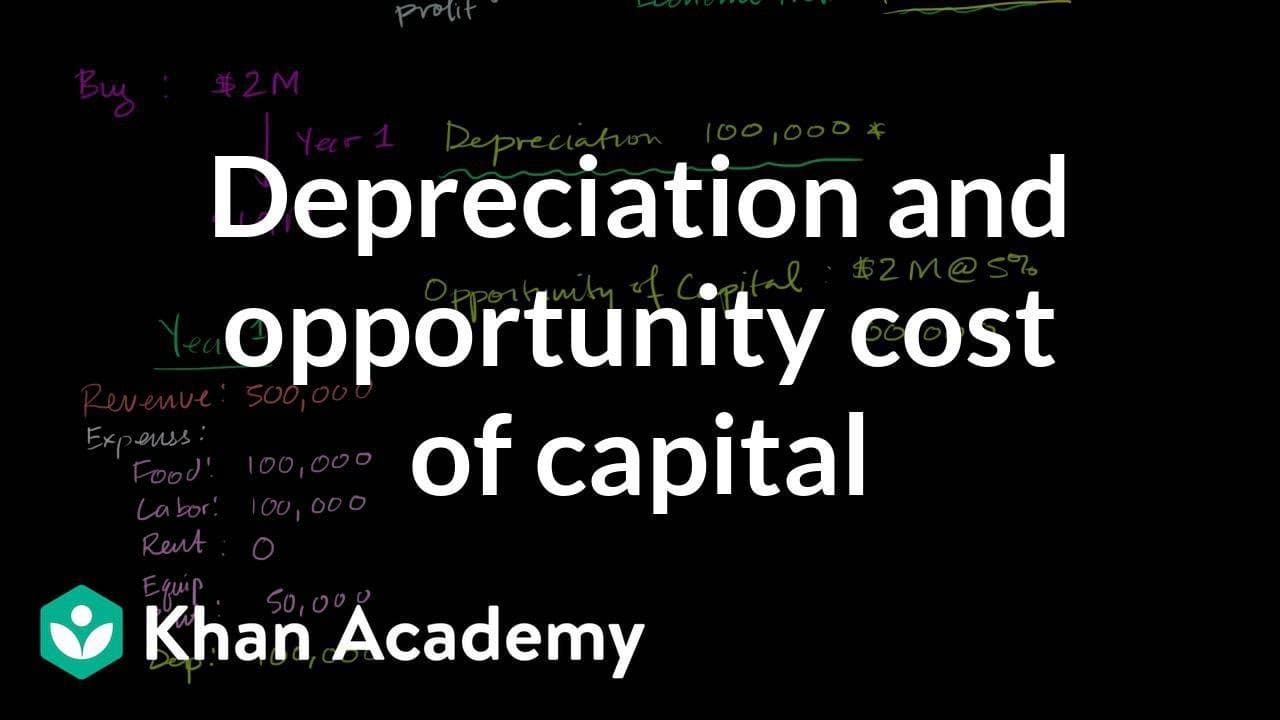
Renting a building incurs explicit costs (rent expense) while buying a building incurs implicit costs (depreciation and opportunity cost of capital).
Transcript
Background voice: Let's think about how we would have accounted for things, if instead of renting our building for $200,000, instead we bought the building for $2,000,000, how would that showed up … how would that have shown up from an accounting profit point of view and an economic profit point of view? We're going to buy our building for $2,000,0... Read More
Key Insights
- 👪 Renting a building incurs explicit rent expense, while buying a building incurs implicit costs such as depreciation and opportunity cost of capital.
- 👋 Depreciation reflects the market value decrease of capital goods, and economists prefer the difference in market value over time.
- 🔠 Opportunity cost of capital accounts for the return that could have been earned by investing the capital in alternative uses.
- 🇨🇷 Accounting profit only considers explicit costs, while economic profit includes explicit and implicit costs.
- 👪 Buying a building may reduce rent expenses, but it introduces additional costs that affect economic profit.
- ❓ Different methods of depreciation can be used in accounting, but economists focus on the market value difference.
- 👨💼 Economic profit provides a more comprehensive analysis of the viability and cost-effectiveness of running a business.
Install to Summarize YouTube Videos and Get Transcripts
Explore YouTube Video Summarizer or Get YouTube Transcript Extractor
Questions & Answers
Q: What is the difference between accounting profit and economic profit?
Accounting profit only considers explicit costs, such as rent expenses, while economic profit considers both explicit and implicit costs, such as depreciation and opportunity cost of capital.
Q: How does buying a building affect the financial statements?
Buying a building eliminates rent expense but introduces depreciation expense, reducing the pretax accounting profit. However, the economic profit takes into account the opportunity cost of capital as well.
Q: What is depreciation and how does it affect profit statements?
Depreciation measures the decrease in market value of capital goods. In accounting, different methods can be used, but economists prefer the difference in market value between the beginning and end of a period.
Q: What is the opportunity cost of capital?
The opportunity cost of capital represents the return that could have been earned by investing the capital in other ventures instead of using it to buy a building.
Summary & Key Takeaways
-
Renting a building for $200,000 incurs a rent expense of $200,000, resulting in an accounting profit of $150,000 after deducting expenses.
-
Buying a building for $2,000,000 incurs implicit costs of $100,000 for depreciation and another $100,000 for opportunity cost of capital, resulting in an economic profit of -$100,000.
-
Depreciation is a measure of the market value of capital goods used in a business, while economists consider the difference in market value of a capital good at the beginning and end of a period.
Read in Other Languages (beta)
Share This Summary 📚
Summarize YouTube Videos and Get Video Transcripts with 1-Click
Try YouTube Summary with ChatGPT & Claude or YouTube Transcript Generator
Explore More Summaries from Khan Academy 📚



Summarize YouTube Videos and Get Video Transcripts with 1-Click
Try YouTube Summary with ChatGPT & Claude or YouTube Transcript Generator