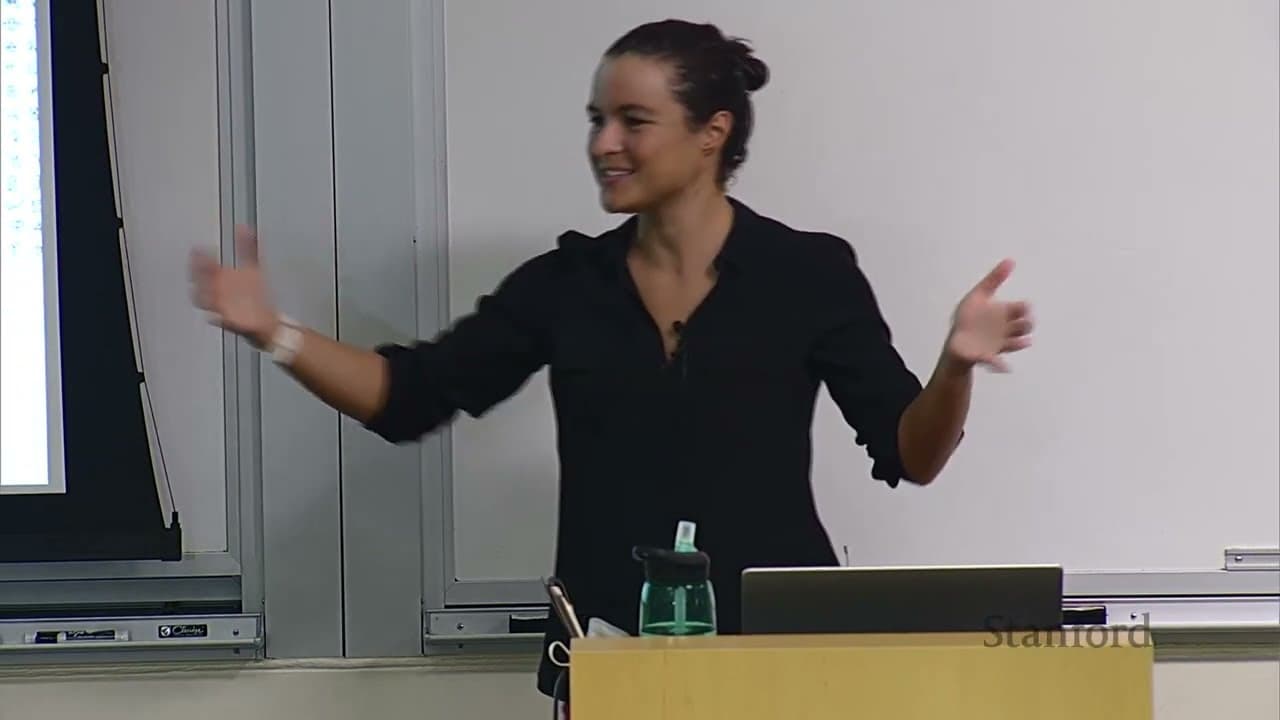
Stanford CS330 Deep Multi-Task & Meta Learning - Black Box Meta Learning l 2022 I Lecture 4
TL;DR
This content discusses metal learning algorithms, specifically focusing on a few-shot learning problem, and provides insights on the tasks, assumptions, and architectures involved.
Transcript
so for the plan for today um we're gonna be talking about Better Learning and first I'm going to recap a little bit of what we talked about on Monday with regard to the problem formulation and the general recipe of metal learning algorithms and then we're going to actually get into approaches for solving a few shot learning problems uh and so this ... Read More
Key Insights
- ✋ Metal learning aims to solve new tasks with less data and higher accuracy.
- 🤘 The more tasks and data available, the better the performance of metal learning algorithms.
- 🤘 Metal training involves implementing a learning procedure using neural networks.
- 🤘 Metal testing focuses on making predictions for new tasks using trained parameters.
- 😫 Different architectures, such as recurrent neural networks and deep sets, can be used for metal learning.
Install to Summarize YouTube Videos and Get Transcripts
Explore YouTube Video Summarizer or Get YouTube Transcript Extractor
Questions & Answers
Q: How many tasks are required for effective few-shot learning?
There is no definitive answer, but in general, a higher number of tasks leads to better learning. More tasks allow for better generalization and faster learning with less data.
Q: Can metal learning be used for tasks that seem to have little in common?
Yes, metal learning can discover shared structure between seemingly unrelated tasks. By finding commonalities, metal learning can optimize for learning new tasks quickly with limited data.
Q: Is it better to have more data points per task for metal learning?
In metal learning, having more data points per task is beneficial, but not necessarily required. Metal learning algorithms can still be effective with a small number of examples per task due to the use of shared structure between tasks.
Q: How does metal learning handle tasks with different distributions?
Metal learning assumes that task data points are drawn from the same task distribution. However, in practice, it may be challenging to realize this assumption. Handling different distributions requires finding commonalities and optimizing for shared structure between tasks.
Summary & Key Takeaways
-
The content introduces metal learning algorithms and their goal of solving new tasks with less data and higher accuracy.
-
It discusses the assumptions of task similarity and the need for a sufficient number of tasks for effective few-shot learning.
-
The content explains the process of metal training and metal testing, including the use of neural networks to predict task parameters and make predictions.
Read in Other Languages (beta)
Share This Summary 📚
Summarize YouTube Videos and Get Video Transcripts with 1-Click
Try YouTube Summary with ChatGPT & Claude or YouTube Transcript Generator
Explore More Summaries from Stanford Online 📚
Summarize YouTube Videos and Get Video Transcripts with 1-Click
Try YouTube Summary with ChatGPT & Claude or YouTube Transcript Generator