Fine-Tuning ChatGPT 3.5 with Synthetic Data from GPT-4 | VERY Interesting Results (!)
TL;DR
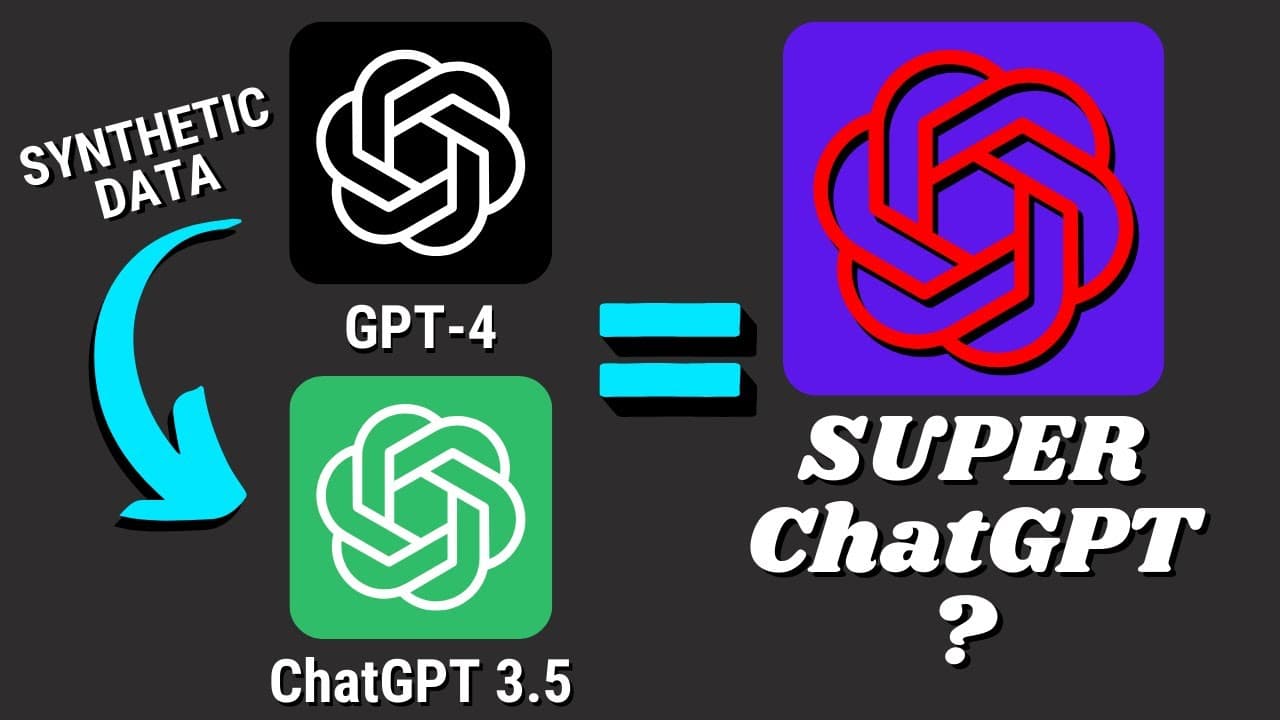
Using GPT-4 to create a synthetic dataset and fine-tuning the ChatGPT 3.5 model shows promise for improving performance.
Transcript
I wanted to find out what happens if I use gpt4 to create a fully synthetic data set and I use that data set to fine-tune our chatibility 3.5 model will we get like a super chat TPT or will not make any difference at all let's find out I created this workflow you can see here on how we are going to do this so we've got to use gpt4 to create a synth... Read More
Key Insights
- 🛀 Fine-tuning the ChatGPT 3.5 model using a synthetic dataset generated by GPT-4 shows the potential for improved performance.
- 🆘 The step-by-step Chain of Thought approach in problem-solving helps in generating accurate responses.
- 🌥️ The cost of creating a synthetic dataset using GPT-4 can be significant, especially for larger datasets.
- 🌸 Monitoring training loss during the fine-tuning process indicates the model's learning progress and potential issues like overfitting.
- 🥠 Vanilla ChatGPT and the fine-tuned model show distinct differences in their ability to solve complex problems accurately.
- 🖕 The fine-tuned model provides a middle ground between the accuracy of GPT-4 and the limitations of the vanilla ChatGPT model.
- 🥹 Synthetic data holds promising potential for enhancing chatbot models, but further research and testing are required.
Install to Summarize YouTube Videos and Get Transcripts
Explore YouTube Video Summarizer or Get YouTube Transcript Extractor
Questions & Answers
Q: What is the purpose of using GPT-4 to create a synthetic dataset?
The synthetic dataset allows for fine-tuning of the ChatGPT 3.5 model and testing its performance against vanilla ChatGPT and GPT-4.
Q: How are the synthetic problems generated using Python?
Python scripts are used to create problems and their solutions step-by-step. The scripts generate text files containing the problems.
Q: What is the significance of the step-by-step Chain of Thought principle in problem-solving?
The step-by-step approach ensures that the fine-tuned model captures the reasoning and problem-solving process, leading to more accurate responses.
Q: How are the synthetic problems converted into a JSON format for fine-tuning?
Another Python script is used to convert the text file containing the problems into a JSONL format, enabling easy input for the fine-tuning process.
Summary & Key Takeaways
-
The content explores the process of using GPT-4 to generate a synthetic dataset and using it to fine-tune the ChatGPT 3.5 model.
-
A mixture of riddles, math problems, and logical problems is chosen as the dataset for benchmarking.
-
Python scripts are used to automate the generation of synthetic problems and the conversion into a JSON format required for fine-tuning.
Read in Other Languages (beta)
Share This Summary 📚
Summarize YouTube Videos and Get Video Transcripts with 1-Click
Try YouTube Summary with ChatGPT & Claude or YouTube Transcript Generator
Explore More Summaries from All About AI 📚






Summarize YouTube Videos and Get Video Transcripts with 1-Click
Try YouTube Summary with ChatGPT & Claude or YouTube Transcript Generator