How to Simplify Division by Cancelling Zeros
TL;DR
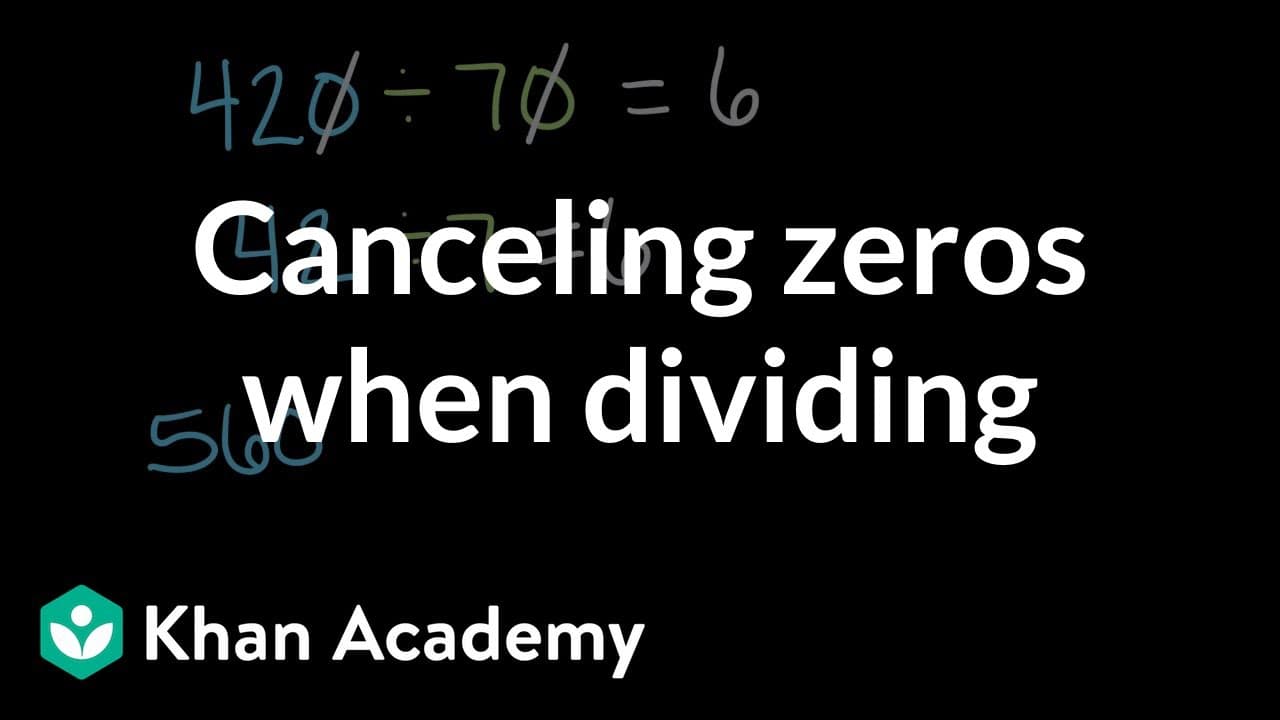
To simplify division, you can cancel the zeros at the end of both the dividend and the divisor, as they do not affect the outcome. For example, 350 divided by 50 can be simplified to 35 divided by 5, both yielding the same result of 7. Ensure the same number of zeros are cancelled from each number at the end.
Transcript
- [Voiceover] Let's solve 350 divided by 50. So, one way to think about this is if we had 350 of something, let's say, something delicious like brownies. If we had 350 brownies and we were dividing them into groups of 50, how many groups of 50 could we get? Well, one idea is to count by 50's until we get to 350 and see how many groups there are. On... Read More
Key Insights
- ➗ Division can be thought of as a fraction, and cancelling zeroes is possible in both division and fractions.
- ➗ Cancelling zeroes in division simplifies the problem by reducing the numbers involved.
- 0️⃣ The same solution is obtained even after cancelling zeroes, as long as the same amount of zeroes is cancelled in both the dividend and the divisor.
- 0️⃣ Cancelling zeroes is only possible if the zeroes are at the end of both the dividend and the divisor.
Install to Summarize YouTube Videos and Get Transcripts
Explore YouTube Video Summarizer or Get YouTube Transcript Extractor
Questions & Answers
Q: How can cancelling zeroes in division problems simplify calculations?
Cancelling zeroes at the end of both the dividend and divisor reduces the numbers and makes the division problem easier to solve. It allows for the use of smaller numbers, which can be more manageable in calculations.
Q: Is it possible to cancel zeroes in division problems if they are not at the end?
No, cancelling zeroes is only possible if both the dividend and divisor have zeroes at the end. If the zeroes are not at the end, they cannot be cancelled out, and the division problem cannot be simplified in this way.
Q: Is cancelling zeroes in division the same as factoring out a 10?
Yes, when cancelling zeroes in division, it is essentially factoring out a 10 from both the dividend and the divisor. This simplifies the problem, making it easier to solve.
Q: Does cancelling zeroes in division affect the solution?
Cancelling zeroes does not affect the solution of the division problem. The same solution is obtained even after cancelling zeroes, as long as an equal number of zeroes is cancelled in both the dividend and the divisor.
Summary & Key Takeaways
-
Division is the same as a fraction, and when both whole numbers end in zeroes, the zeroes can be cancelled out.
-
Cancelling zeroes in division problems simplifies the problem and makes it easier to calculate.
-
The same solution is obtained even after cancelling zeroes, as long as the same amount of zeroes is cancelled in both the dividend and the divisor.
Read in Other Languages (beta)
Share This Summary 📚
Summarize YouTube Videos and Get Video Transcripts with 1-Click
Try YouTube Summary with ChatGPT & Claude or YouTube Transcript Generator
Explore More Summaries from Khan Academy 📚



Summarize YouTube Videos and Get Video Transcripts with 1-Click
Try YouTube Summary with ChatGPT & Claude or YouTube Transcript Generator