Solubility and intermolecular forces | AP Chemistry | Khan Academy
TL;DR
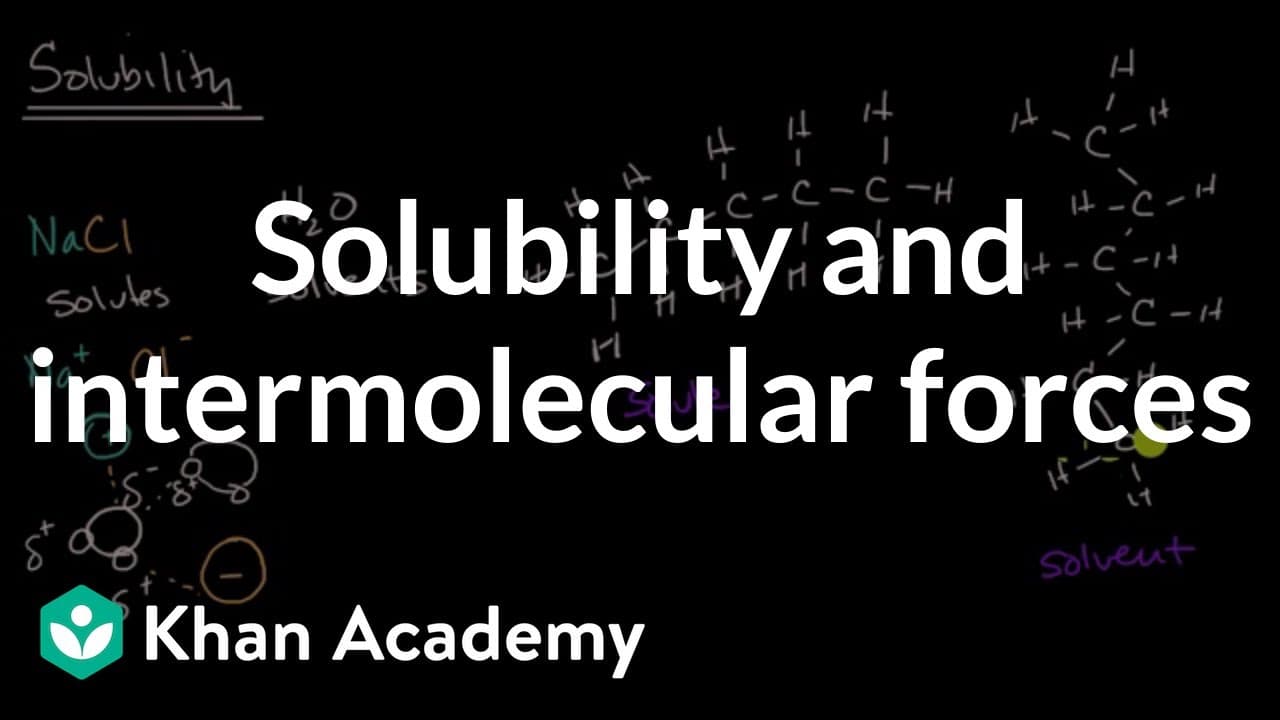
Solubility is the ability of solutes to dissolve in solvents, and like dissolves like due to similar attractive forces between molecules.
Transcript
- [Instructor] In this video, we're going to talk about solubility, which is just a way of describing how well certain solutes can dissolve in certain solvents. And just as an example, we could go to our old friend sodium chloride and think about why does it dissolve well in water. Well, to do that, you just have to remind yourself what water is do... Read More
Key Insights
- ❓ Solubility is determined by attractive forces between solute and solvent molecules.
- 💦 Ionic compounds can dissolve well in water due to the attractive forces between their ions and water molecules.
- 💦 Molecules with polarity, like alcohols, can dissolve in water due to their ability to form hydrogen bonds with water molecules.
- ❓ Dissolving processes involve the attractive forces between solute-solute, solvent-solvent, and solute-solvent.
- ❓ Like dissolves like, meaning substances with similar attractive forces can dissolve in each other.
- 💦 Organic molecules with longer carbon chains have reduced solubility in polar solvents like water.
- 🐻❄️ Dispersion forces can attract weakly polar molecules to each other.
Install to Summarize YouTube Videos and Get Transcripts
Explore YouTube Video Summarizer or Get YouTube Transcript Extractor
Questions & Answers
Q: Why does sodium chloride dissolve well in water?
Sodium chloride dissolves well in water because it can dissociate into sodium and chloride ions, which are attracted to the partially positive and partially negative ends of the water molecules, respectively.
Q: What determines the solubility of a substance?
The solubility of a substance is determined by the balance of attractive forces between the solute and solvent molecules. Like dissolves like, meaning substances with similar attractive forces can dissolve in each other.
Q: Can all organic molecules dissolve in water?
No, not all organic molecules can dissolve in water. Organic molecules with polarity, such as those containing hydroxyl groups (like ethanol), can dissolve in water due to their ability to form hydrogen bonds with water molecules.
Q: How does the size of a molecule affect its solubility in a polar solvent?
The larger the molecule, the less likely it is to dissolve in a polar solvent like water. As the carbon chain lengthens in an alcohol molecule, for example, the proportion of polarity compared to the overall size of the molecule increases, making it harder for the molecule to dissolve in water.
Summary & Key Takeaways
-
Solubility is determined by the attractive forces between solute and solvent molecules.
-
Ionic compounds like sodium chloride dissolve well in water because the positive and negative charges are attracted to the partially negative and partially positive ends of the water molecules.
-
Molecules with polarity, like ethanol, can dissolve well in water due to their ability to attract water molecules.
Read in Other Languages (beta)
Share This Summary 📚
Summarize YouTube Videos and Get Video Transcripts with 1-Click
Try YouTube Summary with ChatGPT & Claude or YouTube Transcript Generator
Explore More Summaries from Khan Academy 📚





Summarize YouTube Videos and Get Video Transcripts with 1-Click
Try YouTube Summary with ChatGPT & Claude or YouTube Transcript Generator