GNN Short Course Chapter 4 - Multiple Features and Pooling
TL;DR
This content explains multi-feature graph signals and pooling in graph neural networks.
Transcript
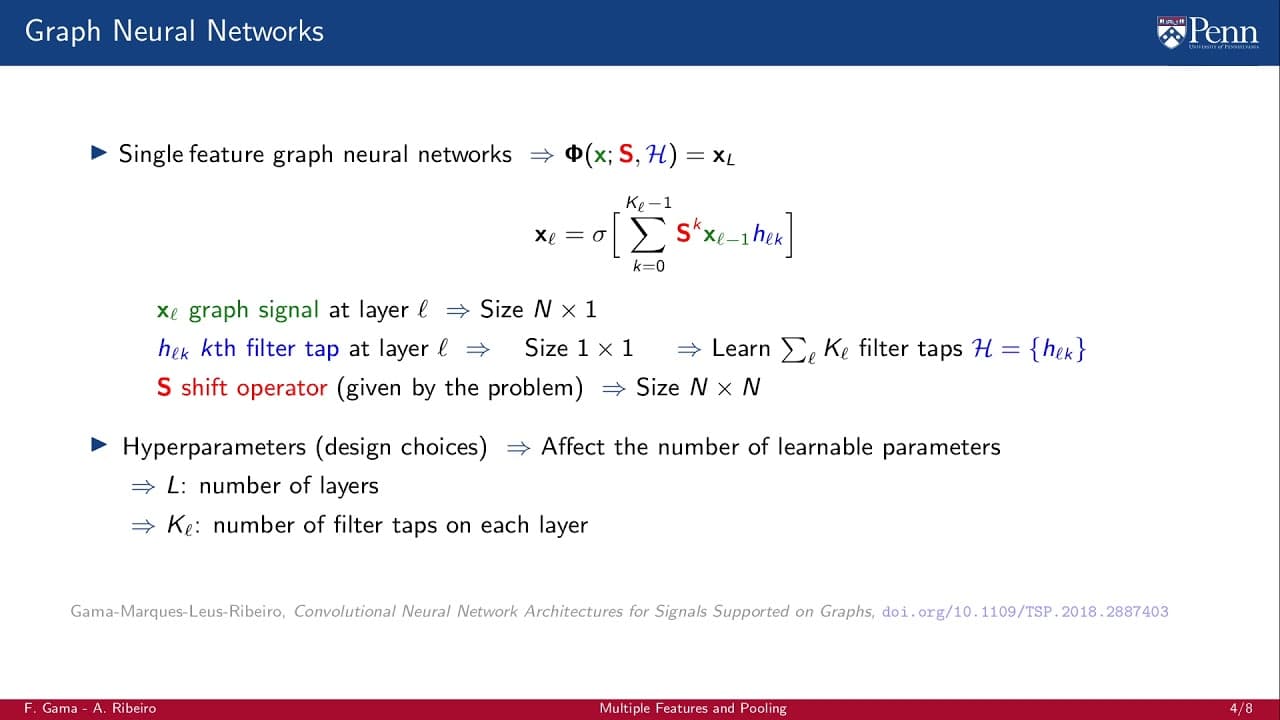
in this segment we will introduce the notions of multi-feature graph signals and pulling we know that the gnn which is a cascade of layers each of which applies a graph convolution followed by a pointwise non-linearity acts on a graph signal as input we also know that the graph signal describes data by assigning a single scalar to each node this fa... Read More
Key Insights
- Graph neural networks (GNNs) use multi-feature graph signals to enhance descriptive power by assigning vectors to nodes instead of scalars.
- Multi-feature graph signals require adapted graph convolution operations, which are equivalent to applying a bank of graph filters.
- Increasing the number of features in GNNs enhances descriptive power but also increases computational cost.
- Pooling strategies are employed to reduce computational cost by creating regional summaries and downsampling graph signals.
- The pooling operation involves a local summarizing function and downsampling, reducing the dimensions of graph signals.
- Dimension mismatch between shift operators and pooled signals is resolved using zero padding and sampling matrices.
- Pooling operations respect graph topology and reduce computational costs for both centralized and decentralized computations.
- The reduced shift operator, obtained before training, allows for efficient computation by focusing on sampled nodes.
Install to Summarize YouTube Videos and Get Transcripts
Explore YouTube Video Summarizer or Get YouTube Transcript Extractor
Questions & Answers
Q: What are multi-feature graph signals?
Multi-feature graph signals assign vectors to each node in a graph, rather than a single scalar, thereby enhancing the descriptive power of graph neural networks (GNNs). This approach allows for more detailed data representation at each node, accommodating multiple features and enabling more complex graph signal processing operations.
Q: How is graph convolution adapted for multi-feature signals?
Graph convolution for multi-feature signals involves a linear operation that accounts for local information through neighboring exchanges. This operation is equivalent to applying a bank of graph filters, where each feature is processed with a corresponding filter, resulting in a linear, local, and distributed convolution operation suitable for multi-feature graph signals.
Q: Why is pooling important in GNNs?
Pooling is crucial in GNNs as it reduces the computational cost associated with increased features. By creating regional summaries and downsampling graph signals, pooling decreases the dimensions of signals, thus managing the computational complexity while maintaining the integrity of the graph's topology in both centralized and decentralized computations.
Q: How does pooling resolve dimension mismatches?
Pooling resolves dimension mismatches by employing zero padding and sampling matrices. The zero padding aligns the dimensions of the shift operator with the pooled signals, while sampling matrices adjust the size of graph signals. This ensures compatibility between the shift operator and the graph signals at different layers, maintaining computational efficiency.
Q: What role does the reduced shift operator play?
The reduced shift operator, pre-computed before training, plays a vital role in enhancing computational efficiency. It focuses on the sampled nodes, reducing the dimensions of the shift operator from n times n to n_l-1 times n_l-1. This reduction facilitates efficient computation, particularly in centralized settings, by minimizing matrix multiplication dimensions.
Q: How does pooling respect graph topology?
Pooling respects graph topology by ensuring that the convolution operations remain local and distributed. The process involves summarizing information at each node based on neighboring values and performing downsampling that aligns with the graph's structure. This approach maintains the integrity of the graph's topology while reducing computational demands.
Q: What is the impact of increasing features in GNNs?
Increasing features in GNNs enhances the descriptive power of graph signals, allowing for more detailed data representation. However, it also raises computational costs due to the increased dimensionality of the signals. This necessitates the use of pooling strategies to manage complexity and maintain computational feasibility in graph signal processing.
Q: How does centralized computation benefit from pooling?
Centralized computation benefits from pooling by reducing the dimensions of matrix multiplications involved in graph convolutions. The pooling operation decreases the size of the shift operator, focusing on sampled nodes, which minimizes the computational load. This efficiency is crucial for handling large-scale graph data in centralized processing environments.
Summary & Key Takeaways
-
This content explores the concept of multi-feature graph signals in graph neural networks (GNNs), which enhance descriptive power by assigning vectors to nodes instead of scalars. The adapted convolution operation for these signals is equivalent to applying a bank of graph filters, increasing computational demands.
-
To address increased computational costs, pooling strategies are introduced. Pooling involves creating regional summaries and downsampling graph signals, effectively reducing the dimensions of signals while respecting graph topology. This process helps manage computational complexity in GNNs.
-
Dimension mismatches arising from pooling are resolved using zero padding and sampling matrices. The reduced shift operator can be pre-computed, facilitating efficient centralized and decentralized computations by focusing on sampled nodes during the convolution process.
Read in Other Languages (beta)
Share This Summary 📚
Summarize YouTube Videos and Get Video Transcripts with 1-Click
Try YouTube Summary with ChatGPT & Claude or YouTube Transcript Generator
Explore More Summaries from Alelab Alelab 📚
Summarize YouTube Videos and Get Video Transcripts with 1-Click
Try YouTube Summary with ChatGPT & Claude or YouTube Transcript Generator