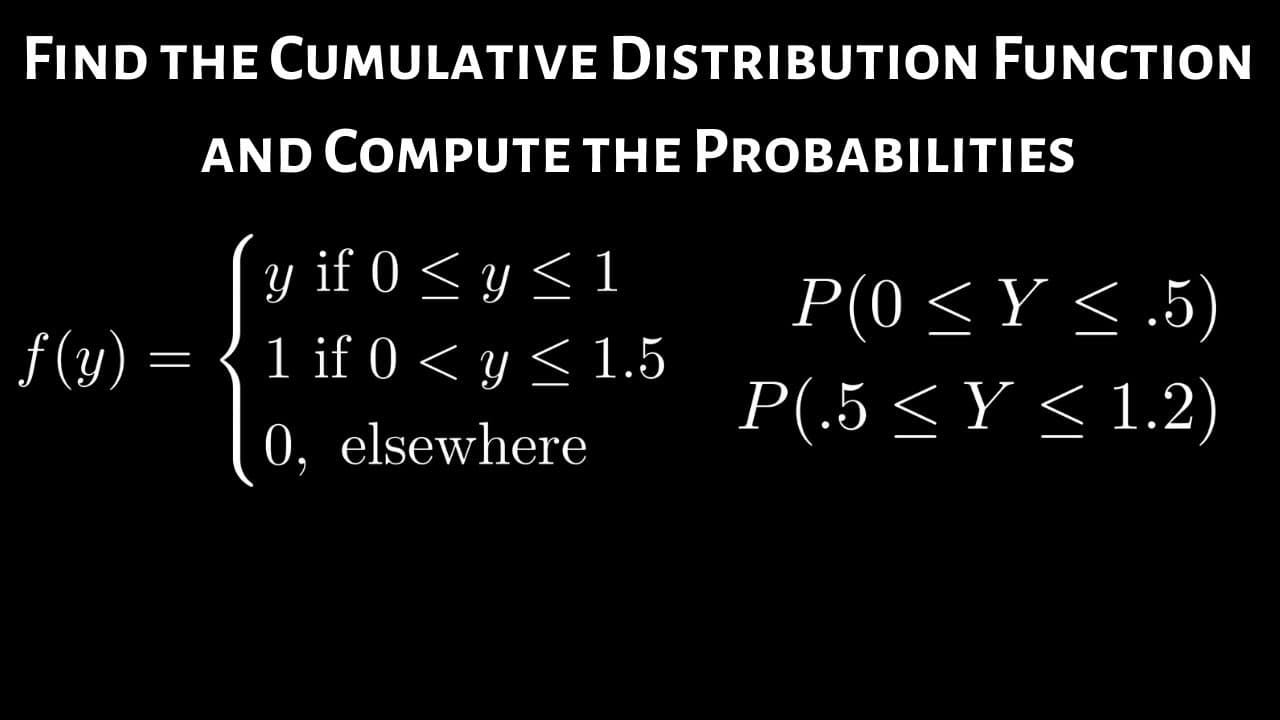
How to Find the Cumulative Distribution Function and Compute the Probabilities given the Density
TL;DR
Calculating distribution function and probabilities using density function in various scenarios.
Transcript
in this problem we have a density function f of y and we have three different questions part a is to find the distribution function for little f of y and then part b and c we have to find probabilities which we can do once we have part a part b and c shouldn't be too difficult to do so let's go ahead and start by doing part a so solution to a so re... Read More
Key Insights
- 😀 Different ranges of y result in distinct cases for calculating the distribution function.
- ❓ The integral of the density function yields the distribution function, enabling probability calculations.
- ❓ Understanding between-probabilities is essential for determining probabilities within specific intervals.
- 😀 Clear differentiation between various y-values ensures accurate computation in each case.
- ❓ Mastery of the formula for between-probabilities simplifies probabilistic calculations.
- 💁 Interpreting the distribution function is vital for extracting probabilistic information.
- 💼 Case-by-case analysis based on y-values facilitates a comprehensive solution approach.
Install to Summarize YouTube Videos and Get Transcripts
Explore YouTube Video Summarizer or Get YouTube Transcript Extractor
Questions & Answers
Q: How is the distribution function related to the density function?
The distribution function is derived from the density function by integrating it with respect to the variable y, providing cumulative probabilities for different values of y.
Q: What are the different cases considered while calculating the distribution function?
Cases are established based on y being less than zero, between zero and one, between one and 1.5, and greater than 1.5, each requiring specific integrations to determine the distribution function.
Q: How are probabilities computed using the distribution function?
Probabilities for specific intervals are found by subtracting the cumulative probabilities for the upper and lower bounds of the interval using the distribution function.
Q: What key concept is essential in understanding density and distribution functions?
The fundamental relationship between density and distribution functions is crucial, as one describes the probability density of a random variable while the other provides cumulative probabilities.
Summary & Key Takeaways
-
Calculation involves finding the distribution function for a given density function.
-
Cases are established based on different ranges of values for y.
-
Probabilities are determined using the distribution function for specific intervals.
Read in Other Languages (beta)
Share This Summary 📚
Summarize YouTube Videos and Get Video Transcripts with 1-Click
Try YouTube Summary with ChatGPT & Claude or YouTube Transcript Generator
Explore More Summaries from The Math Sorcerer 📚


Summarize YouTube Videos and Get Video Transcripts with 1-Click
Try YouTube Summary with ChatGPT & Claude or YouTube Transcript Generator