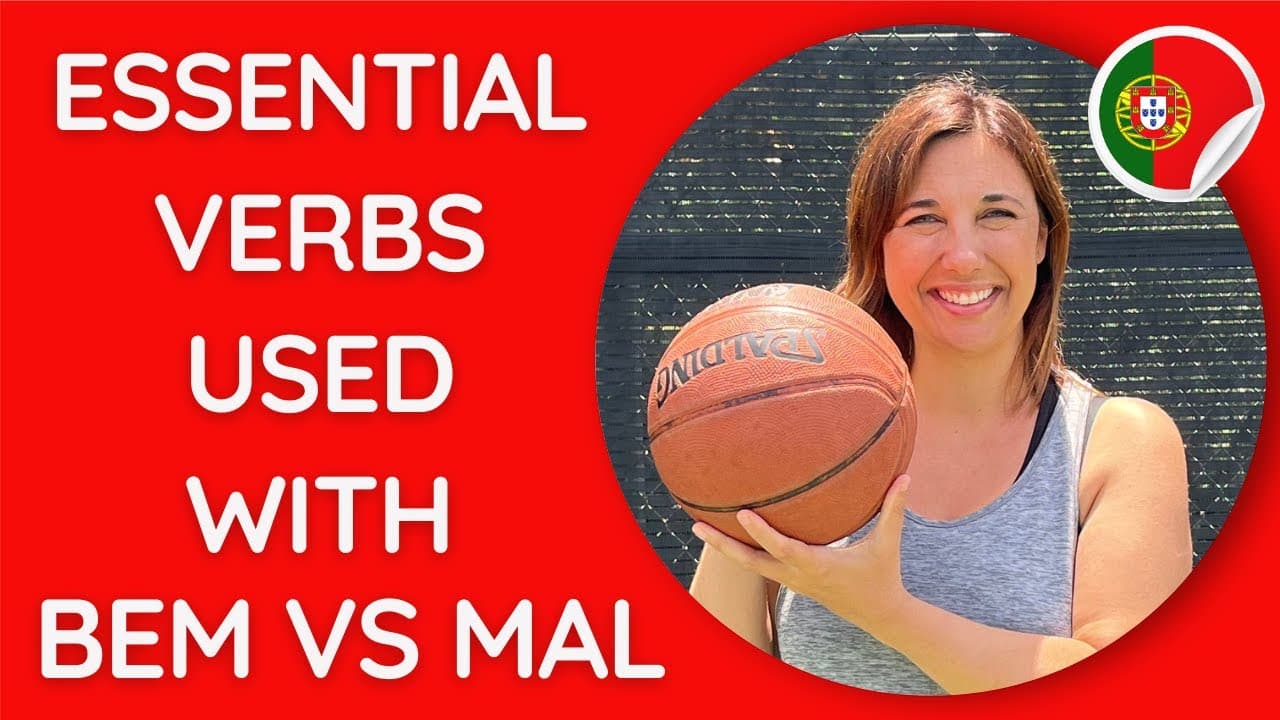
TOP verbs that pair with "bem" e "mal" in Portuguese! Speak like a local!
TL;DR
Learn key Portuguese verb expressions with 'bem' and 'mal'.
Transcript
Ola to I've noticed that many students struggle when using the adverbs b well and mal badly poorly. In European Portuguese, many verbs pair with and mal in fixed expressions. These expressions often carry meanings that are not a direct translation of their English equivalents. So, it's important to learn them as whole phrases. For example, while yo... Read More
Key Insights
- Understanding the adverbs 'bem' and 'mal' is crucial for mastering European Portuguese, as they often pair with verbs in expressions that differ from English translations.
- Many verbs in Portuguese form fixed expressions with 'bem' and 'mal', requiring learners to memorize them as whole phrases for accurate usage.
- The video provides a list of 11 common verbs that pair with 'bem' and 'mal', illustrating their meanings with practical examples.
- Expressions using 'bem' and 'mal' can convey different meanings, such as irony or praise, depending on the context in which they are used.
- Verbs like 'to speak', 'to feel', and 'to go' have specific expressions with 'bem' and 'mal' that indicate proficiency or how an event unfolded.
- The verb 'ficar', when used with 'bem' and 'mal', often refers to appearance or suitability, especially in relation to clothing and personal looks.
- Expressions with 'bem' and 'mal' are frequently used in questions, helping to assess someone's well-being or the success of an event.
- The video concludes with a common Portuguese expression equivalent to 'take care', highlighting cultural nuances in language use.
Install to Summarize YouTube Videos and Get Transcripts
Explore YouTube Video Summarizer or Get YouTube Transcript Extractor
Questions & Answers
Q: Why are 'bem' and 'mal' important in learning Portuguese?
Understanding 'bem' and 'mal' is crucial because they frequently pair with verbs to form expressions that carry meanings different from their English counterparts. Mastering these adverb-verb combinations helps learners improve their fluency and grasp subtle nuances in European Portuguese, which are essential for effective communication.
Q: How can learners effectively use the expressions taught in the video?
Learners can effectively use the expressions by memorizing them as whole phrases rather than translating them word-for-word from English. Practicing these expressions in context, such as through conversation or writing exercises, will help reinforce their meanings and improve both fluency and comprehension in real-life situations.
Q: What is the significance of fixed expressions in language learning?
Fixed expressions are significant because they often carry meanings and cultural nuances that are not directly translatable. Learning these expressions enhances a learner's ability to communicate naturally and understand the language's subtleties, ultimately leading to greater fluency and confidence in using the language in various contexts.
Q: Can you provide an example of a verb and its expression with 'bem' or 'mal'?
An example is the verb 'to go', which when paired with 'bem' or 'mal', expresses how an event unfolded. For instance, 'The doctor's appointment went well' translates to 'A consulta médica correu bem', while 'The exam didn't go well' translates to 'O exame não correu bem', indicating the outcome of these events.
Q: How does the verb 'ficar' change meaning with 'bem' and 'mal'?
The verb 'ficar', when combined with 'bem' and 'mal', often refers to appearance or suitability, especially in relation to clothing. For example, 'This dress looks good on Maria' translates to 'Este vestido fica bem na Maria', while 'That color doesn't suit Antonio' becomes 'Essa cor não fica bem no António', highlighting suitability.
Q: What cultural nuances are highlighted in the video?
The video highlights cultural nuances such as the use of irony in expressions that differ from their literal translations. For example, saying 'well done' sarcastically when something goes wrong. It also introduces the expression 'Fica bem' or 'Fique bem', which means 'take care', showing how language reflects cultural attitudes towards well-being.
Q: Why is it important to learn these expressions as whole phrases?
Learning these expressions as whole phrases is important because their meanings often do not align with direct translations. By understanding them contextually, learners can accurately convey emotions, intentions, and subtleties that are essential for effective communication in European Portuguese, enhancing both spoken and written language skills.
Q: How does the video support beginners in learning Portuguese?
The video supports beginners by breaking down complex language concepts into manageable parts, providing clear examples and explanations of how 'bem' and 'mal' pair with common verbs. This targeted approach helps beginners build a strong foundation in the language, making it easier to integrate these expressions into everyday conversations and improve overall proficiency.
Summary & Key Takeaways
-
The video discusses the importance of understanding the Portuguese adverbs 'bem' and 'mal', which are often used in fixed expressions with verbs that differ from their English translations. It provides a list of 11 verbs commonly paired with these adverbs, offering examples to help learners grasp their meanings.
-
Sandra, the presenter, emphasizes the need to learn these verb-adverb combinations as whole phrases to improve fluency and comprehension. The content is particularly beneficial for beginners learning European Portuguese, providing practical insights into everyday language use.
-
The video also highlights cultural nuances in the use of these expressions, such as their ironic or literal meanings. It concludes with a common Portuguese expression for 'take care', encouraging viewers to practice and integrate these expressions into their language skills.
Read in Other Languages (beta)
Share This Summary 📚
Summarize YouTube Videos and Get Video Transcripts with 1-Click
Try YouTube Summary with ChatGPT & Claude or YouTube Transcript Generator
Explore More Summaries from Learn European Portuguese Online 📚


Summarize YouTube Videos and Get Video Transcripts with 1-Click
Try YouTube Summary with ChatGPT & Claude or YouTube Transcript Generator